


Listen to the article
Artificial intelligence has emerged as a double-edged sword in today’s society, simultaneously helping government officials recover fraudulent funds while enabling sophisticated disinformation campaigns, according to a leading expert in the field.
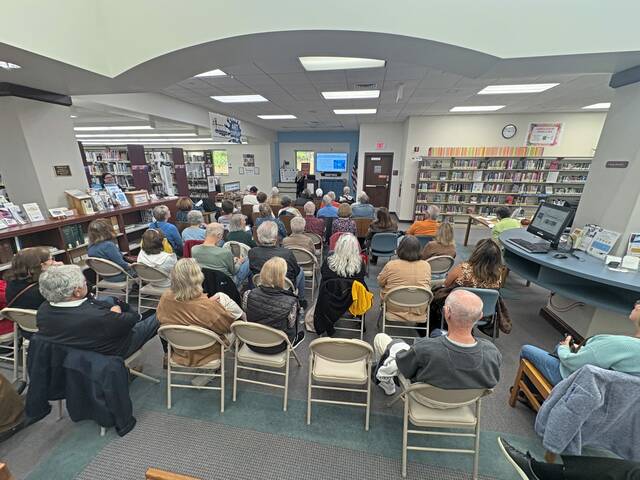
Kathleen Carley, a professor in Carnegie Mellon University’s Software and Societal Systems Department, presented both the beneficial and concerning aspects of AI during a recent discussion hosted by the American Association of University Women’s Murrysville chapter at the local community library.
“Artificial intelligence helped U.S. Treasury officials recover about $1 billion from check fraudsters in 2024,” Carley explained, highlighting one of the positive applications of the technology. But she quickly pivoted to its darker potential as “the latest tool in the disinformation toolbox, used to create false stories, images and video.”
The presentation was part of the Murrysville AAUW’s longstanding monthly speaker series, which has been running since 1971. Susan Greenberg, the association’s policy chair, noted that topics are selected based on member interest and current events, with AI being a particularly timely subject.
According to Carley, artificial intelligence has already become deeply integrated into everyday life in ways many people might not recognize. “Office workers use it to filter their email, companies use it to make recommendations to customers based on their previous purchases,” she said. “And it can assist you with tasks like checking spelling or helping to write a paragraph.”
However, the professor expressed particular concern about AI’s role in creating and disseminating misinformation. The technology can be deployed to shape narratives around political figures or influence public opinion on social issues—often in ways that are difficult for average users to detect.
“Our studies have shown that you as a human being have a difficult time recognizing if something is being posted by a ‘bot’ social media account, especially if it’s saying something you agree with,” Carley explained. This phenomenon can create what she termed “echo chambers,” where groups become isolated from alternative viewpoints.
The problem is compounded by social media algorithms designed to maximize user engagement, creating feedback loops that continuously reinforce existing beliefs regardless of their accuracy.
Carley cited a particularly alarming example from the 2014 Russian invasion of Crimea, Ukraine. She described how Russian bot accounts initially connected young men through shared interests in adult content, gradually building a network of followers. Once established, these accounts “switched gears” to promote pro-Russian military messaging.
“Eventually they were all following one another, and at that point the bot switched gears and started talking about the war in Crimea and where you could find weapons to fight with the Russians,” she explained. The result was the radicalization of these young men, who eventually formed a fighting force in the region.
The professor described the current state of AI security as an ongoing technological arms race. “They get more tools and become more adept at creating fake posts, images and video,” she said of those misusing the technology. “We get better at detecting them, and then they step their game up again and it keeps going back and forth.”
Despite these concerns, Carley emphasized that artificial intelligence itself is neutral—its impact depends entirely on how people choose to use it. “It’s like any other tool—it can be used for good or bad,” she concluded.
The presentation utilized the library’s TechNook, a screen made possible through a memorial donation that enables the AAUW to host both in-person and remote speakers. Greenberg noted the success of this approach in bringing timely and relevant topics to the community.
The Murrysville AAUW speaker series remains open to the public, with information available on their website, Murrysville-pa.aauw.net.
Fact Checker
Verify the accuracy of this article using The Disinformation Commission analysis and real-time sources.
