


Listen to the article
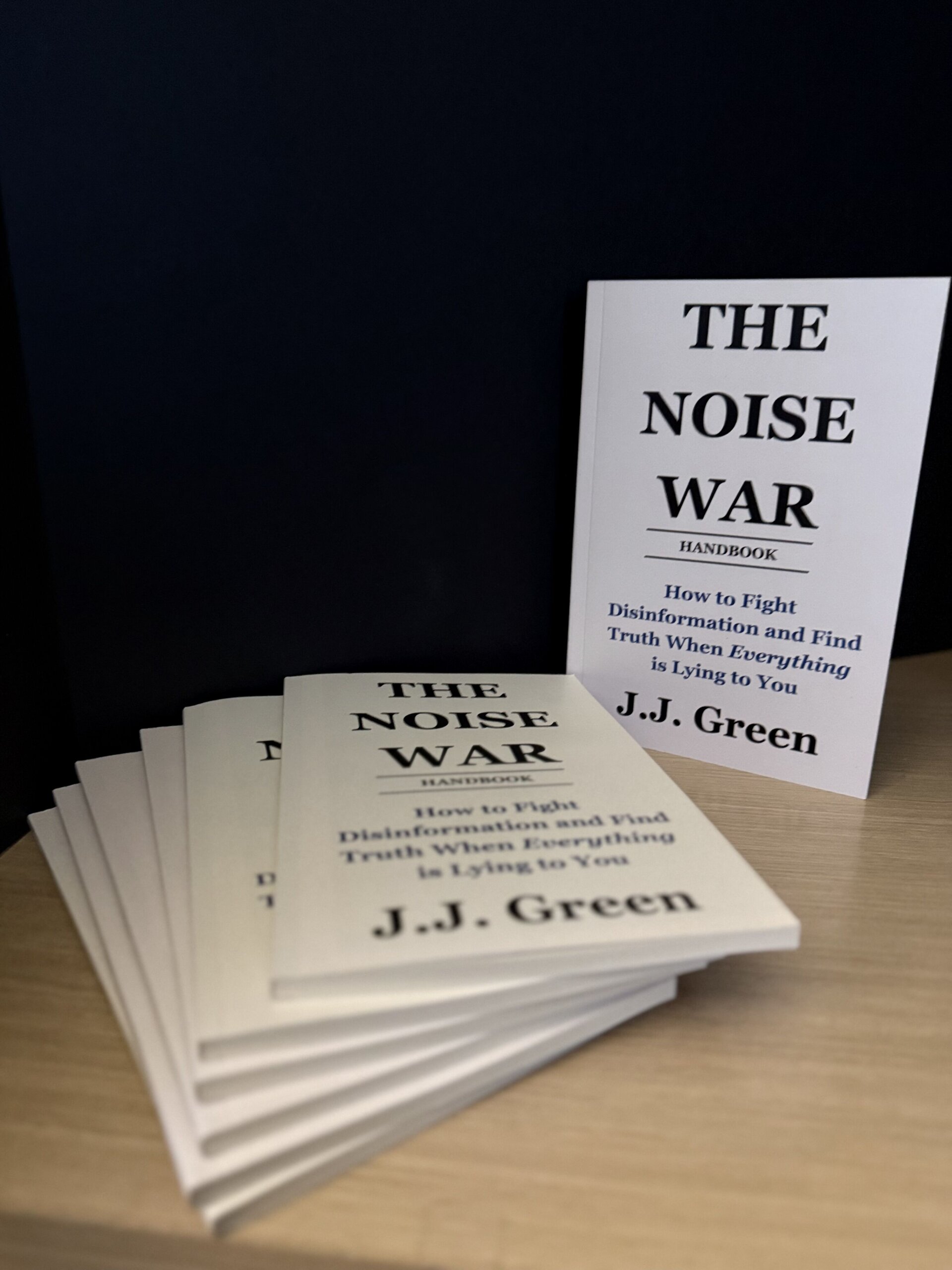
In a world increasingly plagued by disinformation, veteran journalist J.J. Green has taken a bold stand against the tide of falsehoods with his new book, “The Noise War Handbook.” The WTOP National Security Correspondent’s work comes at a critical time when truth itself seems under siege in public discourse.
Green’s journey to writing the handbook began with a profound moral choice. In October 2025, he and several esteemed colleagues walked out of the Pentagon after refusing to sign a memo requiring journalists to report only pre-approved information—a fundamental violation of journalistic independence.
“We refused to sign a memo that asked us to pledge something no journalist should ever pledge: to report only what had been cleared,” Green writes, describing the pivotal moment that would later crystallize his mission.
Though initially confident in his decision, Green recounts how doubt crept in during the early morning hours days later. Lying awake at 3 a.m., he confronted fears about his career and legacy, questioning whether he had “stepped off a cliff without a parachute.” This moment of vulnerability became a catalyst for clarity.
Drawing on more than two decades of reporting from conflict zones worldwide, Green had witnessed firsthand how disinformation operations function—how propaganda hardens into policy and how falsehoods can travel faster than truth. Yet he realized that merely understanding the problem was insufficient.
“I knew the system was broken. I knew citizens were being overwhelmed. I knew journalists, educators and even policymakers were being outrun,” Green reflects in the book, which he had been conceptualizing for five years before that decisive night.
The urgency of the disinformation crisis is what ultimately drove Green to complete the project. He describes what he calls “The Noise War” as the pervasive feeling that nothing is trustworthy anymore—that headlines might be bait, and finding truth requires exhaustive effort while falsehoods arrive “prepackaged, emotionally tuned and algorithmically boosted.”
This crisis extends beyond simple factual distortions, Green argues. It actively erodes the foundations of civic society by undermining trust in democratic institutions, journalism, and expertise. The danger lies not in people’s intelligence but in their humanity—our natural vulnerability to emotional appeals and repetitive messaging.
“According to the doctrine of disinformation, speed beats accuracy. Repetition outpaces correction. Emotion conquers evidence. It always has,” Green observes, highlighting the psychological mechanics that make disinformation campaigns so effective.
Rather than producing yet another theoretical work that might sit unread on shelves, Green opted for a practical approach. “The Noise War Handbook” is designed as an accessible field manual—something readers can carry and reference in real-world situations where information literacy matters most.
The book targets a broad audience: journalists working under deadline pressure, educators teaching critical thinking skills, and ordinary citizens feeling overwhelmed by the information landscape. Green aims to provide these groups with concrete tools and frameworks to navigate what he describes as an “information battlefield.”
His motivation stems from a conviction that “disinformation thrives in confusion and clarity is an act of resistance.” The handbook represents Green’s response to what he sees as a moral obligation—to translate his professional insights into practical guidance for others.
The timing of “The Noise War Handbook” is particularly relevant given the upcoming international disinformation conference in Brussels that Green mentions planning to attend. Such gatherings of journalists, content creators, and fact-checkers have become increasingly common as global awareness of information warfare has grown.
Green’s work arrives amid mounting concerns about the impact of disinformation on democratic processes, public health initiatives, and international security. Media literacy experts have long warned that technological developments, particularly in artificial intelligence, will only make the challenge more acute in coming years.
By framing his book as a handbook rather than merely an analysis, Green positions his contribution as an active countermeasure—a tool for resistance rather than just another warning. For a journalist who has built a career reporting on national security threats, this approach represents both a natural evolution and a necessary adaptation to a new kind of warfare.
Fact Checker
Verify the accuracy of this article using The Disinformation Commission analysis and real-time sources.

11 Comments
Green’s decision to walk away from the Pentagon rather than comply with censorship demands is a powerful testament to journalistic integrity. I hope this book reaches a wide audience and helps equip more people to resist the onslaught of falsehoods in our information landscape.
Agreed. Maintaining independent, fact-based reporting is crucial, especially on complex topics like energy and commodities that can be rife with misinformation.
As someone who closely follows the mining and energy sectors, I’m intrigued by the prospect of applying the lessons from the ‘Noise War Handbook’ to cut through the clutter of misinformation in those domains. Green’s experience and insights could prove invaluable.
The ‘Noise War Handbook’ seems like a timely and necessary resource for navigating the murky waters of modern disinformation. As someone who follows energy and mining news, I’m curious to learn how Green’s insights could be applied to that domain, where misinformation can have real-world consequences.
The excerpt highlights the ethical dilemma that journalists like Green face in an era of heightened disinformation. I admire his willingness to sacrifice his career rather than compromise his principles. This book could be an important tool for restoring public trust in the media.
This book sounds like an essential read for anyone concerned about the erosion of truth in public discourse. Green’s first-hand account of the pivotal moment when he refused to compromise his principles is both inspiring and sobering. I’m eager to see how he proposes to empower citizens to discern fact from fiction.
Kudos to J.J. Green for having the courage to stand up for truth, even in the face of professional risks. The ‘Noise War Handbook’ sounds like a must-read for anyone who cares about the future of journalism and democratic discourse.
Indeed. Green’s principled stance is a powerful reminder that journalists must remain steadfast in their commitment to reporting the facts, no matter the pressures.
Fascinating insight into the ethical dilemmas journalists face in the age of disinformation. Green’s principled stand for journalistic independence is commendable. I look forward to learning more about his strategies for combating the ‘noise war’ in this new handbook.
Kudos to J.J. Green for his courageous stand against censorship. The ‘Noise War Handbook’ sounds like a timely and necessary resource for equipping citizens to navigate the complex information landscape, especially when it comes to specialized topics like mining and energy.
Agreed. Green’s firsthand experience gives him a unique perspective on how to identify and counter disinformation in these critical sectors.