


Listen to the article
Fighting False Information at the Community Level
One of the central paradoxes of the 21st century is that while technology has made it easier to access information, the public isn’t necessarily better informed. The decline of legacy news institutions, disappearance of local news outlets, and rise of platforms that reward inflammatory content have created fertile ground for false and misleading information.
This problem was particularly apparent during the 2024 presidential election cycle. From AI-generated robocalls in the New Hampshire primaries to false claims about immigrants in Springfield, Ohio, disinformation spread widely across the political spectrum. Each breaking news moment – including the July assassination attempt on Trump – provided fresh opportunities for falsehoods to proliferate.
Against this backdrop, PEN America expanded its programming to help journalists and communities resist disinformation. The organization’s Disinformation and Community Engagement (DCE) program took an innovative approach: tackling a global problem through local and regional initiatives to distribute trustworthy information while building community capacity for critical information consumption.
A Focus on Sunbelt Communities
PEN America piloted these interventions in three rapidly growing, diverse metropolitan areas: Miami, Dallas–Fort Worth, and Phoenix. These Sunbelt cities were selected as bellwethers for how disinformation operates, with each facing unique challenges while providing learning opportunities for similar communities nationwide.
Though PEN America maintains a nonpartisan stance, many of the issues that concerned partners and audiences connected to the polarized presidential election. This environment featured constant accusations of disinformation from both Democrats and Republicans – all while the term “disinformation” itself became weaponized for partisan purposes.
Even with the election concluded, the supply of and demand for false information hasn’t diminished. In 2025, deceptive information continues to drive key aspects of the administration’s agenda, particularly in education, press relations, and foreign assistance, often through false or exaggerated claims about government programs.
Three Key Initiatives
The program pursued three main activities:
-
A “trusted messengers” initiative that trained people to have difficult conversations promoting broader news and information consumption. The approach leveraged existing interpersonal trust to help individuals build resilience against disinformation.
-
Subgrants to support regional counter-disinformation efforts. Recognizing the constraints on national organizations working at the community level, PEN America invested in regional nonprofits with established audiences and positions of trust.
-
Instructional webinars on disinformation resilience. Responding to community needs, PEN America created training webinars on topics like cognitive bias, fact-checking standards, and the role of influencers in the media landscape.
Building Trust Through Personal Connections
The trusted messengers initiative recognized a critical reality: while Americans’ trust in media and political institutions remains at historic lows, there is one key resource that Americans still trust for information – friends and family. A 2023 Economist/YouGov poll found 65 percent of respondents named “friends and family” when asked who they trust most for election-related information.
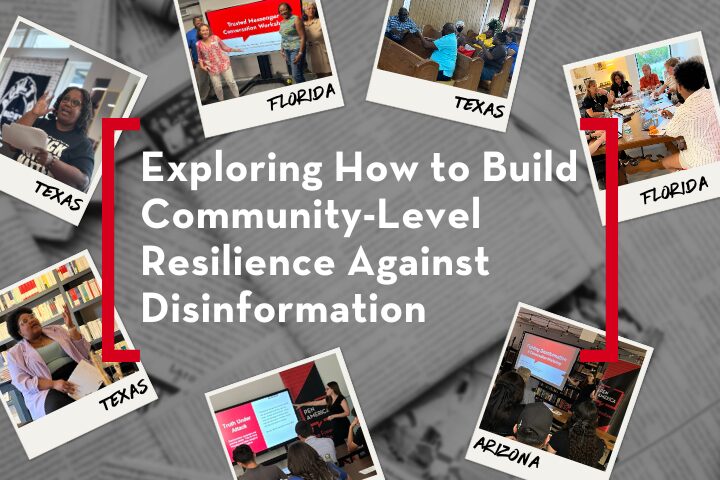
Through 23 workshops across the three cities, PEN America trained 501 trusted messengers to encourage someone close to them to broaden their news diet as a way to foster resilience against disinformation.
“I realized that it wasn’t my role to try to persuade anybody to change their minds to be in agreement with me,” explained Barbara James from Dallas, who participated in the program. “I’m just trying to make a suggestion into what I think would be a more informed source of diverse opinions of the news that you’re taking in, versus just relying on the one source you’re using.”
The workshops produced measurable results. On a scale of 1 to 10, participants’ self-reported sense of empowerment in having difficult conversations rose from an average of 6.31 before training to 8.18 afterward. That figure remained elevated at 7.26 two weeks after training.
Supporting Trusted Regional Organizations
PEN America awarded grants to three nonprofit organizations: Factchequeado in Miami, the Texas Tribune in Dallas–Fort Worth, and Conecta Arizona in Phoenix. Each organization used the funding to expand their impact in delivering trustworthy information to their communities.
Factchequeado developed Spanish-language fact-checking resources and a WhatsApp media literacy course called #FactChallenge that reached over 130,000 accounts on social media. The Texas Tribune created an automated text message service and AI-powered chatbot to provide voting information, while distributing 3,500 printed voting guides through community organizations. Conecta Arizona hosted regular WhatsApp “cafecitos” – casual conversations over coffee – where community members could discuss current events and engage with subject matter experts.
“These subgrants proved to be an effective framework for turning informal collaborations into formal partnerships,” the report notes. “When PEN America launched this program, we envisioned a different kind of partnership, with PEN staff members joining local community leaders in strategy sessions. But through listening, we came to recognize that the people we hoped to work with didn’t need that sort of help. They knew what messages to send, how to send them, and who to send them to. They primarily needed financial help to expand their impact.”
Educating Through Webinars
Between April 2024 and January 2025, PEN America developed and facilitated six disinformation resilience webinars that attracted 517 live attendees and generated over 1,600 views on YouTube. Topics ranged from cognitive biases and fact-checking to influencers’ impact on the information ecosystem.
The webinar format offered several advantages: accessibility across sprawling metropolitan areas, opportunities for cross-regional learning, and the ability to record presentations for future reference. To maintain a regional focus while reaching a national audience, PEN America featured guest speakers from Miami, Dallas, and Phoenix and highlighted case studies from these regions.
Survey data showed significant impact: 89% of respondents said they would be more mindful about looking for signs of fact-checking when consuming information, and 70% said they would be more likely to speak up if a friend or family member shared an election falsehood.
Looking Forward
“One benefit of relational organizing work is the investment made in bolstering a community’s long-term organizing capacity,” the report concludes. “The tools offered to trusted messengers around person-to-person intervention, paired with bridge-building between community members and local organizers, support the existing infrastructure within a community.”
For future iterations of this work, PEN America recommends hiring local organizers, conducting programming outside of election years, considering a cohort model for trusted messengers, connecting community members with local newsrooms, and forming robust partnerships with local institutions.
As disinformation continues to pose threats to democracy, these community-based approaches offer promising paths forward. By empowering individuals to recognize and resist false information, PEN America’s initiatives demonstrate how combating disinformation remains consistent with supporting free expression – a crucial message in today’s polarized information landscape.
Fact Checker
Verify the accuracy of this article using The Disinformation Commission analysis and real-time sources.

8 Comments
Tackling disinformation at the grassroots level is a smart strategy. By empowering people to be critical consumers of information, we can build resilience against the spread of falsehoods.
It’s encouraging to see organizations like PEN America taking a proactive approach to addressing disinformation. Empowering communities to be discerning consumers of information is crucial in today’s media landscape.
Absolutely. Equipping citizens with the tools to identify and resist false narratives is the best defense against the corrosive effects of disinformation.
The decline of local news sources and the rise of social media platforms have exacerbated the disinformation crisis. Initiatives to strengthen community-based journalism and media literacy are much-needed solutions.
Combatting disinformation is critical, especially at the community level. Building local resilience through journalism and critical thinking is key to withstanding the spread of misinformation.
Strengthening local journalism and media literacy is a smart way to build community resilience against disinformation. This holistic approach targeting both information producers and consumers is promising.
The example of the 2024 election cycle underscores how disinformation can permeate across the political spectrum. A non-partisan, community-driven approach is essential to combating this threat.
Agreed. Disinformation knows no political boundaries, so the response must be broad-based and focused on strengthening democratic institutions and critical thinking.