


Listen to the article
Experts Sound Alarm on Disinformation Crisis at Global Affairs Symposium
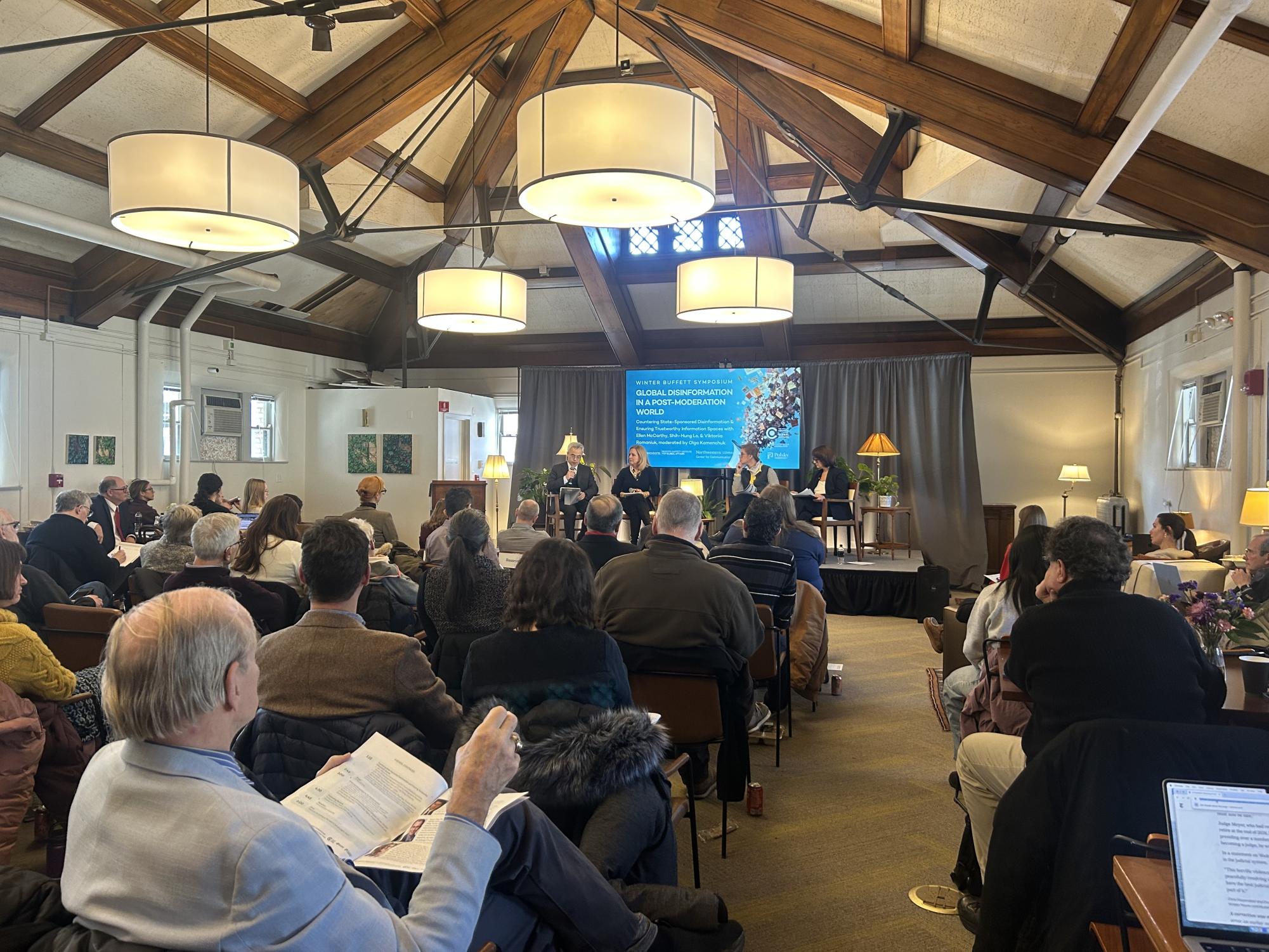
Disinformation represents “our number one national security issue,” warned Ellen McCarthy, former U.S. assistant secretary of state for intelligence and research, during a high-profile symposium held last week that brought together leading experts to address the growing crisis of false information in the digital age.
The Buffett Institute for Global Affairs, in partnership with the Center for Communication and Public Policy, hosted its annual winter symposium titled “Global Disinformation in a Post-Moderation World.” The two-day event featured five panel discussions exploring how traditional safeguards against disinformation have eroded in recent years.
The symposium examined the retreat from content moderation on major platforms, challenges to fact-checking efforts, and potential solutions through media literacy and multi-stakeholder collaboration. Experts painted a concerning picture of how disinformation threatens democratic institutions worldwide.
“I’m really concerned about how we continue to operate as a free and open society — and be cutting-edge and innovative and top of our game — in a world where we don’t trust anything,” McCarthy, who now serves as founder and CEO of the Trust in Media Cooperative, told attendees.
The Chicago Council on Global Affairs hosted Thursday’s initial panel, where speakers highlighted how protective measures against disinformation have weakened significantly. Suzanne Nossel, a senior fellow at the Council and former CEO of PEN America, described the situation as “a real test of a democratic country,” noting a fundamental shift in how information reaches consumers.
“Now your news chooses you because the algorithm discerns what engages you the most and knows how to push your buttons,” Nossel explained, highlighting how personalized content delivery has replaced traditional news consumption patterns.
James Warren, executive editor of NewsGuard, an organization that evaluates online journalism credibility, critiqued major tech platforms’ approach to fact-checking. Warren argued that companies like Meta and Google have scaled back already inadequate fact-checking efforts, suggesting a fundamental conflict with their business models.
“The companies have never really wanted to undermine a revenue model, based in some substantial measure, on audiences devouring craziness,” Warren said.
Friday’s sessions at the Buffett Institute delved deeper into specific aspects of the disinformation landscape. The “Innovating Resilience to Disinformation” panel presented research on how people encounter false information online and discussed emerging approaches to strengthen media literacy.
Another panel explored the need for alignment between government, technology companies, and the public in combating disinformation. David Bray, distinguished fellow at the Henry L. Stimson Center, contextualized the current moment: “We have had this a long time coming, with the internet, plus smartphones, and now AI. It’s going to be the messiness of being a free society.”
The symposium also highlighted international dimensions of the problem. A panel on state-sponsored disinformation examined how Ukraine and Taiwan face organized campaigns targeting their democratic institutions, particularly around elections. Speakers from both countries emphasized the importance of building community trust through rigorous fact-checking efforts.
The final session, “Ensuring Accountability for Disinformation,” addressed potential solutions through public pressure, transparency legislation, and exposing systemic failures that enable harmful content to spread. Imran Ahmed, CEO of the Center for Countering Digital Hate, who was notably barred from entering the U.S. by the Trump administration in December for allegedly censoring American voices, made a compelling case for transparency.
“We need to have legislation to switch on the floodlights so we can actually see how we’re being manipulated, how we’re being lied to,” Ahmed argued. “And I actually think one of the greatest ways we protect ourselves against being misled is to understand the precise ways in which we are.”
The symposium underscored the growing consensus among experts that disinformation represents not just a technological or political challenge, but a fundamental threat to democratic societies. As digital platforms evolve and artificial intelligence accelerates the creation and distribution of false information, the speakers emphasized the urgent need for new frameworks, greater platform accountability, and enhanced public literacy to navigate an increasingly complex information landscape.
Fact Checker
Verify the accuracy of this article using The Disinformation Commission analysis and real-time sources.

12 Comments
Disinformation is a complex and multifaceted problem that requires a coordinated response from various stakeholders. The Buffett Institute symposium seems like an important step in bringing together experts to tackle this critical issue.
Media literacy is a crucial component in the fight against disinformation. I’m curious to learn more about the symposium’s findings on how to empower citizens to critically evaluate online content and identify false information.
Online disinformation is a complex challenge that requires a multifaceted response. I appreciate the Buffett Institute bringing together experts to examine this issue from different angles and explore potential solutions.
It’s concerning to hear that disinformation is seen as a top national security threat. This underscores the urgent need to address this problem at all levels, from individual media literacy to global cooperation.
Disinformation is a worrying issue for our democracies. It’s good to see experts addressing this challenge at the Buffett Institute symposium. I’m curious to learn more about the proposed solutions, like media literacy and multi-stakeholder collaboration.
Yes, the retreat from content moderation on major platforms is a concerning trend that enables the spread of false information. Collaborative approaches will be key to tackling this problem effectively.
The Buffett Institute’s examination of global disinformation is a timely and necessary initiative. As a concerned citizen, I’m eager to learn more about the insights and recommendations that emerge from this high-profile symposium.
Disinformation poses a serious threat to democratic institutions worldwide. I’m glad to see the Buffett Institute bringing together experts to explore solutions and strengthen our defenses against this growing challenge.
The Buffett Institute symposium on global disinformation sounds like an important and timely event. I’m glad to see leading experts coming together to tackle this critical issue that affects democracies worldwide.
Fact-checking efforts are crucial in the fight against disinformation, but the challenges they face are worrying. Innovative solutions and cross-sector collaboration will be key to strengthening this vital work.
It’s encouraging to see the Buffett Institute bringing attention to the disinformation crisis and exploring potential solutions. As a citizen, I’m concerned about the threats this poses to our democratic institutions and I’m curious to learn more about the symposium’s findings.
The retreat from content moderation is a deeply troubling trend that enables the spread of false information. I hope the symposium can offer insights into how to address this challenge and restore trust in our online spaces.