


Listen to the article
Global Experts Warn Against Giving Up in Fight Against Disinformation
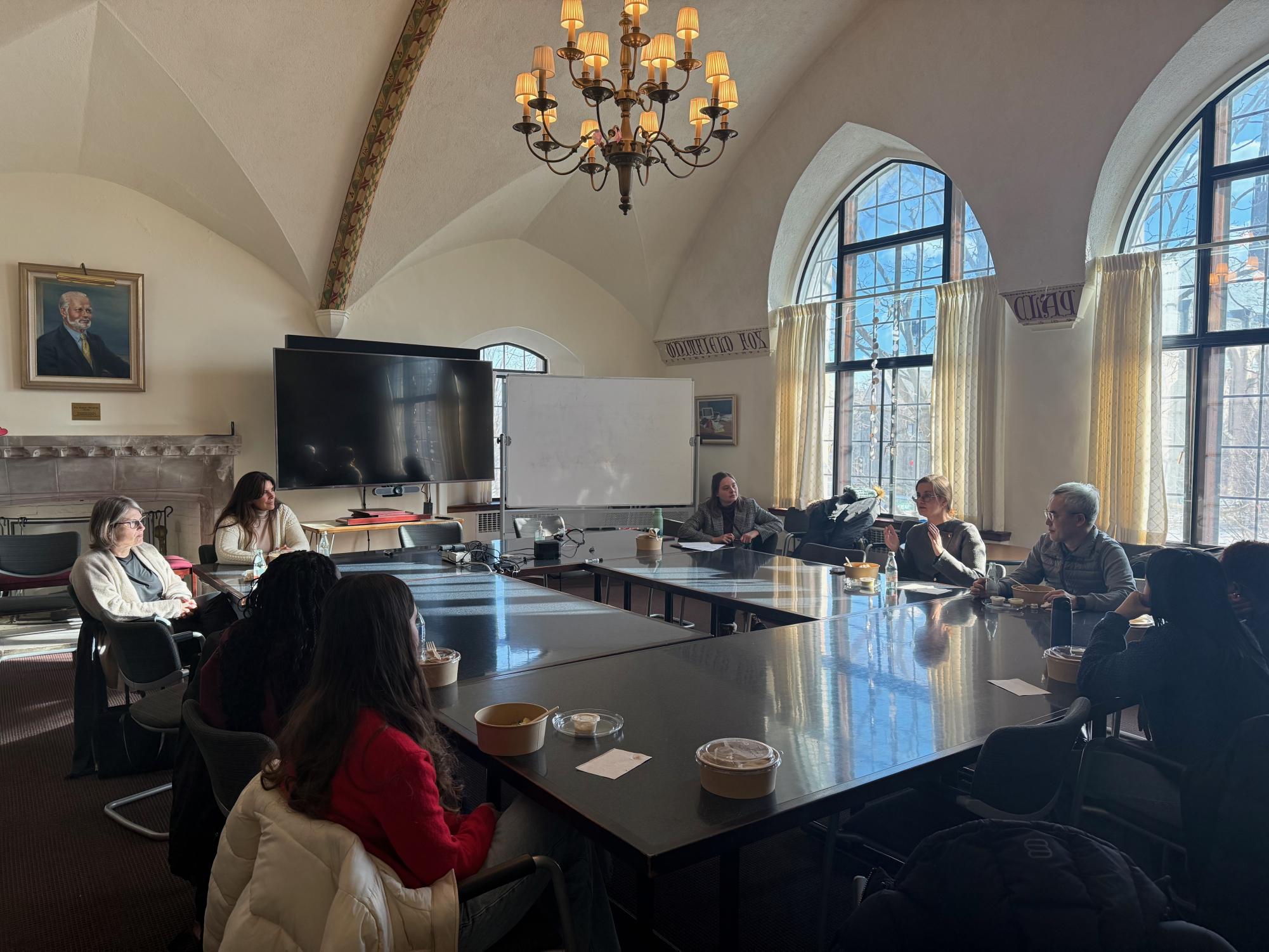
Four leading international experts on fact-checking and disinformation engaged with students during an informal lunch Thursday at Northwestern University’s Buffett Institute for Global Affairs, emphasizing the critical importance of persistence in combating false information despite growing challenges.
The gathering served as a prelude to the institute’s “Global Disinformation in a Post-Moderation World” winter symposium, which began Thursday at the Chicago Council on Global Affairs and continues through Friday at the Buffett Institute’s Evanston campus.
Laura Zommer, co-founder and CEO of Factchequeado, delivered a passionate call for continued vigilance in the face of widespread misinformation. “We are not in the time to give up,” Zommer told attendees. “There’s no option for almost anyone in this field of fact-checking to say, ‘Okay, we’re going to stop because we’re losing the battle.'”
Each expert offered insights from their regional expertise, highlighting how disinformation manifests differently across global contexts. Zommer, who specializes in Latin America and Hispanic communities in the United States, challenged the common assumption that disinformation primarily comes from foreign actors.
“We don’t just focus on foreign interference or propaganda from the outside,” she explained. “Sometimes, disinformation comes from our own government, and that disinformation is systemic.” She noted that in Latin America, informal power structures enable businesses and corporations to fund propaganda campaigns with extensive reach and impact.
Angie Drobnic Holan, Director of the International Fact-Checking Network, addressed the modern challenges of audience engagement. She described how social media has created an “attention economy” where factual news must compete with entertainment, sports, and lifestyle content for limited audience attention.
“There was this time when we saw social media and were like, ‘Oh, this is going to be great for journalism. We’ll be able to distribute all our work through here, and people will see it,'” Holan reflected. “Well, now some years have gone by. We can distribute our work, but people won’t necessarily see it.”
Holan pointed to political manipulation of social media algorithms as a particular concern, citing recent changes to X (formerly Twitter) under Elon Musk’s leadership as an example of how platform governance can impact information distribution.
Zommer expanded on this point, critiquing tech platforms’ prioritization of engagement over democratic values. “Big tech’s domain is not looking for protecting democracy or public interest journalists,” she stated. “They are looking for money. The way they are looking for money is pushing content that can engage people and helping their consumers to stay longer on their platform.”
The panel also featured Viktoriia Romaniuk, deputy chief editor of StopFake, and Shih-Hung Lo, chairman of the Taiwan FactCheck Center, providing perspectives from Eastern Europe and East Asia, respectively. Their inclusion underscored the truly global nature of the disinformation challenge.
The symposium comes at a critical moment, as democracies worldwide grapple with unprecedented levels of misinformation amid major elections and geopolitical tensions. Fact-checking organizations face mounting challenges from both technological changes and politically motivated attacks on their credibility.
Students in attendance appreciated the international scope of the discussion. Mira Trofymchuk, a Northwestern sophomore studying journalism, found particular value in the global perspective. “It was an incredible event for not just journalism majors, but everyone,” she said. “I like that it wasn’t centered on the U.S. perspective but on other countries as well, so I think it was really valuable to see how you can fight disinformation on the international level.”
The Buffett Institute’s symposium continues a series of events focused on global challenges. Previous institute programs have examined U.S. military actions in Venezuela and expanded opportunities for undergraduate global education, reflecting the organization’s commitment to addressing complex international issues through academic discourse and public engagement.
As disinformation continues to evolve with advancing technology, these experts emphasized that the stakes for democracy and civil discourse remain too high to abandon the pursuit of factual information, despite the increasingly difficult landscape they face.
Fact Checker
Verify the accuracy of this article using The Disinformation Commission analysis and real-time sources.

9 Comments
This is an important discussion on the critical issue of disinformation. Fact-checking and vigilance are key to combating the spread of false information, which can have far-reaching consequences. It’s good to see experts emphasizing the need for persistence in this ongoing battle.
The diversity of global perspectives highlighted in this event is valuable. Disinformation manifests differently across regions, so a nuanced, context-specific approach is necessary. Kudos to the Buffett Institute for hosting this timely and relevant discussion.
This event highlights the critical importance of academic institutions and think tanks in addressing complex global issues like disinformation. The Buffett Institute’s role in convening experts and facilitating these crucial discussions is commendable. Continued research and dialogue are key to finding effective solutions.
Combating disinformation is an ongoing battle, but it’s heartening to see leaders in this field refusing to give up. Their persistence and commitment to fact-checking and public education are essential for maintaining the integrity of information sources and democratic processes.
Disinformation is a global problem that requires coordinated, cross-border solutions. I’m glad to see the Buffett Institute bringing together experts from different regions to share their insights and strategies. This kind of collaborative approach is crucial for tackling this challenge effectively.
The experts’ emphasis on the nuanced, context-specific nature of disinformation is a valuable perspective. A one-size-fits-all approach won’t work – we need tailored responses that account for regional and cultural differences. This event seems to have fostered important discussions on that front.
It’s encouraging to hear the experts’ call for persistence in the face of growing disinformation challenges. Fact-checking and public awareness are essential to maintaining trust in information sources and safeguarding the integrity of our shared discourse. This is a complex issue, but one we must continue to address.
Absolutely. Giving up is not an option when the stakes are so high. Fact-checkers and researchers must keep pushing forward, even as the landscape evolves.
Disinformation poses a serious threat to informed decision-making and democratic discourse. I’m glad to see these experts sharing insights and emphasizing the vital importance of continued efforts to fact-check and combat the spread of false information. This is an issue we must remain vigilant about.