


Listen to the article
Big Tech’s Playbook: How Digital Giants Derailed Brazil’s Regulatory Efforts
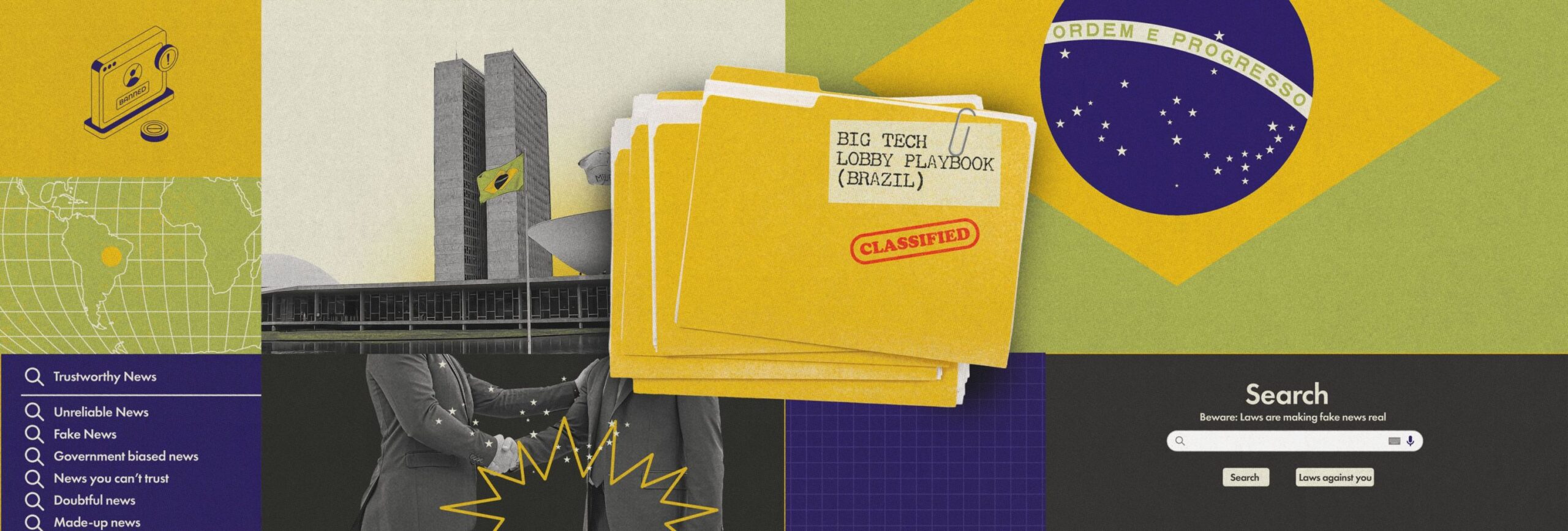
SOMO’s research into Big Tech’s lobbying tactics reveals how major technology companies orchestrated coordinated campaigns to undermine Brazilian regulatory efforts, demonstrating their willingness to manipulate public opinion and weaponize their own platforms to protect their business interests.
As one of the world’s largest digital markets, Brazil has become a battleground for tech regulation, with companies deploying sophisticated strategies to influence policy outcomes. The most notable examples occurred around two key pieces of legislation: the Fake News Bill and the Digital Child Protection Law.
The Fake News Bill Battle: Spreading Misinformation to Fight Anti-Misinformation Laws
When Brazilian lawmakers drafted PL 2630, known as the Fake News Bill, in 2020, they aimed to address rampant disinformation that had impacted elections and worsened the COVID-19 pandemic. The legislation sought to hold digital platforms accountable for enabling harmful content.
While initially approved by the Senate, the bill stalled until early 2023, when the January attack on Congress and Supreme Court by supporters of former President Bolsonaro, along with school attacks linked to online radicalization, created new urgency for action.
Google, Meta, YouTube, and Twitter (now X) immediately launched a coordinated campaign to reframe the bill as “censorship.” Their strategy included publishing joint letters claiming the legislation would restrict access to information and manipulating religious communities with inflammatory claims that the bill could lead to banning parts of the Bible.
“The ‘censorship’ narrative claimed the bill would force publishers to delete Bible verses,” explained Gabrielle Graça de Farias, a researcher at FGV Rio. “It was absurd, but it worked. It created religious panic in Brazil, which is a country with a strong religious community.”
Behind the scenes, industry associations like Câmara-e.net and the Latin American Internet Association lobbied intensively against the bill, creating what Humberto Ribeiro of Sleeping Giants Brasil described as “the illusion that opposition came from a broad coalition rather than from a handful of powerful companies.”
Weaponizing Their Own Platforms
As the vote on PL 2630 neared in 2023, Big Tech companies escalated dramatically, using their own platforms to shape public opinion. Anyone searching “PL 2630” on Google saw advertisements placed by Google itself, linking to a blog post titled “How PL 2630 Can Make Your Internet Worse.” Research from NetLab showed Google search results also prioritized pages that echoed the company’s position.
YouTube followed suit, urging content creators to oppose the bill through blog posts and dashboard alerts. Other platforms, including Spotify and Meta, ran Google’s advertisements, while Telegram sent mass notifications urging users to “defend free speech” and redirecting them to contact lawmakers.
The most brazen move came on May 1, 2023, when Google placed a warning banner on its homepage claiming the bill would “increase the confusion between what is true and what is false in Brazil.” This direct lobbying message was seen by millions of Brazilians.
Brazil’s National Consumer Secretariat immediately accused Google of misleading advertising and demanded removal of the content under threat of significant fines. The Supreme Court ordered Google, Meta, and Spotify to remove coordinated content attacking the bill.
Despite these interventions, the damage was done. The vote was canceled the next day, with Arthur Lira, President of the Chamber of Deputies, acknowledging that “when a text gains a narrative like this, it simply does not have support.”
The Digital Child Protection Law: When Public Outrage Overcomes Corporate Tactics
In August 2025, a viral exposé by an influencer named Felca revealed how platforms were hosting, amplifying, and monetizing content that sexualized children. This sparked immediate public outrage directed at Big Tech, forcing lawmakers to fast-track PL 2628, a draft law on online safety measures.
The companies attempted to deploy the same playbook, but with a twist. Rather than leading the opposition directly, they stayed in the background while far-right influencers and parliamentarians branded the bill as “state control of the internet.” Meanwhile, Big Tech lobbyists met with lawmakers directly, providing technical input aimed at weakening the bill.
Flora de Castro Santana of Sleeping Giants Brasil observed that “Big Tech supplies the technocratic talking points, and the far right translates them into open slogans about censorship to mobilize its base.”
However, this time the strategy failed. Public anger over the exploitation of children created immense pressure for action, and the bill passed despite Big Tech’s efforts. As FGV Rio’s Graça de Farias explained, “The companies did not have time to spin it. Any company defending itself against PL 2628 looked complicit.”
The Pattern of Global Influence
Brazil’s experience offers important lessons about Big Tech’s lobbying tactics and their effectiveness. The companies demonstrated their willingness to align with extreme political viewpoints, manipulate information, and weaponize their own platforms to prevent regulation that might impact their business models.
The different outcomes of the two bills highlight how public pressure can counter corporate influence. When companies lack time to reframe issues and face overwhelming public demand for action, even their sophisticated lobbying machinery can fail.
These tactics aren’t unique to Brazil. Similar strategies have been observed in the United States, European Union, India, Kenya, and Australia, revealing a global pattern of how a handful of tech giants work to dominate policy debates worldwide.
As digital platforms continue to shape democracy and public discourse, understanding these lobbying techniques becomes increasingly important for lawmakers and civil society seeking to establish effective guardrails for the digital economy.
Fact Checker
Verify the accuracy of this article using The Disinformation Commission analysis and real-time sources.

10 Comments
This situation highlights the need for robust, independent regulation of the tech industry. Brazil is an important battleground, and the outcome could have ripple effects globally.
Agreed. Strong, impartial governance is crucial to ensure these companies are held accountable and act in the public interest, not just their own.
The article touches on some key legislation in Brazil like the Fake News Bill and Digital Child Protection Law. It’s important to address disinformation, but tech companies will likely fight hard to protect their interests.
Absolutely. These companies have deep pockets and will use sophisticated lobbying tactics to sway policymakers. It will be interesting to see how this plays out in Brazil.
The January attack on Brazil’s Congress and Supreme Court by supporters of the former president adds an extra layer of complexity to this issue. Disinformation can have real-world, destabilizing consequences.
That’s a good point. The broader political context makes this an even more sensitive and high-stakes situation. Policymakers will need to tread carefully.
Interesting to see the tech companies allege censorship in Brazil amid concerns over disinformation. It highlights the complex balance between free speech and mitigating the spread of harmful content online.
You’re right, it’s a tricky issue. Tech companies have a lot of power and influence, but they also need to be held accountable for the content on their platforms.
Curious to learn more about the specific tactics used by tech companies to undermine Brazil’s regulatory efforts. The article mentions coordinated campaigns to influence public opinion – that’s concerning if true.
Yes, the details on their lobbying tactics are quite troubling. It speaks to the immense power and influence these digital giants wield over the policy process.