


Listen to the article
BBC Faces Criticism for Reporting on Israeli Strike Near RT Journalist in Lebanon
A recent BBC report detailing an incident where a missile landed near a Russian state media journalist in Lebanon has drawn criticism for allegedly failing to provide crucial context and amplifying claims that Israel deliberately targets journalists.
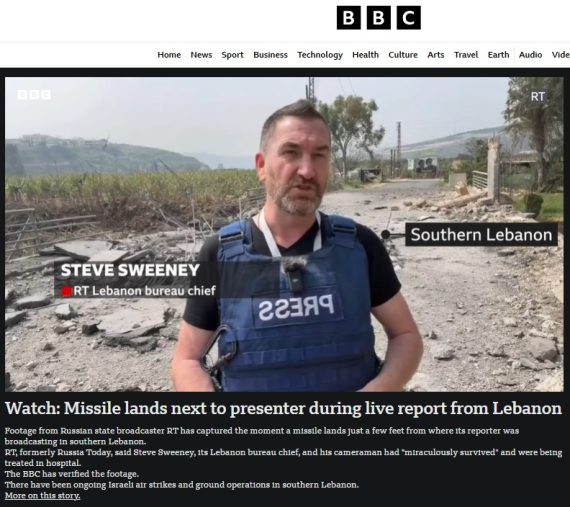
On March 19, the BBC News website published footage under the headline “Watch: Missile lands next to presenter during live report from Lebanon,” showing a strike near RT (formerly Russia Today) reporter Steve Sweeney in southern Lebanon. The BBC’s synopsis stated that Sweeney and his cameraman “miraculously survived” and were receiving hospital treatment, noting the BBC had verified the footage.
Critics argue the BBC’s reporting omitted critical information – specifically that the Israeli Defense Forces (IDF) had issued clear advance warnings about targeting crossings over the Litani River, which they claimed were being used by Hezbollah to transport fighters and weapons. Despite these public warnings, Sweeney reportedly traveled to the area to report.
A day earlier, on March 18, the IDF had announced its intention to target these crossings, and this warning was referenced in a separate BBC article titled “Israel destroys river bridges in southern Lebanon.” That report specifically mentioned that the Israeli military had warned civilians near the Litani crossings to evacuate before conducting strikes.
The controversy deepened when BBC Verify, the corporation’s anti-disinformation unit, published a follow-up report on March 20 titled “Israeli strike next to British journalist is not AI-generated.” While the report acknowledged the IDF had issued warnings before the strike, it also uncritically repeated claims from Sweeney and Russia’s foreign ministry that the journalist and his crew were “deliberately targeted.”
Media watchdogs have noted that the BBC’s reports failed to provide viewers with potentially relevant background information about the journalist involved. Sweeney is reportedly a former Morning Star journalist who has written for Al Mayadeen, described by critics as pro-Hezbollah. His cameraman, Ali Rida Sbeity, allegedly has previous connections to Hezbollah’s Al Manar TV network.
The BBC Verify report also stated that the Israeli military declined to provide specific details about its decision-making process leading up to the strike when asked, though the IDF reiterated it had warned civilians to evacuate the area and that it “does not target civilians or journalists.”
This reporting comes at a sensitive time for the BBC, whose outgoing director general recently wrote in the Times newspaper that “truth is under all-out assault” globally and claimed the corporation was committed to tackling disinformation.
Critics question whether the BBC’s handling of this incident aligns with its stated commitment to providing reliable information, particularly when dealing with conflict reporting in a region where accusations of media bias are common. They suggest that by not prominently including the context of advance warnings in its initial report, the BBC may have created a misleading impression about the circumstances surrounding the incident.
The controversy highlights ongoing tensions between media organizations, military operations, and journalistic safety in conflict zones, as well as the challenges news outlets face when reporting on incidents that become part of larger geopolitical narratives.
Fact Checker
Verify the accuracy of this article using The Disinformation Commission analysis and real-time sources.

6 Comments
Curious to learn more about the specifics here. Were the BBC’s actions truly an ‘amplification’ of Russian propaganda, or was it simply an attempt to cover a newsworthy incident involving a journalist, even if from a state-affiliated outlet? The nuance matters.
This highlights the challenges media organizations face in reporting on complex geopolitical issues. The BBC should strive for impartiality and provide full context, but it’s understandable there may be concerns about amplifying certain narratives, even unintentionally.
This is a complex issue with a lot of nuance. The BBC should be careful to provide full context and not amplify claims without verifying the details. Reporting accurately on conflicts involving state media is challenging but important.
While I appreciate the BBC’s efforts to combat disinformation, this case seems to raise legitimate concerns about their approach. Reporting should be objective and balanced, not potentially amplifying questionable claims. Getting the details right is essential.
I can see both sides of this. The BBC needs to report on incidents involving journalists, but care must be taken to avoid inadvertently spreading misinformation or propaganda. Providing full context is crucial, even when the subject is a state media outlet.
Interesting development. I can understand the concerns about the BBC potentially amplifying Russian propaganda, but it’s also crucial they report on incidents involving journalists, even those from state media outlets. Balancing accuracy and context is key.