


Listen to the article
Artemis II Mission Faces Wave of Misinformation and Conspiracy Theories
The Artemis II lunar fly-by mission has become the latest target of widespread online misinformation, with false narratives proliferating across major social media platforms as astronauts completed their historic journey around the moon.
Since the mission launched, conspiracy theorists have pushed numerous unfounded claims, including assertions that the entire operation was staged in a movie studio and that footage of the crew was generated by artificial intelligence. These false narratives have gained significant traction on platforms like X (formerly Twitter), TikTok, and Facebook, with hashtags such as “fake space” and “fake NASA” trending among skeptics.
One particularly viral image, viewed over a million times on X, purported to show the Artemis II crew floating before a green screen while facing film cameras. Digital forensics experts later confirmed the image showed clear signs of AI manipulation, despite its convincing appearance to casual viewers.
In another instance, conspiracy theorists pointed to a video showing text appearing through the mission’s official mascot as supposed evidence the flight was staged. Fact-checkers from AFP determined the anomaly was merely a technical error—a failed text overlay by a news organization that had syndicated NASA’s official feed.
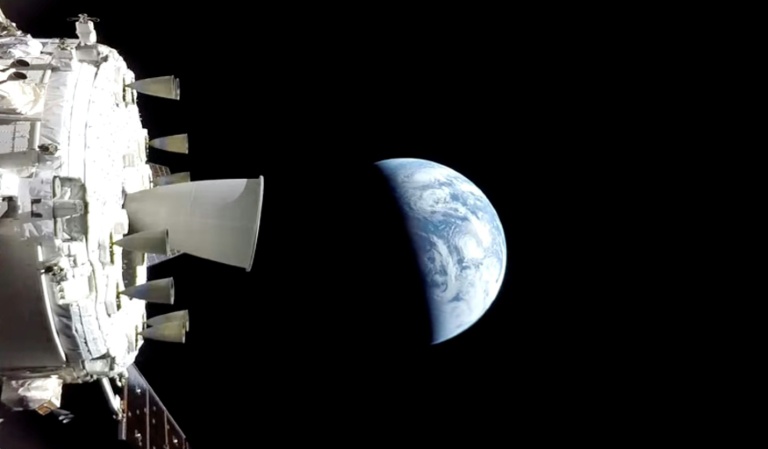
The misinformation spread rapidly even as the four astronauts aboard the Orion spacecraft captured breathtaking visuals during their fly-by of Earth’s natural satellite, preparing on Friday for their high-stakes re-entry and splashdown in the final phase of the mission.
The phenomenon reflects a troubling shift in how scientific achievements are received in today’s media environment. Conspiracy theories that were once relegated to the internet’s fringes have moved into the mainstream, fueled by growing public mistrust of institutions and traditional information sources.
“There are some people whose reflexive reaction to any kind of major event is to claim it’s fake and staged, no matter what it is,” disinformation researcher Mike Rothschild told AFP. He added that many conspiracy theorists “pass themselves off as experts in science and physics because it’s somehow more believable to their followers than just going with ‘the official story.'”
The current landscape of misinformation has been exacerbated by the reduction of content moderation teams at major tech platforms. Several companies have gutted their trust and safety teams, creating what researchers describe as fertile ground for false narratives to flourish unchecked.
Adding another layer of complexity is the rise of artificial intelligence tools, which conspiracy theorists have weaponized in two directions. Some claim the mission footage itself was AI-generated, while others use AI to create convincing fake “evidence” purporting to show the mission was staged. This tactic—using claims about AI manipulation to cast doubt on authentic content—has been dubbed the “liar’s dividend” by misinformation researchers.
The Artemis II controversy has also reinvigorated one of the most enduring conspiracy theories in American history: the notion that NASA faked the 1969 Apollo 11 moon landing. This narrative has remained remarkably persistent in popular culture, even becoming a plot point in recent films like the romantic comedy “Fly Me to the Moon,” which stars Scarlett Johansson as a character tasked with staging a fake lunar landing.
“The moon landing is an example of a conspiracy that will not die,” explained Timothy Caulfield, a misinformation expert from the University of Alberta. “These conspiracies are attractive for a host of reasons including that they are linked to the allure of having ‘secret knowledge’ or being aware of things others don’t know.”
The generational gap between the Apollo missions and Artemis II may contribute to the persistence of these theories. Most of today’s internet-savvy users have no personal memory of previous lunar missions, which last occurred in the early 1970s.
Space exploration expert Francis French noted the irony in this situation: “In many ways, it is a testament to how hard it is for humans to travel to the moon—after all, we did it from 1968 to 1972, and it has taken until 2026 to do it again. It makes many people wonder if it ever happened.”
Despite the wave of misinformation, French remains optimistic that the visual evidence from Artemis II speaks for itself. “Right now we are seeing remarkable photographs and video of the Earth and the moon…These photos alone should remove doubt and show once again the amazing things humans are capable of.”
Fact Checker
Verify the accuracy of this article using The Disinformation Commission analysis and real-time sources.

17 Comments
Exploration results look promising, but permitting will be the key risk.
Good point. Watching costs and grades closely.
Good point. Watching costs and grades closely.
I like the balance sheet here—less leverage than peers.
Uranium names keep pushing higher—supply still tight into 2026.
The cost guidance is better than expected. If they deliver, the stock could rerate.
Nice to see insider buying—usually a good signal in this space.
Good point. Watching costs and grades closely.
Nice to see insider buying—usually a good signal in this space.
Nice to see insider buying—usually a good signal in this space.
The cost guidance is better than expected. If they deliver, the stock could rerate.
Good point. Watching costs and grades closely.
The cost guidance is better than expected. If they deliver, the stock could rerate.
Good point. Watching costs and grades closely.
Production mix shifting toward Disinformation might help margins if metals stay firm.
Uranium names keep pushing higher—supply still tight into 2026.
Good point. Watching costs and grades closely.