


Listen to the article
Russia’s Arctic Disinformation Campaign Threatens Environment and Security
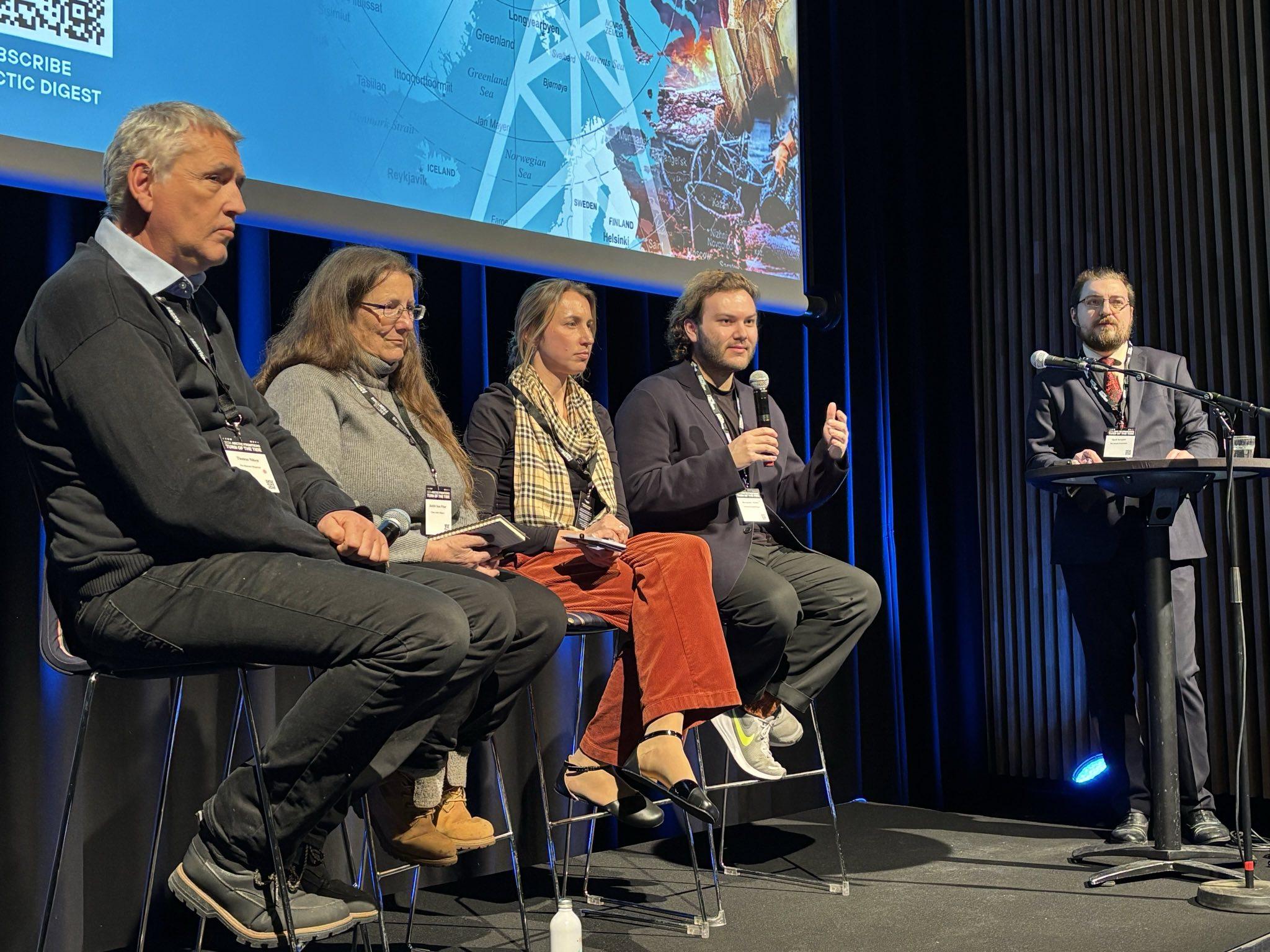
Russian state-controlled media are flooding global information channels with misleading narratives about the Northern Sea Route, potentially distorting both environmental policy and security assessments in the Arctic region, experts warned at a recent Bellona event during the Arctic Frontiers conference in Tromsø.
“When narratives are dictated, the consequences can become very real,” said Yuri Sergeev of Bellona as he opened the discussion focused on the Kremlin’s growing attempts to shape international discourse about Arctic development.
Ksenia Vakhrusheva from the Bellona Environmental Transparency Center in Vilnius highlighted how Russian claims about sustainable development of the Northern Sea Route often escape critical scrutiny from international audiences and policymakers.
“Many people fail to question icebreaker capacity or whether Russia actually has the ability to build 36 new search-and-rescue vessels by 2030,” Vakhrusheva explained. She noted that Russia abruptly stopped publicly reporting accidents along the route in 2023, making it increasingly difficult to assess safety conditions.
Her presentation detailed significant environmental risks associated with increased maritime traffic through the fragile Arctic ecosystem, emphasizing the route’s severely limited emergency response infrastructure that would be critical during any shipping disaster.
The scale of Russia’s information campaign is accelerating dramatically, according to Benjamin Shultz, head of analysis at the American Sunlight Project (ASP). Collaborative research between ASP and Bellona documented a 238% year-on-year increase in Russian state media content about the Northern Sea Route, despite total views dropping by 31%.
“That may indicate the content is increasingly aimed at language models or closed channels such as Telegram and WhatsApp,” Shultz observed. This shift suggests the Kremlin may be targeting AI algorithms and private messaging platforms rather than traditional public audiences, potentially to seed narratives that will be amplified through emerging technologies.
The joint ASP-Bellona investigation identified four primary narratives consistently promoted by Russian sources: that the Northern Sea Route will deliver global economic benefits through faster and cheaper shipping; that it represents a strategic asset for Russia, China and other BRICS nations seeking to counter Western influence; that NATO and Western powers are deliberately obstructing Russia’s rightful development; and that Russia possesses all necessary capabilities to develop the route safely despite sanctions.
Access to reliable information has become increasingly problematic, according to Thomas Nilsen, editor of The Barents Observer. “Journalists no longer have independent access to several of the most contested areas along the route,” Nilsen said, emphasizing that this restriction applies to both international and Russian journalists alike.
Nevertheless, creative monitoring approaches remain effective. Nilsen described tracking stalled icebreaker construction projects through public webcams at Russian shipyards, revealing significant delays following Western sanctions and technological restrictions.
The misinformation extends to scientific discourse as well. Sian Prior of the Clean Arctic Alliance warned that Russia has been submitting questionable research papers attempting to undermine established science on environmental threats. “Russia submits so-called scientific articles that cast doubt on the harmful effects of black carbon, despite solid documentation,” Prior explained.
The heightened strategic importance of the Arctic was evident throughout the Arctic Frontiers conference, which featured high-profile appearances by EU foreign policy chief Kaja Kallas, Norway’s Foreign Minister Espen Barth Eide, and Greenland’s Foreign Minister Vivian Motzfeldt.
Security concerns dominated discussions, closely followed by climate crisis anxieties, reflecting growing international tensions in a region experiencing rapid environmental transformation and declining institutional trust.
The confluence of geopolitical competition, climate change, and sophisticated information warfare presents a complex challenge for Arctic governance at a time when transparent and fact-based cooperation has never been more essential for the region’s sustainable future.
Fact Checker
Verify the accuracy of this article using The Disinformation Commission analysis and real-time sources.

15 Comments
This discussion raises important questions about balancing economic interests, environmental protection, and geopolitical security in the Arctic. Finding the right approach will require nuanced, evidence-based policymaking that resists simplistic narratives.
This is a concerning report on the potential impact of disinformation campaigns around Arctic development. Rigorous data, independent analysis, and multi-stakeholder collaboration will be crucial to navigate these complex issues responsibly.
This report highlights the critical role of information warfare in the geopolitical competition over the Arctic. It’s a sobering reminder that disinformation can have very real consequences for the environment and regional security.
The challenges of Arctic security and environmental protection are critical issues that deserve serious scrutiny. Disinformation campaigns can have real-world consequences, so it’s important to carefully assess the claims and capabilities of all stakeholders in the region.
Agreed. Transparency and fact-based analysis are essential for understanding the complex dynamics at play in the Arctic.
The Arctic is a delicate and complex ecosystem, and responsible development needs to be the top priority. Disinformation campaigns that obscure environmental risks or exaggerate capabilities are concerning and must be countered with rigorous analysis.
Well said. Maintaining scientific integrity and objective assessment should be the foundation for any decisions about the Arctic’s future.
Ensuring transparency and reliable data around Arctic development is crucial. The report of Russia stopping public accident reporting along the Northern Sea Route is worrying – that kind of opacity makes it very difficult to assess safety and environmental impacts.
Agreed, that lack of transparency is a major red flag. Monitoring and independent verification will be essential going forward.
This is an important discussion on the role of disinformation in shaping policy around the Northern Sea Route. Reliable data and impartial assessments will be crucial as nations weigh the risks and opportunities in the rapidly changing Arctic.
Absolutely. Arctic development should be guided by sound science and environmental stewardship, not propaganda.
The Arctic Frontiers conference seems to have highlighted some concerning trends around disinformation and security in the region. I’m curious to learn more about the specific claims and narratives being promoted by Russian state media, and how they might be misleading policymakers.
That’s a good point. Understanding the tactics and motivations behind these disinformation campaigns will be key to countering their influence.
The Arctic Frontiers conference seems to have surfaced some important issues around transparency and the need for fact-based policymaking in the region. Maintaining a clear-eyed, impartial view of both the challenges and opportunities will be essential going forward.
Absolutely. With so much at stake environmentally and geopolitically, we can’t afford to let disinformation distort the conversation.