


Listen to the article
Egypt’s Arabi Facts Hub Leads Fight Against Misinformation in Arab World
In today’s digital landscape, where facts often intermingle with falsehoods, an Egyptian organization has emerged as a frontrunner in the battle against misinformation across the Arab world. Arabi Facts Hub has developed innovative approaches to address the growing challenge of information disorder that plagues journalists, media students, and fact-checkers throughout the region.
The spread of false information has become normalized in the Arab world, embedded in a digital environment shaped by political transformation, humanitarian crises, armed conflicts, and unprecedented social media engagement. Misleading content regularly infiltrates mainstream narratives, whether through coordinated disinformation campaigns or unintentionally inaccurate reporting that rapidly gains traction.
To counter this trend, Arabi Facts Hub employs large language models alongside the region’s most comprehensive open-source fact-checking database. This database aggregates work from leading independent fact-checking initiatives across the Arab world, creating a valuable resource for journalists, researchers, and academics. Additionally, the organization has established an investigative unit dedicated to monitoring inauthentic behavior and coordinated social media campaigns that attempt to manipulate public opinion.
Understanding that lasting change begins with education, Arabi Facts Hub has focused significant efforts on university partnerships to train the next generation of journalists. The organization has developed a methodology built on four core principles: awareness before tools, practice over theory, integration of storytelling with data and AI, and positioning trainees as part of the solution.
“We view digital literacy as a skill developed through hands-on experience,” explained a representative from the Hub. “Every training session involves analyzing actual social media posts, verifying images and videos, and applying fact-checking tools in real time.”
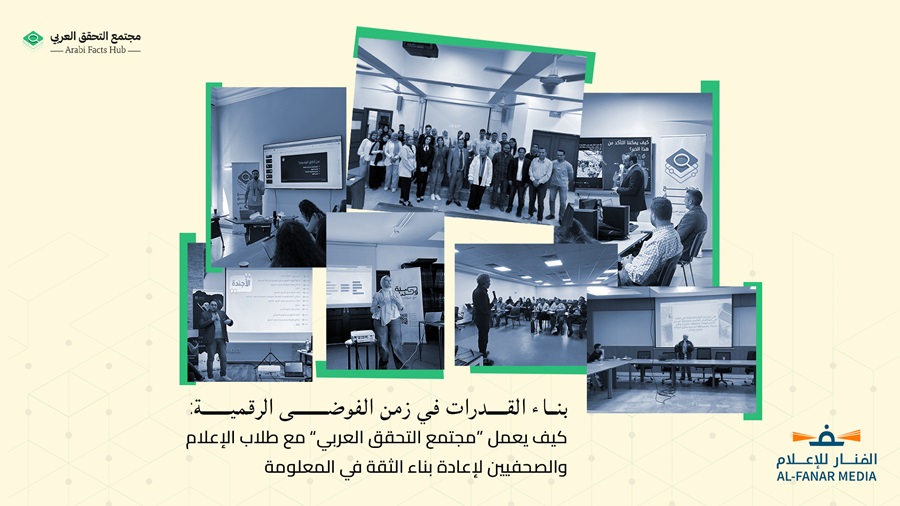
To date, the organization has trained approximately 350 students across four Egyptian universities, with expansion plans underway. At the Arab Academy for Science, Technology and Maritime Transport in Alexandria, students learned digital storytelling, fact-checking, and data journalism through practical exercises. Similar programs at Al-Galala University in Suez Governorate focused on understanding AI-generated content and detecting deepfakes – skills increasingly vital in modern journalism but rarely taught in Arab academic institutions.
The organization’s largest training program took place at Cairo’s Helwan University, where hundreds of students participated in interactive sessions combining presentations, exercises, and open discussions. At Suez University, dozens of students strengthened their fact-checking and digital storytelling capabilities, with particular emphasis on visual storytelling and identifying manipulated content.
These university initiatives have not been without challenges. Trainers have encountered significant disparities in digital literacy among students, limited awareness of misinformation risks, time constraints within university curricula, and outdated academic programs that fail to address contemporary journalism needs. Despite these obstacles, the Hub has persisted, driven by noticeable improvements in student engagement and skill development.
Beyond Egypt, Arabi Facts Hub has expanded its influence across the region. In the past year alone, it trained approximately 500 professionals through 41 training courses in Egypt, Lebanon, Jordan, and Iraq – combining online sessions with in-person workshops. The organization has also conducted specialized training for Syrian women journalists and formed partnerships with regional organizations including Syria’s Silah Wasl Foundation, Tahaqaq 360 in Lebanon, and the Yemeni Archive.
The skills taught in these programs have become essential in today’s media landscape. Modern newsrooms seek professionals who can protect against misinformation while producing well-researched digital stories – journalists who can interpret data critically, verify multimedia content, and understand how algorithms shape audience perception.
To support this broader mission, Arabi Facts Hub maintains an open-access database of misleading content that is updated daily and currently contains over 20,000 verified items from 24 partners across ten Arab countries. The organization also produces annual research reports tracking the evolution of information disorder in the region and has launched initiatives supporting digital policy development and media literacy.
“Building a culture of fact-checking in the Arab world is not a distant aspiration – it’s already taking shape,” noted an Arabi Facts Hub spokesperson. “From Alexandria to Beirut, Nouakchott, and Amman, we’re seeing real progress, one step at a time.”
This initiative represents a crucial effort to reclaim journalism’s respected public role by equipping practitioners with the knowledge and tools necessary to navigate an increasingly complex information environment.
Fact Checker
Verify the accuracy of this article using The Disinformation Commission analysis and real-time sources.

15 Comments
The normalization of misinformation is a global issue, and it’s encouraging to see organizations like Arabi Facts Hub taking a proactive approach to addressing it in the Arab world. Their work could serve as a model for other regions facing similar challenges.
Absolutely. Cross-regional collaboration and the sharing of best practices could be valuable in the broader fight against the spread of false information.
In an era of increasing social media use and widespread access to digital information, the challenge of combating misinformation has become more pressing than ever. Arabi Facts Hub’s efforts are a step in the right direction.
The growth of misinformation, especially in regions facing political and humanitarian crises, is concerning. Arabi Facts Hub’s efforts to create a comprehensive fact-checking database are commendable and much needed.
You’re right, the database could be a valuable resource for media professionals and researchers working to counter the spread of false information in the Arab world.
Fact-checking is critical in an era of information overload and misinformation. The Arabi Facts Hub’s use of AI and aggregated databases is an innovative approach to combat disinformation in the Arab world.
The Arab world has faced significant challenges in recent years, and the proliferation of false information has only exacerbated these issues. Arabi Facts Hub’s efforts to combat disinformation are a much-needed step in the right direction.
I agree. Fact-checking initiatives like this one can help counter the spread of misinformation and ensure that the public has access to reliable, accurate information.
The use of large language models and aggregated databases is an innovative approach to fact-checking. I’m curious to see how effective it is in addressing the complex problem of misinformation in the Arab region.
It’s good to see organizations like Arabi Facts Hub taking the lead in verifying information and pushing back against the spread of false narratives. Fact-checking is essential for maintaining trust in media and public discourse.
Agreed. Fact-checking initiatives play a vital role in upholding journalistic integrity and helping the public navigate the complex information landscape.
Arabi Facts Hub’s use of AI and comprehensive databases sounds like an effective way to tackle the complex problem of misinformation. I’m curious to see how their work evolves and the impact it has on media and public discourse in the Arab world.
It’s heartening to see an organization like Arabi Facts Hub taking a proactive stance against the normalization of misinformation in the region. Their work is essential for promoting media literacy and preserving the integrity of news and information.
Arabi Facts Hub’s work is crucial for supporting journalists, media students, and fact-checkers in the Arab world. Maintaining the integrity of information is key to fostering informed public discourse and decision-making.
I’m curious to learn more about the specific techniques and technologies Arabi Facts Hub is using to identify and debunk misinformation. The combination of language models and open-source data sounds like a promising approach.