


Listen to the article
No Verified Evidence of “El Mencho” Death as Cartel Disinformation Claims Circulate
Unsubstantiated reports claiming the death of Nemesio Oseguera Cervantes, the notorious cartel leader known as “El Mencho,” have spread rapidly across social media platforms in recent days, highlighting the growing threat of organized crime-linked disinformation campaigns in Mexico and beyond.
Despite widespread online rumors suggesting El Mencho was killed during a military operation, no credible evidence supports these claims. Neither Mexican authorities nor international agencies like the U.S. Drug Enforcement Administration have confirmed any such development regarding the Jalisco New Generation Cartel (CJNG) leader.
El Mencho remains one of the world’s most wanted fugitives, with substantial bounties offered by both U.S. and Mexican governments. His organization, the CJNG, has emerged as one of Mexico’s most powerful and violent criminal enterprises, with operations spanning multiple continents and an estimated annual revenue in the billions.
Security analysts monitoring the situation note that the absence of official confirmation is telling. “An event of this magnitude would trigger immediate verification and public statements from multiple government agencies,” explains Dr. Raúl Benítez, a security researcher at the National Autonomous University of Mexico. “The fact that we’ve seen nothing from credible sources strongly suggests this is another example of criminal misinformation.”
The phenomenon of cartel-driven disinformation represents a sophisticated evolution in organized crime tactics. Criminal organizations increasingly deploy digital strategies alongside traditional violence to achieve their objectives. The CJNG, in particular, has demonstrated remarkable proficiency in manipulating information ecosystems.
“These groups have learned to weaponize social media platforms,” says Ana María Salazar, former U.S. Deputy Assistant Secretary of Defense for Drug Enforcement Policy. “They can create artificial panic, undermine public trust in authorities, or distract from actual operations with remarkable efficiency.”
Typical cartel disinformation techniques include flooding platforms like WhatsApp and Facebook with coordinated messaging, recycling imagery from unrelated incidents to fabricate new events, and deploying networks of fake accounts to amplify their narratives. These digital campaigns often coincide with physical operations to maximize confusion and fear.
The impact extends far beyond Mexico’s borders. Similar tactics have emerged in conflict zones worldwide, where non-state actors exploit information vacuums to advance their agendas. From East Africa to Southeast Asia, criminal organizations and militant groups have adopted comparable playbooks, creating what security experts call “information battlegrounds.”
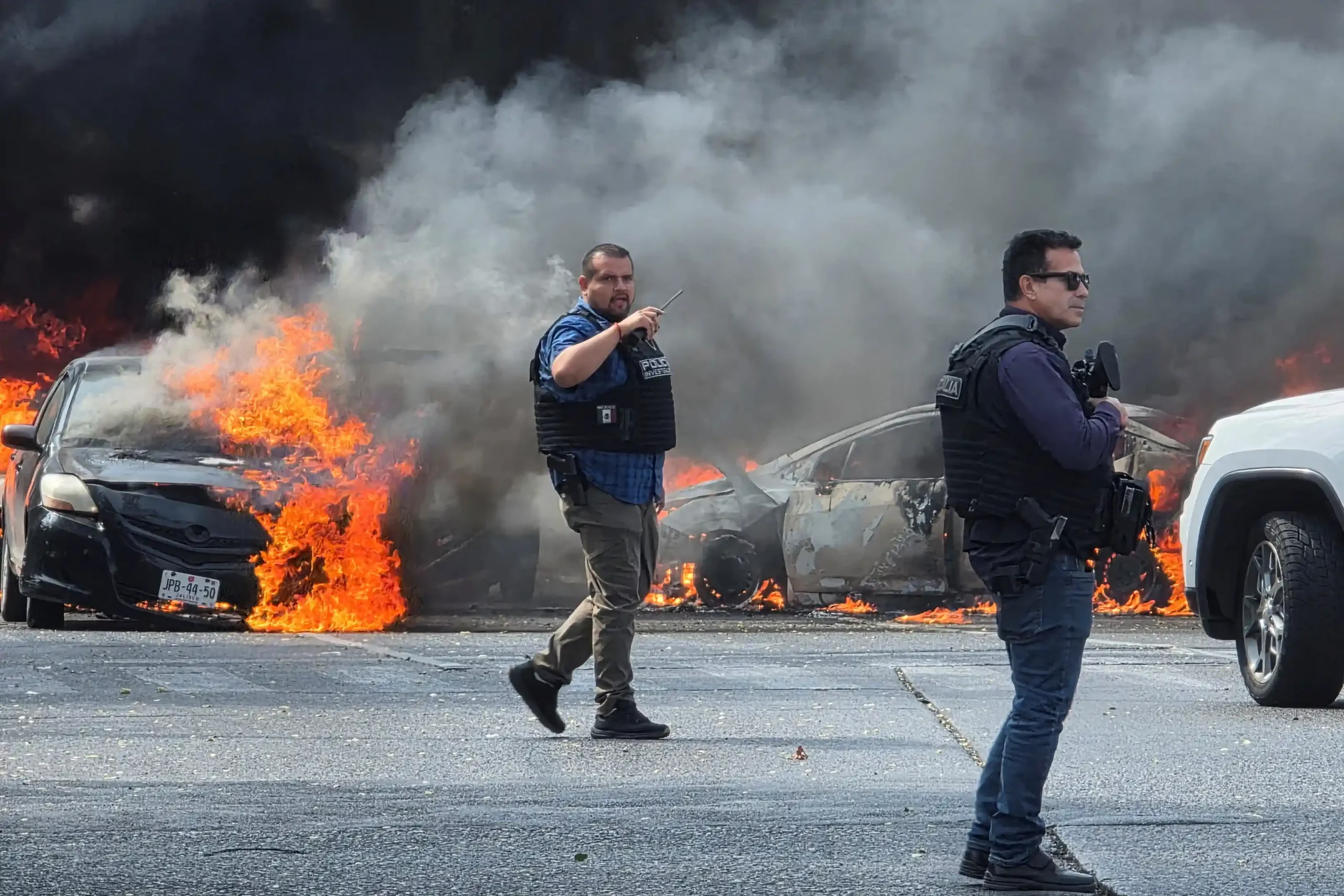
For ordinary citizens, the consequences can be severe. False alarms about violence have triggered real panic in Mexican cities, leading to business closures, school lockdowns, and dangerous traffic situations as people flee perceived threats that never materialized.
“What makes these campaigns so effective is that they operate in environments where violence is already common,” notes Falko Ernst, senior analyst at the International Crisis Group. “When the baseline threat is high, people are primed to believe the worst.”
The verification challenge presents a critical vulnerability for authorities. By the time official denials or clarifications are issued, misinformation has often reached hundreds of thousands of users, creating what researchers call a “reality distortion field” that proves difficult to correct.
Mexico’s government has attempted to counter this trend by establishing rapid-response communication channels, but these efforts face significant obstacles in regions where trust in official sources has eroded due to historical corruption and security failures.
For media organizations, the situation demands heightened vigilance. Unverified claims regarding high-profile cartel figures require extraordinary levels of scrutiny before reporting, as premature coverage risks amplifying criminal propaganda.
As technology evolves, experts anticipate this information warfare will only intensify. Advanced deepfake technology and artificial intelligence tools could soon make distinguishing between authentic and fabricated evidence even more challenging, further blurring the line between perceived and actual security threats.
In this environment, developing robust information verification systems and media literacy becomes not just a journalistic concern but a national security imperative for countries facing organized crime challenges.
Fact Checker
Verify the accuracy of this article using The Disinformation Commission analysis and real-time sources.

29 Comments
Production mix shifting toward Disinformation might help margins if metals stay firm.
I like the balance sheet here—less leverage than peers.
Good point. Watching costs and grades closely.
Interesting update on After Top Drug Lord’s Killing, Cartels Use Fake News to Spread Fear in Mexico. Curious how the grades will trend next quarter.
Good point. Watching costs and grades closely.
Good point. Watching costs and grades closely.
If AISC keeps dropping, this becomes investable for me.
Uranium names keep pushing higher—supply still tight into 2026.
Good point. Watching costs and grades closely.
If AISC keeps dropping, this becomes investable for me.
Good point. Watching costs and grades closely.
Good point. Watching costs and grades closely.
The cost guidance is better than expected. If they deliver, the stock could rerate.
If AISC keeps dropping, this becomes investable for me.
Good point. Watching costs and grades closely.
Good point. Watching costs and grades closely.
Nice to see insider buying—usually a good signal in this space.
Good point. Watching costs and grades closely.
Good point. Watching costs and grades closely.
Interesting update on After Top Drug Lord’s Killing, Cartels Use Fake News to Spread Fear in Mexico. Curious how the grades will trend next quarter.
Good point. Watching costs and grades closely.
I like the balance sheet here—less leverage than peers.
Good point. Watching costs and grades closely.
Uranium names keep pushing higher—supply still tight into 2026.
Good point. Watching costs and grades closely.
Good point. Watching costs and grades closely.
Nice to see insider buying—usually a good signal in this space.
Good point. Watching costs and grades closely.
Nice to see insider buying—usually a good signal in this space.