


Listen to the article
Palestinian rights group 7amleh has released a new study examining how disinformation has become a central component of Israel’s military strategy in Gaza, with particular impact on Palestinian youth caught in the crossfire of both physical and information warfare.
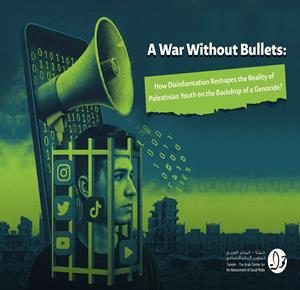
The position paper, titled “A War Without Bullets: How Disinformation Reshapes the Reality of Palestinian Youth on the Backdrop of a Genocide?” argues that information manipulation has evolved into a parallel battlefield alongside military operations, with far-reaching consequences for those consuming digital content.
According to the report, the Israeli government has deployed a sophisticated arsenal of digital tools since October 7, 2023, including artificial intelligence, paid propaganda, cyberattacks, fake accounts, algorithmic manipulation, and press censorship. These tactics create what 7amleh describes as a “distorted reality” designed to reshape truth and provide legitimacy for military actions.
The Arab Center for the Advancement of Social Media, which published the findings, identifies several strategic goals behind the disinformation campaigns. These include dehumanizing Palestinians by portraying them as perpetual threats, manufacturing moral justifications for military operations, bolstering internal Israeli support, and deflecting criticism from political and military leadership decisions.
The research highlights how disinformation has been weaponized to fragment Palestinian and Arab societies while simultaneously controlling international media narratives. The paper points to numerous examples of fabricated and AI-generated content depicting Israel as a “humanitarian actor” while allegedly concealing evidence of potential war crimes.
Palestinian youth face particularly severe consequences from this information war, according to the study. False information about “safe zones” and “humanitarian corridors” has reportedly led to life-threatening decisions for civilians seeking safety. Beyond immediate physical danger, the psychological impact includes heightened fear, confusion, and erosion of trust in media institutions and technology platforms.
“The war on truth is not a side effect of the war on the ground—it is a condition for its continuation,” said Nadim Nashif, General Director of 7amleh. “When algorithms control what we see and hear, disinformation becomes a weapon that strikes awareness before the body. Protecting Palestinian youth today means protecting their right to knowledge and their ability to tell their own reality without bias or digital repression.”
The digital rights organization argues that disinformation has undermined what they term “epistemic justice” for Palestinians by diminishing their credibility in global media while amplifying Israeli narratives in international forums.
To counter these challenges, 7amleh proposes a multi-faceted approach, starting with enhanced media literacy and critical digital education among Palestinian youth. The organization also calls for reformed legal frameworks to hold accountable those producing or spreading false information during conflicts.
The paper urges increased pressure on technology companies to address algorithmic biases, protect Palestinian digital rights, and develop tools to monitor coordinated disinformation campaigns. It recommends stronger cooperation between tech platforms, human rights organizations, and fact-checking networks, while also preventing arbitrary account suspensions of Palestinian users.
For media organizations, 7amleh emphasizes the need for rigorous verification standards, ongoing training in detecting conflict-related disinformation, careful scrutiny of military claims, and ensuring Palestinian sources are central to coverage.
The study concludes that the Gaza conflict has revealed disinformation as a powerful mechanism for controlling public perception and narrative framing. Protecting Palestinians, according to 7amleh, requires safeguarding their voices and right to knowledge in an environment where information control has become a strategic military objective.
Fact Checker
Verify the accuracy of this article using The Disinformation Commission analysis and real-time sources.
