


Listen to the article
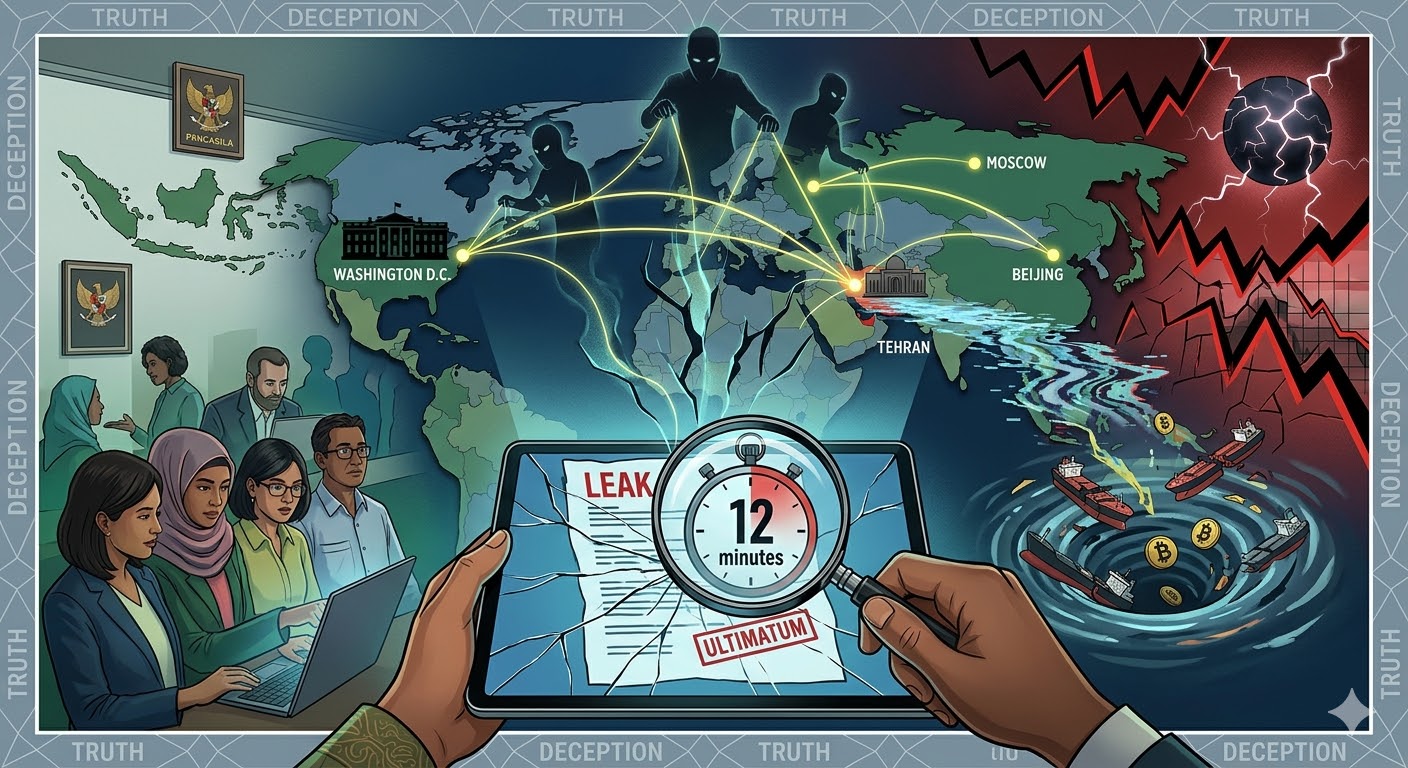
In an era increasingly dominated by information warfare, experts are warning about a viral document claiming to detail an Iranian ultimatum that has unsettled energy markets and cryptocurrency communities worldwide. Analysis reveals the document titled “Gulf Crisis 2026: The Twelve-Minute Ultimatum” bears hallmarks of sophisticated disinformation rather than genuine intelligence.
Security analyst Abas Tohar from Mitra Buana Internasional’s Strategic Observatory has identified the document as “black propaganda” – disinformation that strategically combines factual elements with engineered fiction to simulate a crisis and manipulate public perception.
“This is a textbook example of an engineered crisis,” Tohar explains in his detailed assessment of the viral narrative, which alleges that Mojtaba Khamenei issued an ultimatum to the United States demanding $500 billion in compensation with a 30-day deadline and threats to close the Strait of Hormuz.
The document contains several red flags that expose its fabricated nature. While Iran’s leadership has indeed entered a new phase with confrontational rhetoric toward Washington, the overly specific details in the viral narrative – from precise financial demands to rigid timelines – signal what Tohar calls “amplified fabrication.”
Another inconsistency lies in the document’s procedural claims. “The suggestion that the United States would negotiate under such an ultimatum via Swiss or Omani channels contradicts fundamental principles of Washington’s strategic doctrine,” Tohar notes. “Compliance with public ultimatums would irreparably damage hegemonic credibility.”
The document’s references to specific market reactions – Brent crude supposedly surpassing $121 and Bitcoin allegedly plunging by 22 percent – appear designed to trigger financial panic and potentially create self-fulfilling market movements.
Disinformation experts identify several sophisticated techniques employed in the document, including the “truth sandwich” method, where accurate details about diplomatic mediators and U.S. officials are placed between layers of falsehood to enhance credibility.
The narrative also leverages the psychological tendency to trust “leaked” information over official statements, citing a purported “Washington Post leak” as its source. Meanwhile, claims of a “12-hour silence from the White House” represent what analysts call “weaponized uncertainty” – deliberately prolonging tension despite the fact that U.S. strategic communication typically addresses such situations within minutes.
From a geopolitical perspective, the document contains logical inconsistencies. Its suggestion that Russia and China would support closing the Strait of Hormuz defies strategic logic, as China depends heavily on Gulf energy flows and would effectively be undermining its own interests by supporting such an action.
For countries like Indonesia, this wave of disinformation presents both challenges and opportunities. While Indonesia possesses diplomatic credibility as a non-aligned nation, uneven public digital literacy creates vulnerabilities. Tohar suggests Indonesia could position itself as a credible information mediator within the Global South, but warns that narrative manipulation threatens to destabilize domestic markets and public opinion.
The incident highlights the growing importance of national information security architecture, particularly in strategic communication and digital diplomacy. As information warfare intensifies globally, the ability to identify and counter disinformation becomes increasingly vital for national security.
“The ’12-Minute Ultimatum’ reminds us that in future geopolitics, the most potent weapons may not be ballistic missiles, but narratives capable of paralyzing public rationality,” Tohar concludes. “Methodological skepticism is not cynicism, but intellectual vigilance.”
Financial analysts recommend investors exercise caution when making decisions based on dramatic geopolitical claims, particularly those without verification from multiple credible sources.
Fact Checker
Verify the accuracy of this article using The Disinformation Commission analysis and real-time sources.

16 Comments
I’m glad the experts were able to identify this as a disinformation campaign. With tensions high between Iran and the US, it’s crucial that we don’t get swept up in false narratives that could further escalate the situation. Fact-based analysis is key.
Absolutely, the level of detail in this forged document is quite alarming. It’s a good reminder to always verify sources and information, especially on sensitive geopolitical issues that could impact energy and financial markets.
This is a prime example of why we need to be so cautious about information, especially around sensitive geopolitical and economic topics. The ability of bad actors to create such sophisticated disinformation campaigns is truly concerning. Careful analysis is key to avoiding falling for these traps.
This is a concerning example of how disinformation can be used to create a false sense of crisis and manipulate public opinion. I appreciate the detailed analysis provided, which helps shed light on the techniques used. Staying vigilant against these tactics is so important.
Interesting analysis of this apparent disinformation campaign. It’s concerning how sophisticated these fabricated narratives can be, combining real elements with fiction to manipulate public perception. Fact-checking and critical thinking are so important to avoid falling for such engineered crises.
Absolutely, the level of detail in this forged document is quite alarming. It’s a good reminder to always verify sources and information, especially on sensitive geopolitical issues that could impact energy and financial markets.
Interesting analysis of this apparent disinformation campaign. It’s concerning how sophisticated these fabricated narratives can be, combining real elements with fiction to manipulate public perception. Fact-checking and critical thinking are so important to avoid falling for such engineered crises.
Absolutely, the level of detail in this forged document is quite alarming. It’s a good reminder to always verify sources and information, especially on sensitive geopolitical issues that could impact energy and financial markets.
The experts’ assessment of this document as ‘black propaganda’ is really insightful. The combination of factual elements with fabricated details is a common disinformation tactic designed to seem credible. Kudos to the analysts for exposing the true nature of this viral narrative.
Absolutely, the level of specificity in the ultimatum claims is a red flag. It’s crucial that we don’t let ourselves get swept up in these kinds of engineered crises, no matter how convincing they may seem at first glance.
I’m glad the experts were able to identify this as a disinformation campaign. With tensions high between Iran and the US, it’s crucial that we don’t get swept up in false narratives that could further escalate the situation. Fact-based analysis is key.
Agreed. Disinformation poses a serious threat, especially around critical infrastructure and resources like energy. Careful scrutiny is required to separate truth from fiction and avoid unintended consequences.
The experts’ assessment of this document as ‘black propaganda’ is really insightful. The combination of factual elements with fabricated details is a common disinformation tactic designed to seem credible. Kudos to the analysts for exposing the true nature of this viral narrative.
Absolutely, the level of specificity in the ultimatum claims is a red flag. It’s crucial that we don’t let ourselves get swept up in these kinds of engineered crises, no matter how convincing they may seem at first glance.
This is a concerning example of how disinformation can be used to create a false sense of crisis and manipulate public opinion. I appreciate the detailed analysis provided, which helps shed light on the techniques used. Staying vigilant against these tactics is so important.
This is a prime example of why we need to be so cautious about information, especially around sensitive geopolitical and economic topics. The ability of bad actors to create such sophisticated disinformation campaigns is truly concerning. Careful analysis is key to avoiding falling for these traps.