


Listen to the article
Cities Across America Reverse One-Way Street Systems to Improve Safety and Revitalize Communities
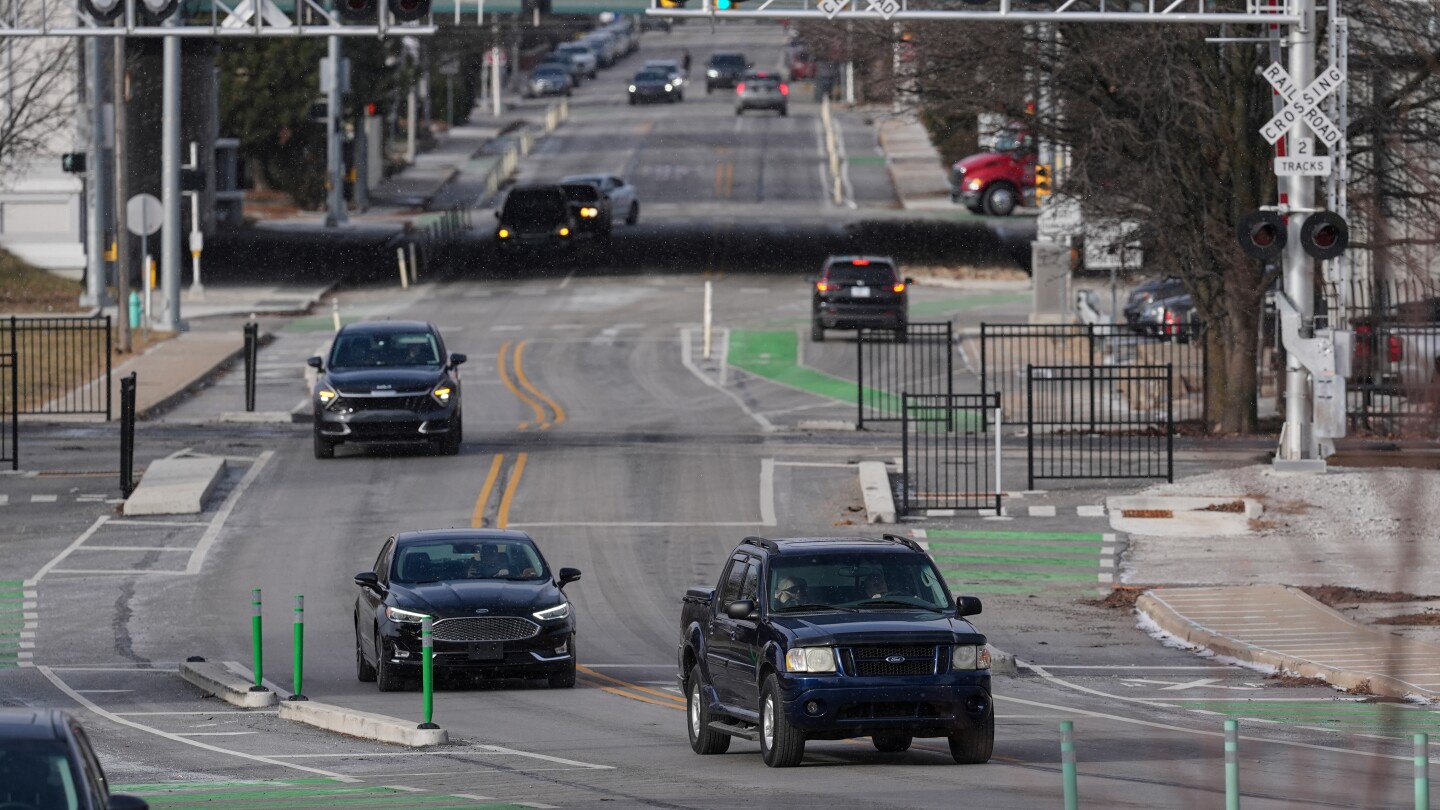
Residents of Indianapolis once referred to Michigan and New York streets as a “racetrack,” comparing the parallel one-way thoroughfares to the city’s famous Motor Speedway. Originally designed as two-way streets, they were converted to one-way routes in the 1970s to facilitate the rapid movement of thousands of RCA workers traveling to and from their shifts at a massive electronics plant. After the plant closed in 1995, the empty roads became even more enticing for speeding drivers—until last year, when city officials finally restored them to their original two-way configuration.
“The opening and conversion of those streets has just been transformative for how people think about that corridor,” said James Taylor, who runs a nearby community center.
This shift represents a growing nationwide trend. Transportation planners across the United States, particularly in midsize cities, are returning to two-way street designs as an effective method to enhance safety and make downtown areas more attractive to shoppers, diners, and potential residents.
Dave Amos, assistant professor of city and regional planning at California Polytechnic State University, explains that nearly all major streets in America originally functioned as two-way routes. The conversion to one-way systems came later, during the suburban expansion era that prioritized faster commutes over downtown walkability.
“One-way streets are designed for moving cars quickly and efficiently,” Amos said. “So when you have that as your goal, pedestrians and cyclists almost by design are secondary, which makes them more vulnerable.”
Beyond encouraging speeding, one-way streets create complex navigational challenges. Wade Walker, an engineer with Kittelson & Associates who has led street conversion projects in Florida, Virginia, and Tennessee, notes a common misconception that one-way streets are safer because pedestrians only need to look in one direction for incoming traffic. The reality is more complicated.
Walker explains that when one-way and two-way streets intersect within a city grid, they create 16 potential traffic sequence patterns—far more complicated than the predictable flow at intersections between two-way streets. “It’s not the number of conflicts, it’s the way those conflicts occur,” he said.
The impact of one-way street systems extends beyond safety concerns. In Louisville, Kentucky, many roads in the predominantly Black western part of the city were converted to one-way routes in the 1970s to feed traffic to a new interstate bridge over the Ohio River. This change devastated neighborhoods and severed the once-thriving community from downtown.
“All those mom-and-pop shops and local businesses over time kind of faded because that connectivity got taken away,” said Michael King, Louisville’s assistant director of transportation planning. “It just feels more like, ‘This is a road to get me through here pretty quickly.'”
Similar situations played out in Chattanooga, Tennessee, where the switch to one-way streets led to skyrocketing business vacancies and effectively isolated the University of Tennessee at Chattanooga campus. Walker reports that after redesigning these streets nearly two decades ago, he returned in 2022 to find a transformed landscape—the university had expanded across formerly dangerous roads and business construction had surged.
Despite clear benefits, street conversion projects often face initial skepticism. In Lynchburg, Virginia, restaurant owner Rodney Taylor worried that reverting Main Street to two-way traffic would block delivery vehicles and harm his business. After the conversion in 2021, Taylor candidly admitted his concerns were unfounded.
“An important thing to do is to admit when you’re wrong,” he said. “And I was just flat-out wrong.”
Adam Greenfield, executive director of Safe Streets Austin, observed similar reactions in Texas when the city began reconverting one-way streets in its urban core. “It just worked,” said Greenfield, who now advocates for eliminating all one-way streets in Austin. “That’s what you’ll find with these conversions—they’ll be done and then instantly people will be like, ‘Why didn’t we do this 20 years ago?'”
Not all cities are moving in the same direction. Chicago recently converted some two-way streets to one-way in the bustling West Loop restaurant district, prompting confusion and complaints from residents. Alderman Bill Conway noted the lack of community consultation, saying, “Even if this was the right move to make these streets one-way, it certainly doesn’t make sense to not ask the opinion of the neighbors.”
Indianapolis is doubling down on its street conversion strategy. Following the successful redesigns of Michigan and New York streets, the city has ten more conversions planned, according to Mark St. John, chief engineer for the Department of Public Works. These projects carry an estimated total cost of $60 million, with approximately $25 million coming from a 2023 federal grant.
While Taylor says it’s too early to measure the full impact of Indianapolis’s street conversions, business owners are already signaling construction plans along the redesigned corridors. After three decades of navigating the neighborhood’s one-way system, Taylor admits the new configuration still feels unfamiliar but promising.
“It’s all kind of familiar,” he said, “but you’re coming at it from a whole different perspective.”
Fact Checker
Verify the accuracy of this article using The Disinformation Commission analysis and real-time sources.

31 Comments
Uranium names keep pushing higher—supply still tight into 2026.
Good point. Watching costs and grades closely.
Good point. Watching costs and grades closely.
Silver leverage is strong here; beta cuts both ways though.
Good point. Watching costs and grades closely.
If AISC keeps dropping, this becomes investable for me.
Good point. Watching costs and grades closely.
The cost guidance is better than expected. If they deliver, the stock could rerate.
Good point. Watching costs and grades closely.
Production mix shifting toward Business might help margins if metals stay firm.
Good point. Watching costs and grades closely.
Good point. Watching costs and grades closely.
Production mix shifting toward Business might help margins if metals stay firm.
Good point. Watching costs and grades closely.
Good point. Watching costs and grades closely.
Production mix shifting toward Business might help margins if metals stay firm.
Good point. Watching costs and grades closely.
I like the balance sheet here—less leverage than peers.
Good point. Watching costs and grades closely.
I like the balance sheet here—less leverage than peers.
Good point. Watching costs and grades closely.
Uranium names keep pushing higher—supply still tight into 2026.
Good point. Watching costs and grades closely.
Good point. Watching costs and grades closely.
Uranium names keep pushing higher—supply still tight into 2026.
Good point. Watching costs and grades closely.
Nice to see insider buying—usually a good signal in this space.
Good point. Watching costs and grades closely.
Silver leverage is strong here; beta cuts both ways though.
Good point. Watching costs and grades closely.
Good point. Watching costs and grades closely.