


Listen to the article
Chinese Military Flights Near Taiwan Drop Dramatically, Puzzling Analysts
A notable decline in Chinese military aircraft flying toward Taiwan has left security experts questioning Beijing’s intentions, introducing a new element of uncertainty in an already tense region.
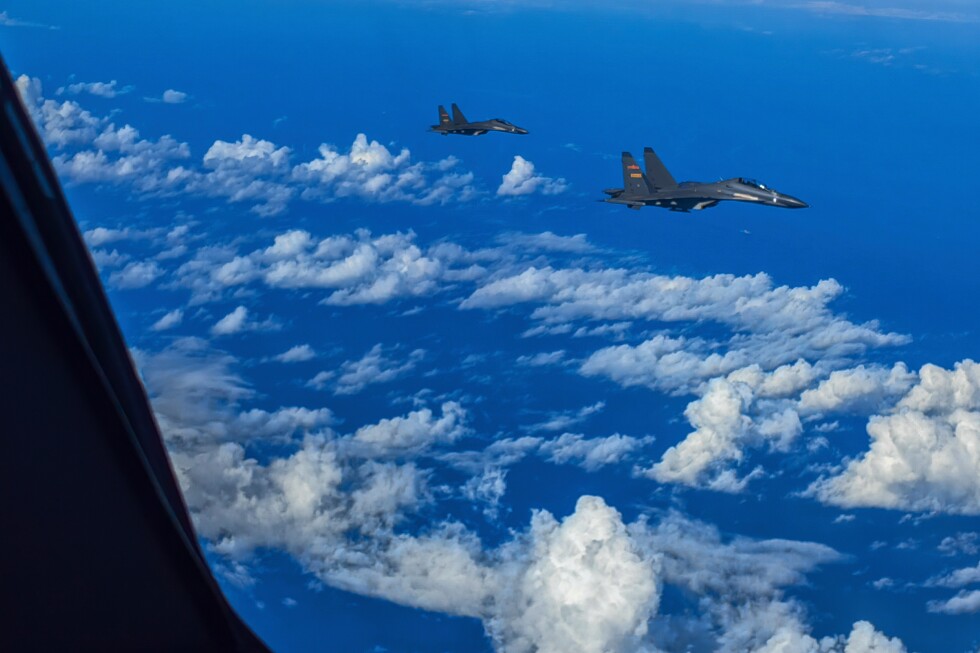
Over the years, China has conducted regular military flights toward Taiwan, the self-governing island it claims as its territory. These operations have consistently raised concerns from Taipei to Washington. However, recent weeks have seen an unexpected and sharp reduction in these flights, creating a strategic puzzle for regional observers.
“There are so many theories and the lack of understanding of China’s intentions is what’s disconcerting,” said Drew Thompson, a former U.S. defense official now serving as a senior fellow at Singapore’s S. Rajaratnam School of International Studies. “You fill the void with uncertainty, and uncertainty increases risk.”
The decline has been particularly pronounced since late February. Taiwan’s Defense Ministry, which issues daily reports on Chinese military activities around the island, has frequently omitted its usual maps showing flight paths—simply because there were no flights to report.
From February 27 to March 5, Taiwan detected no Chinese military aircraft in its Air Defense Identification Zone for seven consecutive days. After briefly detecting two planes on March 6, another four-day stretch passed without activity. Only in the past two days have flights resumed, with three aircraft detected on Wednesday and two on Thursday, bringing the two-week total to just seven flights. During the same period last year, Taiwan recorded 92 such incursions.
The timing of this reduction coincided with the annual session of China’s National People’s Congress, and while military activities have historically decreased during major political events and holidays, this year’s drop is unusually steep.
“That alone would not be the only or primary reason for sorties dropping to zero,” noted K. Tristan Tang, a Taipei-based nonresident fellow at the National Bureau of Asian Research.
Some analysts suggest the decline might reflect Beijing’s desire to ease tensions ahead of U.S. President Donald Trump’s upcoming visit to China, scheduled for March 31 to April 2. However, Thompson emphasized that cross-strait issues may not be Trump’s primary concern.
“Trump sees China as an economic negotiation, not as a security challenge,” Thompson explained.
The United States has consistently opposed any forceful change to Taiwan’s status. China maintains that the democratically governed island of 23 million people must eventually come under Beijing’s control, while the U.S. position emphasizes a peaceful resolution to cross-strait issues.
Tang believes the reduction may signal a shift in China’s military strategy rather than a political calculation. He suggests that the People’s Liberation Army (PLA) could be exploring new models for joint training between its air force, navy, and possibly ground forces.
“Such exploratory activity would likely be conducted away from Taiwan to prevent other countries from monitoring it,” Tang noted, which might explain the reduced presence of Chinese aircraft near Taiwan.
Despite the decrease in aerial activity, Taiwan’s military remains vigilant. Defense Minister Wellington Koo pointed out that China’s naval presence in nearby waters has remained active even as air operations have diminished.
“We cannot rely solely on a single symptom like the absence of PLA aircraft to make a judgment,” Koo told journalists. “We will continue to closely monitor the PLA’s movements.”
The unexpected shift in Chinese military behavior highlights the complex and often opaque nature of strategic signaling in the Taiwan Strait. Whether the reduction represents a temporary tactical adjustment, a strategic recalibration, or merely operational factors remains unclear.
What is certain is that all parties in the region continue to watch closely, aware that in the delicate balance of cross-strait relations, patterns can shift quickly and unexpectedly.
Fact Checker
Verify the accuracy of this article using The Disinformation Commission analysis and real-time sources.
