


Listen to the article
Federal investigators are working to determine the cause of a deadly collision between an Air Canada regional jet and a fire truck at New York’s LaGuardia Airport that killed two pilots and injured dozens.
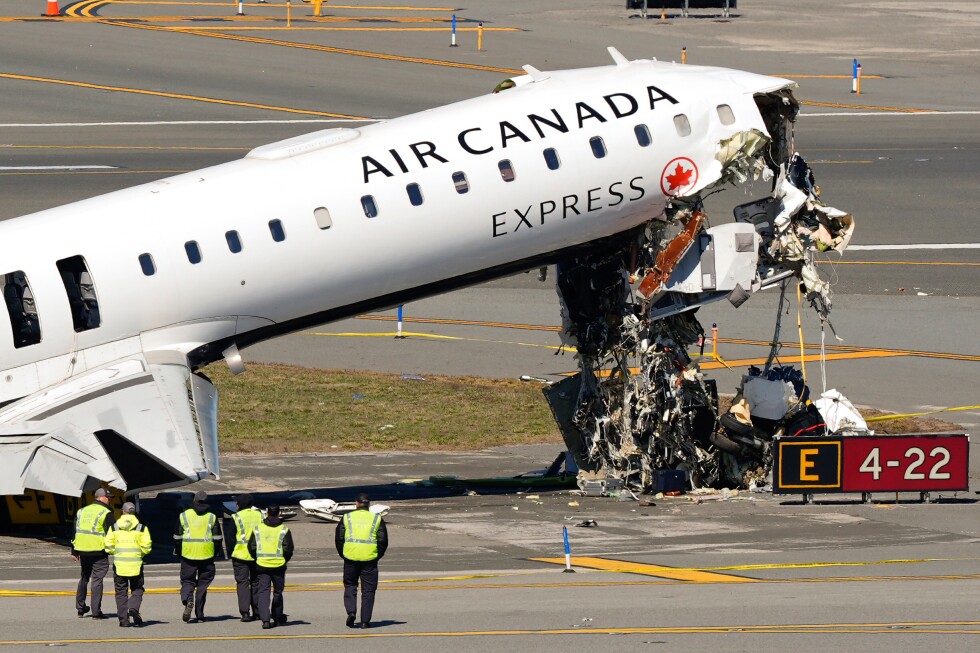
The accident occurred around 11:37 p.m. Sunday when the flight arriving from Montreal struck an airport fire truck that was crossing the runway to investigate an unusual odor reported on another aircraft. The impact crushed the cockpit, sheared off the plane’s nose and rolled the fire truck onto its side.
LaGuardia was unusually busy that night due to flight delays. According to aviation analytics firm Cirium, the airport handled nearly 70 takeoffs and landings after 10 p.m. — more than double the 31 scheduled operations. Planes continued landing every few minutes in misty, somewhat foggy conditions.
National Transportation Safety Board investigator Doug Brazy revealed that approximately 20 seconds before the collision, air traffic control cleared the truck to cross the runway. About 11 seconds later, a controller began repeatedly ordering the truck to stop. It remains unclear whether the driver heard these instructions. Audio recordings later captured an unnamed controller saying: “I messed up.”
The two confirmed fatalities were the pilot and co-pilot. Though officials haven’t formally released their names, a family member identified one of the deceased as Antoine Forest. Around 40 passengers were taken to hospitals with varying degrees of injuries. Two emergency responders in the fire truck were also injured.
While most injured passengers were quickly released from hospitals, some remain under care, including a flight attendant who was thrown from the aircraft. According to her daughter, she was found still strapped to her seat several yards from the wreckage.
NTSB Chair Jennifer Homendy emphasized that major accidents rarely result from a single failure. “We rarely, if ever, investigate a major accident where it was one failure,” she noted during a Tuesday news conference.
Investigators plan to analyze the plane’s cockpit and flight data recorders, interview air traffic controllers and firefighters, and examine various factors including control tower staffing and collision-prevention systems.
The Federal Aviation Administration had encouraged airports with runway alert systems to install transmitters in airport vehicles. While some airports have implemented these devices, LaGuardia’s system tracked the truck via radar and failed to produce an alert during the incident.
LaGuardia does have multiple runway safety measures in place, including pavement lights that turn red when aircraft are approaching to warn vehicles. These lights were reportedly functioning at the time of the crash. The control tower also provides a physical view of the runway.
Staffing in the tower may be examined as part of the investigation. Two controllers were working at the time, covering what are typically four different positions — a common practice during overnight shifts at U.S. airports. Investigators will assess whether this arrangement is appropriate for a busy facility like LaGuardia.
Although the NTSB has previously raised concerns about fatigue during overnight shifts in control towers, Homendy stated there’s no indication thus far that it was a factor in Sunday’s collision. Canadian authorities have also sent investigators to participate in the inquiry.
The crash forced LaGuardia — one of America’s 20 busiest airports — to shut down completely. One runway reopened Monday afternoon, but operations remained limited on Tuesday, with approximately 25% of scheduled flights canceled and significant delays continuing.
This incident adds to the challenges facing U.S. air travel, which has already been dealing with long security lines amid ongoing disagreements over Department of Homeland Security funding. While this funding dispute doesn’t directly affect air traffic controllers, who work under the Department of Transportation, the controller workforce has faced its own difficulties in recent years, including chronic staffing shortages that have led to increased overtime in an already stressful profession.
U.S. Transportation Secretary Sean Duffy described LaGuardia’s tower as generally “well-staffed” despite these industry-wide challenges.
Fact Checker
Verify the accuracy of this article using The Disinformation Commission analysis and real-time sources.

8 Comments
This is a tragic incident. My condolences to the families of the pilots who lost their lives. It’s concerning to hear that the airport was unusually busy that night, which may have contributed to the accident. I hope the NTSB investigation can shed light on what happened and lead to improvements in runway safety protocols.
This is a sobering reminder of the risks that airport ground operations can pose. My heart goes out to the loved ones of those who lost their lives. I’m hopeful the NTSB inquiry will uncover ways to strengthen runway safety procedures and prevent such devastating accidents from happening again.
You’re absolutely right. Even with all the advanced technologies in modern aviation, human factors and communication breakdowns can still lead to tragic outcomes. The NTSB will need to leave no stone unturned in its investigation to identify any systemic issues that need to be addressed.
While the details are still emerging, this incident highlights the importance of robust safety systems and procedures at major airports. I hope the NTSB can identify any gaps or areas for improvement to prevent similar tragedies in the future. Aviation safety should always be the top priority.
Agreed. Maintaining high safety standards is critical, especially at busy hubs like LaGuardia. The investigators will need to thoroughly examine all the factors that led to this collision, from air traffic control protocols to vehicle operator training. Enhancing runway safety should be the key focus going forward.
Runway incursions are a major aviation safety issue. I’m curious to learn more about the factors that led to the air traffic controller clearing the fire truck to cross the active runway. Proper communication and coordination between ground vehicles and aircraft is crucial to prevent these types of collisions.
You make a good point. The audio recordings will be key evidence in determining if there were any breakdowns in communication or procedures that allowed the collision to occur. Hopefully the investigation uncovers lessons that can be applied to enhance runway safety at airports worldwide.
As an aviation enthusiast, this incident is deeply concerning. Runway incursions are one of the biggest threats to flight safety. I’m curious to learn more about the specific circumstances that allowed the fire truck to enter the active runway, especially given the busy traffic conditions that night. Improving coordination between ground crews and air traffic control will be crucial.