


Listen to the article
Vietnam’s Communist Party Begins Critical Leadership Congress Amid Economic Ambitions
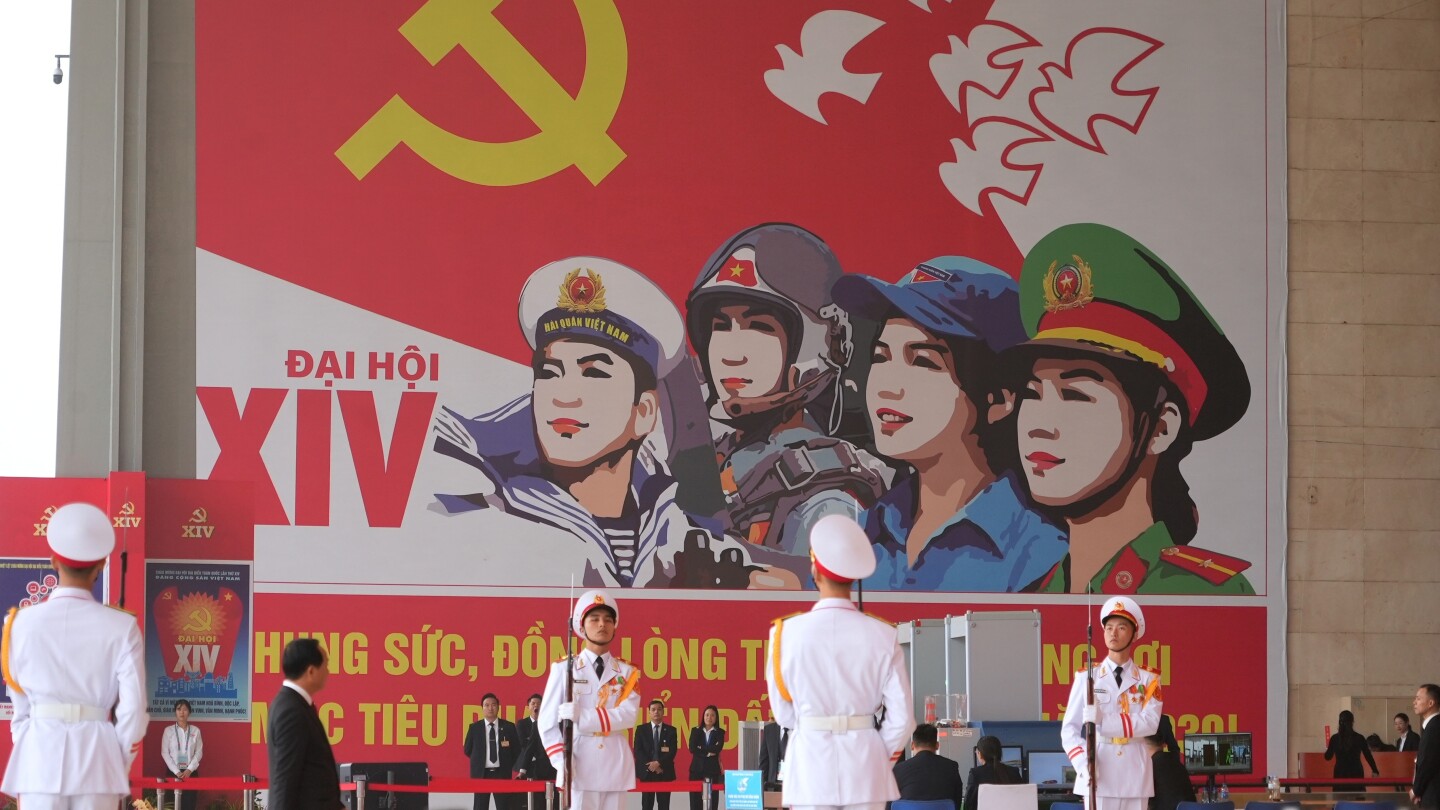
Vietnam’s ruling Communist Party launched its highly anticipated National Congress in Hanoi on Monday, bringing together 1,588 delegates from across the country for the party’s most significant political gathering. The quinquennial event will determine Vietnam’s leadership and policy trajectory through 2031 during a period of increasing global economic uncertainty.
The week-long Congress follows a tightly orchestrated process where delegates will elect approximately 200 members to the party’s Central Committee, which will subsequently appoint 17 to 19 members to the influential Politburo—the country’s supreme decision-making body.
Beyond leadership selection, the Congress comes at a pivotal moment for Vietnam as it pursues its ambitious goal of becoming a high-income economy by 2045 while navigating intensifying U.S.-China tensions and a fragmenting global economic landscape.
Current Communist Party General Secretary To Lam is widely expected to secure confirmation for a full five-year term. Political analysts and diplomats anticipate he may consolidate power by combining the roles of party chief and state president, mirroring the leadership model in neighboring China under Xi Jinping and in Laos.
Such a move would represent a significant departure from Vietnam’s traditional “four pillars” governance system, where power is distributed among the party chief, president, prime minister, and National Assembly chair. Consolidating these positions would make To Lam the most powerful Vietnamese leader in decades.
To Lam, who rose through the ranks of the Ministry of Public Security before becoming its minister in 2016, has already initiated Vietnam’s most ambitious bureaucratic and economic reforms since the country’s economic liberalization in the late 1980s. His reform agenda includes eliminating tens of thousands of public sector jobs, streamlining administrative boundaries, and launching major infrastructure projects across the country.
He also continued the high-profile anti-corruption campaign championed by his predecessor, Nguyen Phu Trong. During this campaign, the Politburo lost six of its 18 members, including two former presidents and Vietnam’s parliamentary head.
Political analysts identify two main factions within the party: To Lam’s group, aligned with the Ministry of Public Security, and a more conservative military-aligned faction. Nguyen Khac Giang, a Vietnam Studies fellow at Singapore’s ISEAS-Yusof Ishak Institute, notes that conservatives harbor concerns about Lam’s reform agenda, fearing Vietnam could “go astray” from its socialist principles.
The Congress is expected to finalize a resolution targeting ambitious annual GDP growth of 10% or more from 2026 to 2030—a significant increase from the 6.5-7.0% growth target set for the current period. Vietnam’s economy grew by 8% in 2025, demonstrating the country’s resilience despite global economic headwinds.
To achieve its high-income ambitions, Vietnam is prioritizing industrial upgrading, modernizing production, and increasing reliance on technology and digital tools. A notable example is military-run Viettel’s recent groundbreaking of Vietnam’s first semiconductor chipmaking plant, scheduled to begin trial production by 2027—part of Hanoi’s strategy to build high-tech capacity and reduce dependence on foreign suppliers.
The draft resolution notably describes the private sector as “one of the most important driving forces of the economy,” signaling a potential shift away from state-owned enterprise dominance. Analysts suggest To Lam may deepen this approach by giving large private conglomerates greater roles in major national projects.
The document also elevates “foreign affairs and international integration” to the same priority level as national defense and security, highlighting Vietnam’s dependence on global markets as an export-driven economy. Environmental protection has also been designated a “central” task alongside economic and social development—a significant shift for a country where rapid industrialization has contributed to serious air pollution and environmental challenges.
As the Congress proceeds through the week, international observers and investors will closely monitor leadership appointments and policy directions that will shape Vietnam’s economic and political landscape for years to come.
Fact Checker
Verify the accuracy of this article using The Disinformation Commission analysis and real-time sources.

12 Comments
With the party congress, Vietnam has a chance to chart its economic future and solidify its global standing. But the leadership selection process and policy decisions will be closely watched, especially as US-China tensions simmer.
Vietnam will need to carefully balance its relationships and economic interests amid the great power competition. Managing this will be crucial for its continued growth and development.
Becoming a high-income economy by 2045 is an ambitious goal for Vietnam. The party congress will set the stage, but executing on this vision in a turbulent global environment will be the true test.
Diversifying trade and investment ties beyond just the US and China will be key for Vietnam to achieve its economic aspirations. Navigating these geopolitical waters skillfully will be critical.
As Vietnam seeks to become a high-income economy, the party congress will be a crucial inflection point. The country’s choices on economic policy, geopolitical positioning, and governance will reverberate well beyond its borders.
Vietnam’s success or struggles in navigating this transition will be closely watched, with implications for the broader Southeast Asian region and global economic dynamics.
Interesting to see Vietnam’s leadership jockeying for position at this critical economic and geopolitical juncture. Consolidation of power by the party chief could signal a more authoritarian approach, but may also provide stability as Vietnam navigates the complex global landscape.
Agreed, Vietnam’s economic ambitions and delicate balance between the US and China will be critical factors in how this leadership transition plays out.
The concentration of power in the party chief role raises some concerns about democratic accountability, but may also provide the clarity of direction Vietnam needs to achieve its ambitious goals.
Striking the right balance between economic growth, political stability, and human rights will be a delicate challenge for Vietnam’s leadership in the years ahead.
This party congress comes at a pivotal moment for Vietnam, with major economic and leadership decisions on the table. The outcome will shape the country’s trajectory for years to come.
Vietnam’s ability to maintain stability and steady growth amid global uncertainties will be closely watched. Its success or struggles could have ripple effects across the region.