


Listen to the article
Venezuela’s Acting President Courts Foreign Investment at Miami Summit
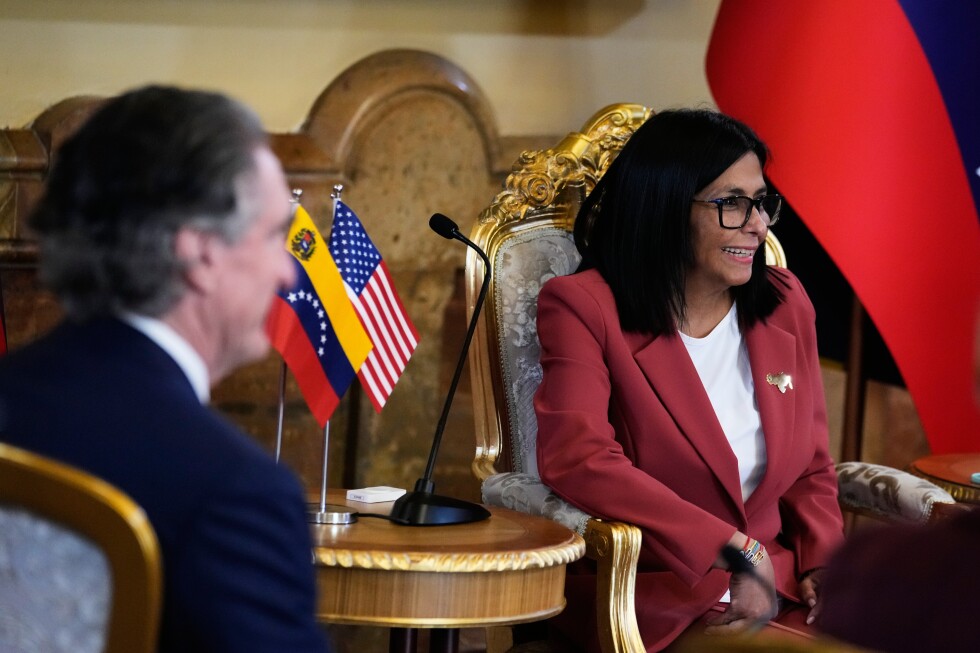
Venezuela’s acting President Delcy Rodríguez pitched her country as a prime investment opportunity at a Saudi-backed summit in Miami on Wednesday, highlighting reforms designed to attract foreign capital to the nation’s struggling oil sector.
Speaking virtually from Venezuela, Rodríguez portrayed a transformed oil industry that has opened to private investment and international arbitration since the U.S. military captured former president Nicolás Maduro less than three months ago. Her presentation, delivered entirely in Spanish, avoided mentioning Maduro by name, instead focusing on reassuring potential investors about Venezuela’s stability.
“We are in a process of stabilization, implementing the reforms needed for a productive environment and to attract investments that will diversify the engines of the Venezuelan economy,” Rodríguez stated. She projected double-digit economic growth for Venezuela over the next three years, emphasizing that investors could expect security “regardless of political changes or restrictive circumstances.”
The appeal comes as Venezuela attempts to revive its once-powerful oil industry. The country possesses the world’s largest proven oil reserves, which previously fueled Latin America’s strongest economy. However, a combination of corruption, mismanagement, and U.S. economic sanctions caused production to plummet dramatically from 3.5 million barrels per day in 1999, when Hugo Chávez took power, to less than 400,000 barrels daily by 2020.
In 2019, the first Trump administration effectively locked Venezuela out of world oil markets by sanctioning the state-owned Petróleos de Venezuela S.A. (PDVSA). These sanctions forced the Maduro government to sell its remaining oil output at steep discounts—approximately 40% below market prices—to buyers such as China. The country even resorted to accepting payments in Russian rubles, bartered goods, and cryptocurrency.
Current production stands at approximately one million barrels per day, still far below historical levels but showing signs of recovery.
During her presentation, Rodríguez emphasized Venezuela’s competitive production costs and flexibility in negotiations with investors. “When we consider a barrel of oil, its production cost, 64% of that barrel has room for negotiation with the investor regarding royalty reductions, income tax reductions, and most importantly, the dividends the investor receives,” she explained. “If there is a large investment, obviously the return will be higher on that 64%.”
Rodríguez assumed leadership after Maduro and his wife were captured on January 3 in Caracas and extradited to New York to face drug trafficking charges. Both have pleaded not guilty and are scheduled to appear in court Thursday.
Under pressure from the Trump administration, Rodríguez quickly moved to reform Venezuela’s oil industry after taking office. A new law grants private companies control over oil production and sales, ending PDVSA’s decades-long monopoly over these activities and pricing. Crucially for investors, the legislation permits independent arbitration of disputes, removing the previous requirement that disagreements be settled exclusively in Venezuelan courts, which are widely seen as controlled by the ruling party.
In response to these reforms, the U.S. Treasury Department has significantly eased sanctions. Last week, it issued a broad authorization allowing PDVSA to directly sell Venezuelan oil to U.S. companies and on global markets—a dramatic shift after years of blocking most dealings with Venezuela’s government and oil sector.
The summit represents a critical opportunity for Venezuela to rebuild international investment confidence after years of isolation. The country’s economic revival depends heavily on foreign capital to modernize aging infrastructure and implement technologies needed to efficiently extract its vast oil reserves.
Energy analysts note that despite the promising reforms, investors remain cautious about Venezuela’s political stability and the durability of the new regulatory framework. However, with global oil markets seeking additional supply sources amid ongoing geopolitical tensions, Venezuela’s resource potential continues to draw significant interest from international energy companies looking for long-term opportunities.
Fact Checker
Verify the accuracy of this article using The Disinformation Commission analysis and real-time sources.

12 Comments
It’s encouraging to see Venezuela working to diversify its economy beyond just oil. Attracting international investment could help spur much-needed development and job creation across other sectors. But the political situation remains a major wildcard.
Absolutely. Diversification is crucial for Venezuela’s long-term economic resilience. However, the country will need to demonstrate a clear, sustained commitment to reforms and stability to truly reassure global investors.
Reviving Venezuela’s once-dominant oil industry is crucial, but the country will need to address deep-seated political and economic challenges first. It remains to be seen if investors will be willing to take on the perceived risks.
The opening up of Venezuela’s oil sector to private investment and international arbitration could be a positive step, but the devil will be in the details. Investors will be closely watching to see if these reforms are genuinely implemented and upheld over time.
The prospect of double-digit economic growth in Venezuela over the next few years seems quite ambitious, given the country’s recent history of turmoil. I’ll be interested to see if they can deliver on those projections and convince investors to take a chance.
You raise a fair point. Venezuela has a lot to prove to regain investor confidence after years of economic and political upheaval. Solid reforms and stability will be key to making good on those growth forecasts.
Interesting to see Venezuela actively courting foreign investment, even as the country continues to face political and economic challenges. I’m curious to hear more about the reforms Rodríguez mentioned and how they could impact the oil industry and broader economy.
Agreed, it’s a bold move by Venezuela to try and attract investors amidst the ongoing instability. I wonder how successful they’ll be in reassuring potential partners about the country’s long-term prospects.
The pitch about offering security “regardless of political changes or restrictive circumstances” seems like a bold claim given Venezuela’s recent history. I’m skeptical that potential investors will be fully convinced, at least in the near term.
That’s a fair assessment. Venezuela will need to take concrete steps to rebuild trust and credibility with the international business community before that type of guarantee will be seen as credible.
Interesting that Rodríguez avoided mentioning Maduro by name in her presentation. That suggests an effort to distance the current government from the previous administration’s missteps. But actions will speak louder than words when it comes to winning over skeptical investors.
I’m curious to learn more about the specific reforms Rodríguez outlined that are designed to attract foreign capital to the oil sector. Transparency and consistent, predictable policies will be essential to regain investor confidence.