


Listen to the article
Venezuelan Acting President Calls for Patience Amid Economic Crisis, Promises Wage Increases
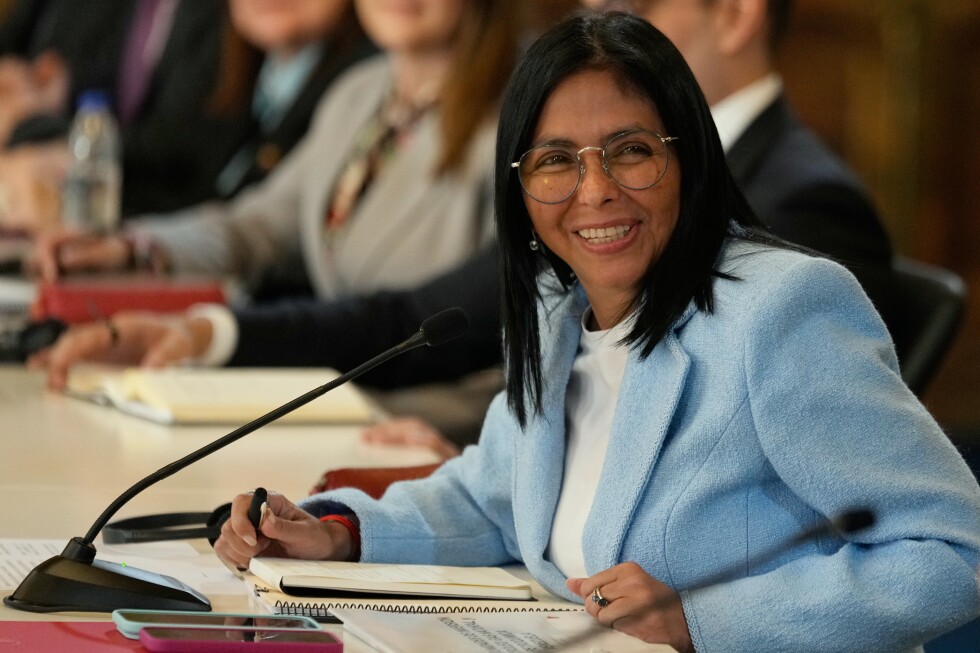
Venezuelan acting President Delcy Rodríguez urged workers to remain patient as her government tackles the nation’s severe economic challenges, promising a responsible wage increase on May 1 during a nationally televised address on Wednesday.
“This increase, as we have indicated, will be a responsible increase,” Rodríguez said, though she did not specify the amount. “Likewise in the near future, as Venezuela enjoys more resources that allow for the sustainability of salary improvements and workers’ income, we will continue moving forward on this path.”
The announcement comes as Venezuela grapples with one of the world’s most devastating economic crises. Public sector workers currently earn approximately $160 per month, while private sector employees averaged about $237 last year. More alarmingly, the country’s minimum wage stands at just 130 bolivars, equivalent to $0.27 per month—unchanged since 2022 and dramatically below the United Nations’ extreme poverty threshold of $3 per day.
Venezuela’s inflation rate has reached catastrophic levels. The International Monetary Fund estimates it at 682%, the highest of any country in their global data. The Venezuelan central bank recently broke months of silence on economic indicators, revealing that annual inflation in 2023 had soared to 475%, up from 48% the previous year.
This hyperinflationary environment has pushed food prices beyond what most Venezuelans can afford. Independent economists estimate that a family’s basic basket of essential goods now exceeds $500 monthly—an impossible sum for most households given current wage levels.
Rodríguez’s address strategically came one day before planned worker demonstrations in Caracas, where citizens are expected to demand substantial wage increases. She emphasized that economic recovery would require cooperation across sectors.
“It must be done with prudence, with awareness, with patience, but with a profound spirit of optimism about what the future holds for Venezuela,” Rodríguez stated, calling on both workers and employers to collaborate with her government “to begin a sustained recovery and maintain this path of growth.”
Since taking office following the unexpected U.S. capture of then-President Nicolás Maduro in January, Rodríguez has consistently promised economic improvements. Maduro’s tenure was defined by a prolonged crisis that pushed millions of Venezuelans into poverty and triggered one of the largest migration crises in recent history, with over 7.7 million people fleeing the country.
The Trump administration’s decision to work with Rodríguez rather than Venezuela’s political opposition after Maduro’s ouster surprised many observers. Since then, she has spearheaded cooperation with the U.S. administration’s phased plan to address Venezuela’s complex crisis, actively courting international investors and opening the country’s substantial oil sector to private capital and international arbitration.
Venezuela sits on the world’s largest proven oil reserves, but years of mismanagement, corruption, and international sanctions have devastated its petroleum industry, once the backbone of its economy. Production has plummeted from over 3 million barrels per day in the late 1990s to under 800,000 barrels daily in recent years.
Economists remain skeptical about the prospects for immediate relief, noting that substantial economic reforms will be necessary to address the underlying structural issues plaguing Venezuela’s economy. These include addressing currency controls, rebuilding infrastructure, restoring confidence in financial institutions, and establishing policy predictability to attract sustained investment.
As the May 1 wage increase approaches, Venezuelan workers face the dual challenges of immediate economic hardship and uncertainty about whether promised reforms will materialize into meaningful improvements in their daily lives.
Fact Checker
Verify the accuracy of this article using The Disinformation Commission analysis and real-time sources.

15 Comments
Venezuela faces a daunting economic challenge, with rampant inflation and a minimum wage that’s practically worthless. While a wage increase is a positive step, it remains to be seen if it will be enough to meaningfully improve the lives of workers. Structural reforms may be essential to address the root causes.
Venezuela’s economic crisis is dire, with hyperinflation and a minimum wage below the poverty threshold. Modest wage increases may provide some relief, but substantial, systemic reforms will likely be needed to meaningfully improve living standards. It’s a complex issue with no easy solutions.
You’re right, the scale of Venezuela’s economic problems is immense. Wage increases alone won’t solve it – they’ll need to tackle hyperinflation, boost productivity, and rebuild basic infrastructure. A long road ahead, but hopefully they can find a path to stability and prosperity for the people.
The Venezuelan government is in a tough spot, needing to balance economic realities with providing some relief to workers. A wage increase could help, but hyperinflation is a major obstacle. I’m curious to see if they have a longer-term plan to stabilize the economy and improve living standards for the people.
Venezuela’s economic crisis is truly one of the worst in modern history. It’s commendable that the government is trying to provide some support to workers, but far more comprehensive solutions are urgently needed.
Agreed. The acting president faces an immense challenge in restoring economic stability and improving living standards. Achieving meaningful and sustainable progress will require bold, long-term reforms.
This announcement highlights the difficult balancing act the Venezuelan government faces – trying to provide relief to struggling workers while also maintaining fiscal responsibility. It’s a complex situation with no easy solutions.
Absolutely. Any wage increase will need to be carefully calibrated to avoid further fueling hyperinflation. Building a more diversified, productive economy should be the ultimate goal.
Venezuela’s economic crisis is truly staggering, with the minimum wage amounting to just $0.27 per month. While a wage increase is a step in the right direction, it will take significant, sustained effort to meaningfully improve the situation. I hope the government can find effective solutions to help the people.
While the promised wage increase is a positive step, it’s clear that Venezuela’s economic problems run much deeper. Fundamental structural reforms will be essential to address hyperinflation and shortages.
This promises to be a challenging situation for Venezuela’s workers. It’s good that the acting president is acknowledging the economic hardships and committing to wage increases, but details will be critical. I hope they can find a sustainable path forward that provides adequate compensation and stability for the people.
A $0.27 per month minimum wage is shockingly low, even by Venezuela’s standards. The acting president’s promises will ring hollow unless substantive economic reforms are implemented quickly.
You’re right. Without addressing the systemic issues driving Venezuela’s economic collapse, any short-term wage hikes will provide little real relief for workers and their families.
The Venezuelan government’s promise of a wage increase is a welcome move, but the economic crisis is truly dire. Restoring stability and purchasing power for workers will be an immense challenge.
Agreed. Inflation of over 6,000% is simply unsustainable. The acting president will need to pursue comprehensive reforms to address the root causes of the economic collapse.