


Listen to the article
Asian Markets Rally Following U.S. Supreme Court’s Tariff Ruling, While Uncertainties Remain
Asian markets largely climbed on Monday as investors digested the U.S. Supreme Court’s decision to strike down most of President Donald Trump’s sweeping tariffs, though U.S. futures declined amid lingering policy uncertainties.
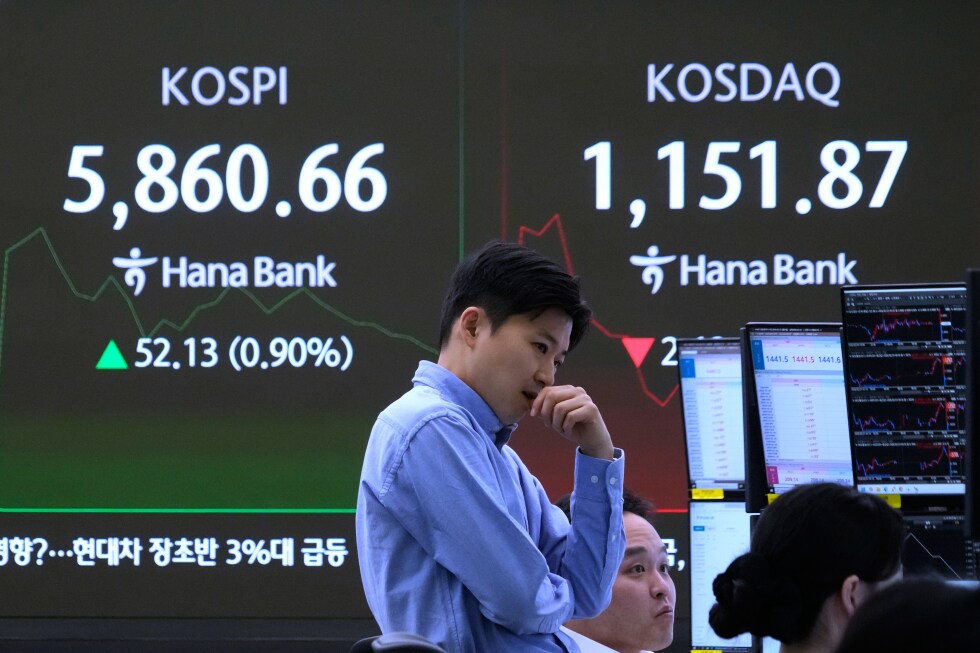
The Hong Kong Hang Seng index led regional gains, surging 2.2% to 27,003.47, while Taiwan’s Taiex jumped 1.4%. South Korea’s Kospi also posted a solid gain, rising 1.1% to 5,873.07. Tokyo’s markets were closed for a holiday.
Conversely, mainland Chinese shares bucked the regional uptrend, with the Shanghai Composite index falling 1.3% to 4,082.07. Australia’s S&P/ASX 200 also shed 0.4% to close at 9,041.00.
“The mixed reactions are highlighting the winners-and-losers effect of shifts in tariff policy that has just delivered a boost to countries who previously had a comparatively bad deal,” noted Benjamin Picton of Rabobank in a commentary. He added that “U.S. tariff policy will continue to be a source of uncertainty for markets as traders attempt to price in the implications of what is still a movable feast.”
U.S. equity futures pointed to a lower opening on Wall Street, with S&P 500 futures down 0.7%, Dow Jones Industrial Average futures dropping 0.6%, and Nasdaq futures falling 0.8%.
This followed Friday’s relatively calm response on Wall Street to the Supreme Court’s ruling, which had initially triggered significant market anxiety when the tariffs were announced last year. The S&P 500 rose 0.7% to 6,909.51, while the Dow added 0.5% to 49,625.97, and the Nasdaq composite gained 0.9% to 22,886.07.
Despite the court’s decision, tariffs aren’t disappearing from the policy landscape. Trump quickly responded to the ruling by announcing alternative approaches to imposing import taxes. “Just so you understand, we have tariffs, we just have them in a different way,” Trump told reporters, revealing plans to sign an executive order imposing a global tariff of 15% under a law that could limit it to 150 days.
The president also indicated he’s exploring additional tariff mechanisms through the Commerce Department, creating persistent uncertainty that has tempered market reactions.
On the corporate front, Akamai Technologies dropped 14.1% despite reporting stronger-than-expected results for late 2025. Investors were concerned by the cybersecurity firm’s lower-than-anticipated profit forecast for the upcoming year as it plans to increase spending on equipment and other investments—potentially signaling how AI-driven computer memory shortages are affecting businesses across the economy.
Recent economic data showing slowing U.S. growth alongside accelerating inflation has highlighted the Federal Reserve’s challenging position as it manages interest rate policy. Nevertheless, traders still expect at least two rate cuts this year, according to CME Group data, though Fed officials have indicated they want to see further inflation declines before supporting additional rate reductions.
In commodity markets, U.S. benchmark crude oil fell 53 cents to $65.95 per barrel, while Brent crude, the international standard, declined 51 cents to $70.79 per barrel. Precious metals showed strength, with gold rising 1.9% and silver jumping 5.5%.
Currency markets saw the U.S. dollar slip to 154.11 Japanese yen from 154.99 yen, while the euro strengthened to $1.1828 from $1.1780.
As markets continue to assess the implications of shifting U.S. trade policies and economic conditions, investors remain cautious about potential volatility ahead, particularly regarding the implementation and scope of alternative tariff mechanisms that could emerge in the coming weeks.
Fact Checker
Verify the accuracy of this article using The Disinformation Commission analysis and real-time sources.

14 Comments
The impact of the Supreme Court’s tariff ruling on Asian markets is intriguing. It highlights the complex interplay between trade policy, commodity prices, and the profitability of mining operations.
I wonder if this could lead to any shifts in global supply chains or investment patterns within the mining industry.
Interesting to see how the Supreme Court’s tariff ruling is impacting global markets. It highlights the ongoing uncertainty around trade policy and how it can shift the competitive landscape for different countries and industries.
I’m curious to see how this will affect commodity prices and mining operations in the long run.
The mixed market reactions highlight the complexities involved when trade policies shift. It’ll be crucial for mining companies to closely monitor the policy landscape and adjust their strategies accordingly.
I wonder if this could lead to any consolidation or realignment within the mining industry as companies adapt to the new trade environment.
The mixed reactions from Asian markets underscore the complex ripple effects of trade policy decisions. It’ll be important to monitor how this unfolds for key sectors like metals, energy, and minerals.
Do you think this could create new opportunities for some mining companies while posing challenges for others?
The Supreme Court’s decision to strike down Trump’s tariffs is a significant development that could have far-reaching implications for the global mining and commodities landscape. It will be interesting to see how it unfolds.
This could potentially open up new opportunities for mining companies to expand their global footprint and access new markets.
The Supreme Court’s move to strike down Trump’s tariffs is a significant development. It will be interesting to see how it impacts commodity prices and the profitability of mining operations going forward.
This could potentially open up new avenues for global trade and investment in the mining industry.
The mixed reactions from Asian markets to the Supreme Court’s tariff decision underscores the ongoing uncertainty in the global trade environment. This could have significant implications for the mining and commodities sectors.
It will be important for mining companies to stay agile and adapt their strategies to navigate these shifting policy landscapes.