


Listen to the article
Asian markets faltered Wednesday as President Trump’s tariff threats against Greenland rippled through global trading, pushing gold prices to an unprecedented high above $4,800 amid growing investor uncertainty.
The tensions came as Trump prepared to deliver a speech at the Davos World Economic Forum in Switzerland, though his journey was briefly delayed when Air Force One returned to Washington due to “a minor electrical issue,” requiring him to board another aircraft.
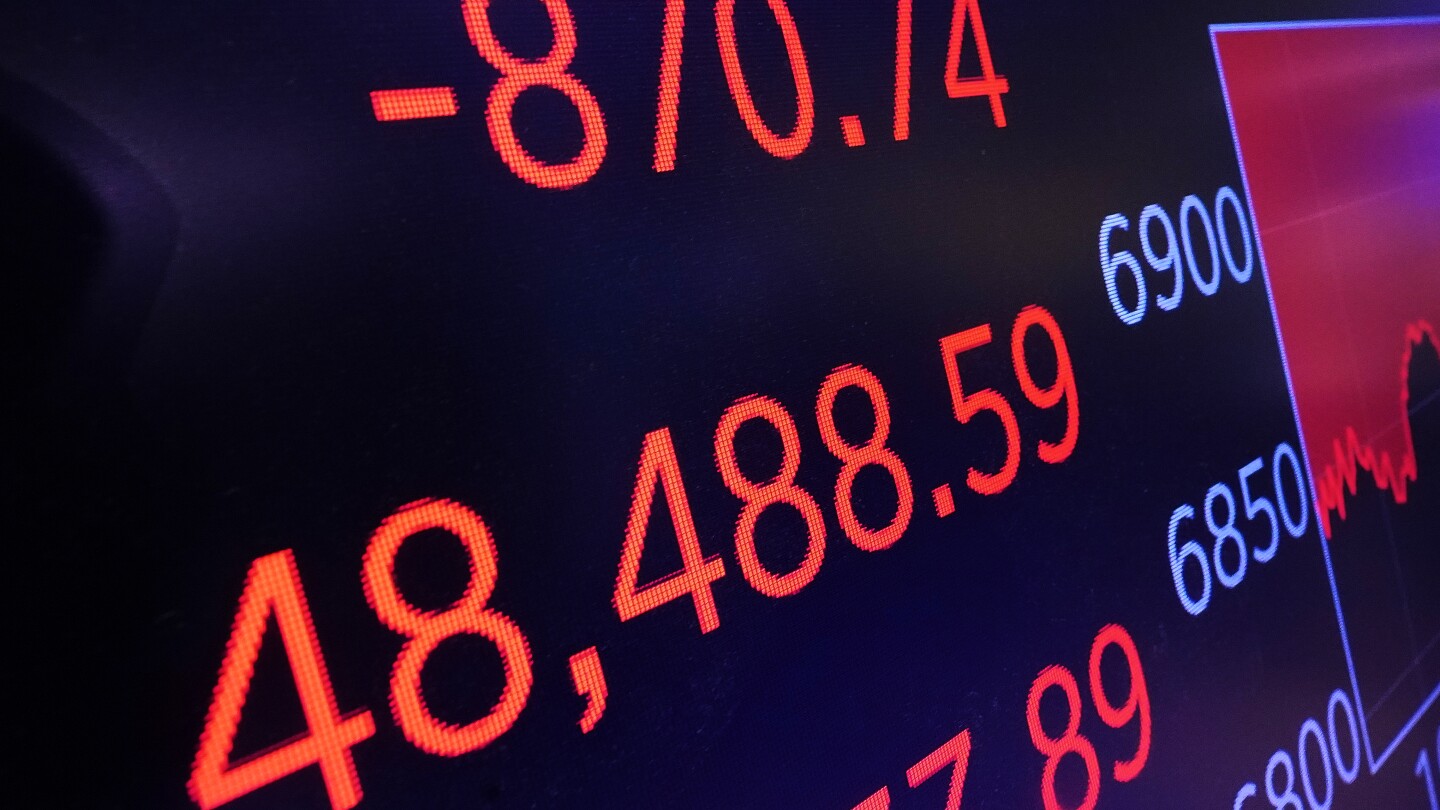
U.S. futures showed modest recovery after Tuesday’s steep Wall Street selloff, with S&P 500 futures rising 0.3% and Dow Jones Industrial Average futures up 0.2%. The previous day saw the S&P 500 tumble 2.1% to 6,796.86, its worst decline since October, while the Dow fell 1.8% to 48,488.59 and the Nasdaq dropped 2.4% to 22,954.32.
Investor anxiety has intensified following Trump’s announcement that he would impose 10% tariffs on Denmark, Norway, Sweden, Germany, France, the United Kingdom, the Netherlands and Finland beginning in February. These would supplement a 15% tariff outlined in a yet-to-be-ratified trade agreement with the European Union.
European leaders are reportedly considering countermeasures, including potential retaliatory tariffs or delaying ratification of the existing trade agreement. The diplomatic tension stems partly from Trump’s unusual grievance over Greenland, which he reportedly linked to not receiving the Nobel Peace Prize last year. In comments to Norway’s prime minister, Trump indicated he no longer felt “an obligation to think purely of Peace.”
In Tokyo, the Nikkei 225 declined 0.7% to 52,603.44 amid both global concerns and domestic political developments. Japanese Prime Minister Sanae Takaichi has called a snap election for February 8, causing yields on long-term government bonds to reach record levels. Market analysts believe Takaichi is attempting to consolidate a majority for her Liberal Democratic Party, potentially through tax cuts and increased spending—policies that could exacerbate Japan’s already substantial government debt challenges.
The yield on 40-year Japanese government bonds reached 4.095% early Wednesday, slightly down from Tuesday’s all-time high of 4.22%.
Other Asian markets mostly tracked the downward trend. South Korea’s Kospi fell 0.5% to 4,862.17, while Hong Kong’s Hang Seng slipped 0.2% to 26,435.20. The Shanghai Composite index managed a modest 0.2% gain to 4,120.10, and Australia’s S&P/ASX 200 retreated 0.4% to 8,781.70. Taiwan’s Taiex dropped 0.9%, while India’s Sensex edged up 0.1%.
The selloff wasn’t limited to regional indices. On Wall Street, technology giants faced significant pressure, with Nvidia dropping 4.4% and Apple falling 3.5%. The weakness extended across sectors, hitting retailers like Lowe’s (down 3.3%), financial institutions including JPMorgan Chase (down 3.1%), and industrial firms such as Caterpillar (down 2.5%).
Market participants remain focused on upcoming central bank meetings, with the Federal Reserve expected to hold its benchmark interest rate steady at its policy gathering next week. The Bank of Japan will conclude its first monetary policy meeting of the year on Friday.
In commodity markets, gold’s surge to record territory reflected its traditional role as a safe-haven asset during periods of geopolitical uncertainty. Meanwhile, oil prices retreated, with U.S. benchmark crude falling 56 cents to $59.80 per barrel and Brent crude, the international standard, declining 70 cents to $64.22 per barrel.
Currency markets showed minimal movement, with the U.S. dollar trading at 158.08 Japanese yen, down slightly from 158.16 yen, while the euro held steady at $1.1719.
As global markets digest these developments, investors will closely monitor Trump’s Davos address for any signals regarding trade policy and international relations that could further influence market sentiment in the coming days.
Fact Checker
Verify the accuracy of this article using The Disinformation Commission analysis and real-time sources.

9 Comments
Interesting how the Greenland dispute is impacting global markets and pushing gold to new highs. Investors seem very anxious about the potential tariffs on EU countries. I wonder how this will all play out diplomatically.
The Greenland issue seems to be just the latest flashpoint in the ongoing US-EU trade tensions. The markets are clearly jittery, with gold and other safe havens rallying. Hopefully, the Davos speech can provide some much-needed clarity and reassurance.
It’s fascinating to see how a dispute over Greenland has managed to roil global financial markets. The surge in gold prices and the sell-off in US equities reflect the high level of investor anxiety. This underscores the need for measured diplomacy to de-escalate the situation.
The Greenland dispute seems to be a very complex geopolitical issue with far-reaching economic consequences. I’m curious to see how President Trump’s speech at Davos will address these tensions and try to calm market jitters.
Yes, the Davos speech will be closely watched for any signs of de-escalation or further escalation in the US-EU trade dispute. Markets are clearly on edge over the potential fallout.
It’s remarkable how a dispute over Greenland has managed to send shockwaves through global financial markets. The flight to safe haven assets like gold is a clear sign of investor uncertainty. I hope cooler heads can prevail and avoid an all-out trade war.
The volatility in US futures and the surge in gold prices show just how sensitive the markets are to the Greenland dispute and broader US-EU trade tensions. This highlights the need for level-headed diplomacy to ease these geopolitical frictions.
Absolutely. Ratcheting up tariffs and escalating trade conflicts is a risky strategy that could backfire economically. Cooler heads need to prevail to avoid a full-blown trade war.
The escalating trade tensions between the US and its European allies are really rattling the markets. Imposing tariffs on Denmark, Norway, and other key US allies is a risky move that could backfire economically. Curious to see if diplomatic efforts can de-escalate the situation.