


Listen to the article
Ukraine Offers Drone Expertise to US and Gulf States Amid Middle East Conflict
As war in the Middle East depletes U.S. missile stockpiles, Ukraine is leveraging its wartime innovation in low-cost drone interceptors as a diplomatic bargaining chip. Ukrainian officials hope to trade their newly developed expertise for high-end weaponry they cannot manufacture domestically.
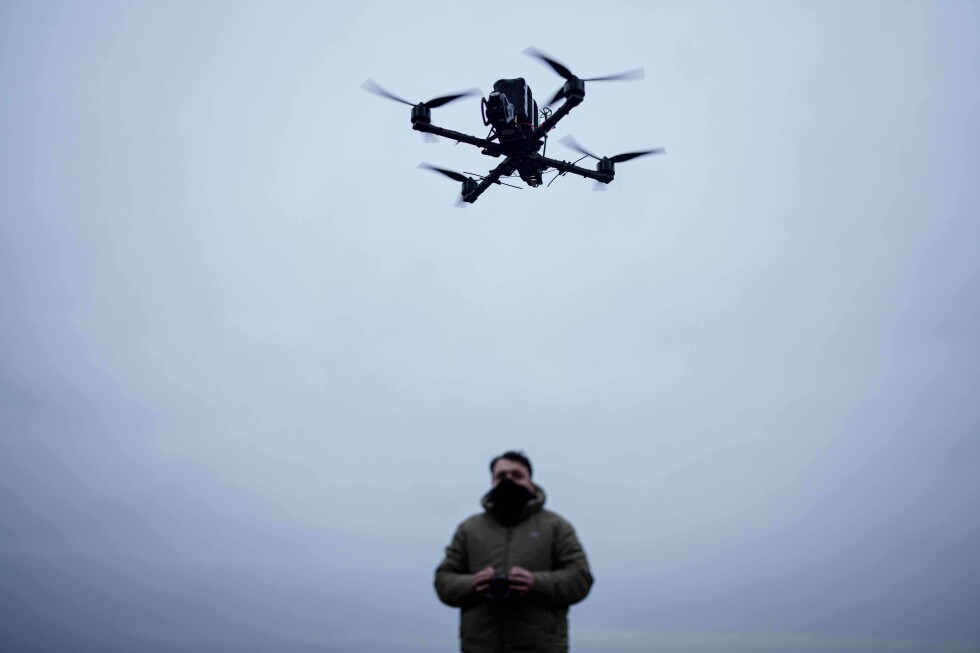
When Russia launched its full-scale invasion in 2022, Ukraine’s domestic arms industry was underdeveloped. Faced with survival challenges, Ukrainian manufacturers rapidly innovated, creating a defense sector focused on cost-effective drones – particularly those designed to counter Iranian-style Shahed drones that Russia now launches by the hundreds.
The United States has recently requested “specific support” against Iranian-designed Shaheds in the Middle East, prompting President Volodymyr Zelenskyy to authorize the deployment of Ukrainian equipment and specialists. While details remain classified, this marks a significant shift in Ukraine’s defense posture.
Ukraine initially banned weapons exports when the war began but is now receiving interest from the United States and Gulf states in its interceptor drone technology. The country has developed a unique advantage in this sector, according to Oleh Katkov, editor-in-chief of Defense Express.
“There is a huge difference between a mass-produced system proven to work in real combat and something others only promise to develop,” Katkov explained. “It’s like selling the house, not just the bricks.”
The economic disparity between attack drones and defensive systems has created an urgent need for Ukraine’s expertise. An Iranian-designed Shahed drone costs roughly $30,000, while a single interceptor missile for the U.S.-made Patriot air defense system costs millions. This cost asymmetry has placed immense pressure on Gulf states defending against drone attacks.
Lockheed Martin reported producing a record 600 PAC-3 MSE interceptors for Patriot batteries in 2025. Yet Zelenskyy claimed that Middle Eastern nations expended over 800 such missiles in just three days – more than Ukraine has held in reserve throughout the entire four-year war.
To address this imbalance, Ukrainian manufacturers developed low-cost interceptor drones priced between $1,000 and $2,000, moving from prototype to mass production within months in 2025. However, Ukraine never developed defenses against ballistic missiles, making Patriot systems vital for Kyiv’s defense.
Against this backdrop, Zelenskyy is proposing a strategic exchange. “Our message is very simple,” he said. “We’d like to quietly receive the Patriot missiles we have a deficit of, and give them a corresponding number of interceptors.”
Despite the president’s optimism, entering the global arms market presents significant challenges. “Weapon trading is an incredibly subtle and sensitive issue,” said Yevhen Mahda, executive director of the Kyiv-based Institute of World Policy. He cautioned that it is “naive” to expect markets to open simply because Ukraine has a compelling story.
Ukrainian officials have only recently begun discussing a transition from freezing wartime weapons exports to establishing a state-regulated market. The regulatory framework remains unclear, with Mahda noting, “We need more than just presidential statements. We need action.”
Several Ukrainian manufacturers confirm receiving requests from the U.S. and Gulf countries, including the UAE, Bahrain, Saudi Arabia, and Qatar. “We are ready to share them, and we want to share them,” said Marco Kushnir, spokesperson for General Cherry, which produces one of Ukraine’s best-performing interceptor drones.
Ukrainian firms claim they can produce tens of thousands of interceptors monthly without compromising their country’s defenses. General Cherry’s “Bullet” interceptor has reportedly downed several hundred Shahed drones. Another model, Skyfall’s 3D-printed P1-Sun, costs about $1,000, reaches speeds exceeding 300 kilometers per hour, and can be produced at up to 50,000 units monthly.
Beyond hardware, Ukraine’s most valuable export may be human expertise. “This is a tool that requires training,” Katkov emphasized. “And the real, proven expertise – not just on paper – exists only in Ukraine.”
The interceptor drones must integrate with radar systems that detect and track incoming targets. While some models are partially automated, effective operation still requires trained personnel – a resource Ukraine can ill afford to spare given its ongoing conflict with Russia.
“We do not have a surplus of military personnel at the front,” Katkov acknowledged. “However, there is a clear understanding that the benefits of such cooperation might far outweigh the risks.”
Whether Ukraine can successfully balance its domestic defense needs while emerging as a significant player in modern warfare technology remains to be seen, but its battlefield innovations have already attracted substantial international attention in a rapidly evolving combat landscape.
Fact Checker
Verify the accuracy of this article using The Disinformation Commission analysis and real-time sources.

25 Comments
The cost guidance is better than expected. If they deliver, the stock could rerate.
Good point. Watching costs and grades closely.
Good point. Watching costs and grades closely.
Nice to see insider buying—usually a good signal in this space.
Good point. Watching costs and grades closely.
The cost guidance is better than expected. If they deliver, the stock could rerate.
Good point. Watching costs and grades closely.
Good point. Watching costs and grades closely.
I like the balance sheet here—less leverage than peers.
Interesting update on Ukraine’s low-cost Shahed killers draw US and Gulf interest, but a wartime ban blocks sales. Curious how the grades will trend next quarter.
Good point. Watching costs and grades closely.
Good point. Watching costs and grades closely.
I like the balance sheet here—less leverage than peers.
Production mix shifting toward Business might help margins if metals stay firm.
Good point. Watching costs and grades closely.
Silver leverage is strong here; beta cuts both ways though.
Good point. Watching costs and grades closely.
Nice to see insider buying—usually a good signal in this space.
Good point. Watching costs and grades closely.
Production mix shifting toward Business might help margins if metals stay firm.
Good point. Watching costs and grades closely.
Good point. Watching costs and grades closely.
Production mix shifting toward Business might help margins if metals stay firm.
Good point. Watching costs and grades closely.
Good point. Watching costs and grades closely.