


Listen to the article
United Farm Workers: A Legacy in Transition Amid Controversy and Change
Most farmworkers in the United States today lack union representation, but United Farm Workers (UFW) has long stood as their recognized advocate. Approximately six decades after César Chavez and fellow activists founded the organization, UFW maintains political influence in California and beyond, though experts differ on its effectiveness in improving farmworkers’ conditions.
The union now confronts disturbing allegations that Chavez, its iconic founder, sexually abused girls and cofounder Dolores Huerta during the organization’s most influential period, creating a profound reckoning with its past.
Today’s UFW represents approximately 10,000 workers across California, New York, Washington, and Oregon, according to spokesman Antonio De Loera-Brust. This membership represents a dramatic decline from the 70,000 workers organized during Chavez’s leadership and accounts for only a small fraction of agricultural laborers in California alone, where much of America’s fresh produce is harvested.
Agricultural laborers remain uniquely vulnerable in American labor law. Unlike most sectors, farmworkers lack federal protections for unionization, a significant hurdle that has limited organized representation across the industry.
Despite its reduced membership, the organization’s influence extends well beyond those numbers. “The impacts and the power and the influence of the UFW go far beyond those 10,000 members,” notes Armando Ibarra, professor at the University of Wisconsin’s School for Workers. Through its sister organization, UFW continues advocating for broader issues including immigration reform and labor rights.
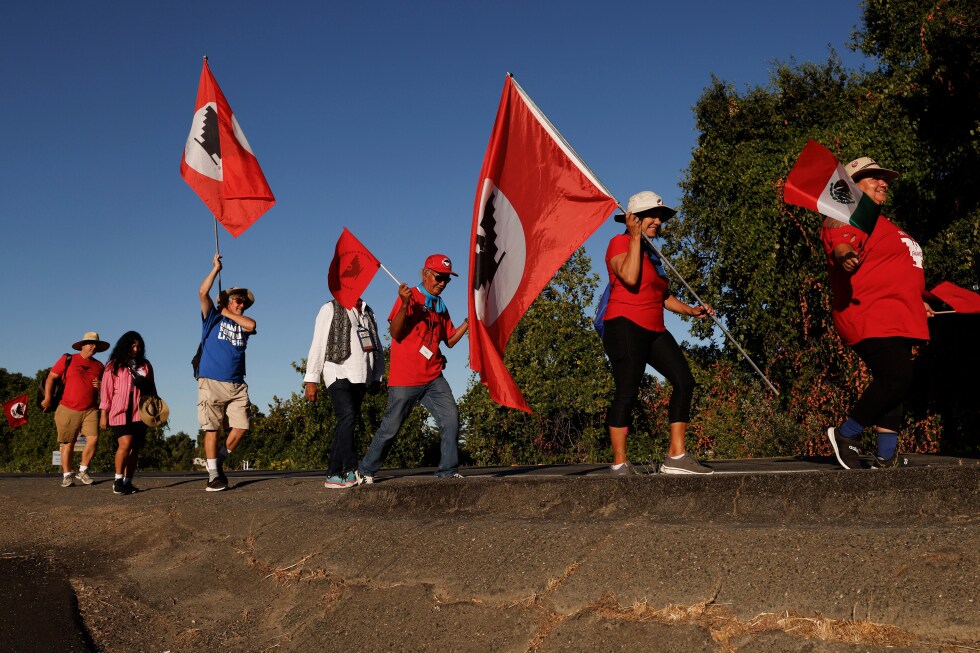
The union’s formative years under Chavez and Huerta marked a watershed moment for agricultural labor organizing. Their consumer grape boycott and the historic march from California’s agricultural heartland to the state capital in Sacramento culminated in the first farmworker labor contract, achievements Ibarra describes as “the most successful era in farmworker organizing campaigns to this date.”
However, the decades since have brought challenges and criticism. Miriam Pawel, author of a 2014 Chavez biography, suggests the UFW has weakened by overly emphasizing Chavez’s legacy rather than focusing on core labor issues. She notes that Chavez, who died in 1993 at age 66, was also known for purging dissenters from the organization, creating a complex legacy that may now require further reassessment.
Despite these challenges, UFW remains politically active. California established a state law and special board in 1975 to protect farmworkers’ unionization rights, though few have organized amid broader national declines in union membership and challenges related to immigration status.
Recent political efforts have shown mixed results. After years of resistance from California governors, a 2022 law expanding farmworker voting options in union elections finally passed when then-President Joe Biden pressured Governor Gavin Newsom to sign the legislation. The measure came after UFW members conducted another march to the Capitol, deliberately echoing the movement’s early tactics under Chavez.
The new law has facilitated unionization at eight locations, according to De Loera-Brust, though large agricultural interests including the Wonderful Company—a major producer of pistachios, pomegranates, and citrus—continue challenging the measure in court.
UFW is simultaneously engaged in federal litigation against Trump-era regulations that made hiring temporary foreign agricultural workers less expensive, arguing these changes depress wages for domestic farmworkers.
Working conditions in agricultural fields have improved since UFW’s founding. President Teresa Romero points to tangible changes in California, where laborers now have access to shade and paid breaks during excessive heat, although enforcement remains inconsistent. “It took us 20 years to be able to get heat and illness protections here,” Romero explained. “And to this day, we have employers that refuse to implement them.”
California has since enacted additional protections including overtime pay and meal breaks for farmworkers. Similar overtime regulations are being implemented in Washington and New York states, reflecting incremental progress on labor standards.
As institutions nationwide reconsider Chavez’s name on buildings and commemorations in light of the abuse allegations, UFW’s sister foundation has canceled all César Chavez Day activities planned for March 31. While acknowledging these difficult decisions, Romero emphasizes that the organization’s fundamental mission remains unchanged.
The union plans to continue pressing for farmworker organizing legislation in Washington state next year and pursuing its organizing efforts. Romero stresses that state-level legal protections remain critical, particularly since many agricultural workers fear asserting labor rights due to potential immigration enforcement.
“We’re going to continue to fight for farmworkers,” Romero affirmed. “I respect the thousands of people who work with the union throughout the years as volunteers, and that is not going to change.”
Fact Checker
Verify the accuracy of this article using The Disinformation Commission analysis and real-time sources.

29 Comments
The cost guidance is better than expected. If they deliver, the stock could rerate.
Interesting update on UFW advocates for farmworkers, but represents fewer now than during Chavez’s era. Curious how the grades will trend next quarter.
Good point. Watching costs and grades closely.
Good point. Watching costs and grades closely.
I like the balance sheet here—less leverage than peers.
Good point. Watching costs and grades closely.
Good point. Watching costs and grades closely.
Uranium names keep pushing higher—supply still tight into 2026.
Good point. Watching costs and grades closely.
Good point. Watching costs and grades closely.
Exploration results look promising, but permitting will be the key risk.
Good point. Watching costs and grades closely.
Good point. Watching costs and grades closely.
Exploration results look promising, but permitting will be the key risk.
Good point. Watching costs and grades closely.
Silver leverage is strong here; beta cuts both ways though.
Good point. Watching costs and grades closely.
Good point. Watching costs and grades closely.
Silver leverage is strong here; beta cuts both ways though.
I like the balance sheet here—less leverage than peers.
Good point. Watching costs and grades closely.
Uranium names keep pushing higher—supply still tight into 2026.
Good point. Watching costs and grades closely.
Interesting update on UFW advocates for farmworkers, but represents fewer now than during Chavez’s era. Curious how the grades will trend next quarter.
Good point. Watching costs and grades closely.
Exploration results look promising, but permitting will be the key risk.
Good point. Watching costs and grades closely.
Interesting update on UFW advocates for farmworkers, but represents fewer now than during Chavez’s era. Curious how the grades will trend next quarter.
Good point. Watching costs and grades closely.