


Listen to the article
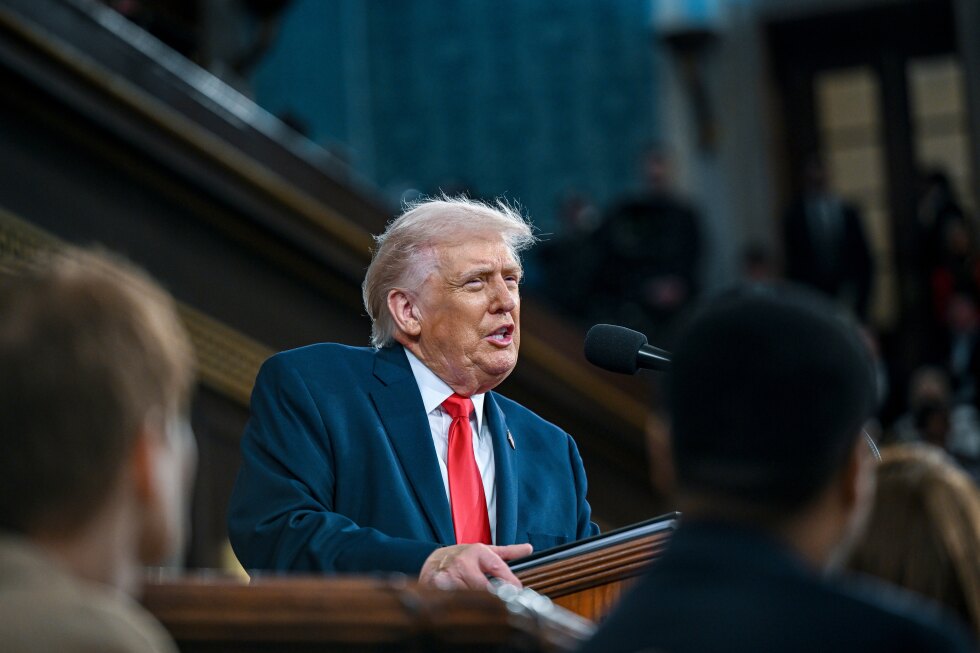
President Donald Trump painted an optimistic picture of the American economy during his first State of the Union address, describing a nation experiencing plummeting inflation, rising incomes, and unprecedented economic growth. However, his rosy assessment stands in stark contrast to the reality many Americans are experiencing, according to recent economic data and polling.
Just hours before Trump’s address, The Conference Board released its latest consumer confidence report showing overall economic confidence remains historically low. The February index ticked up slightly to 91.2, still well below the four-year peak of 112.8 reached in November 2024. The report revealed Americans remain concerned about high prices and perceive limited job availability.
This disconnect between presidential rhetoric and public sentiment isn’t new. Only 39% of Americans approve of Trump’s economic leadership, according to the latest Associated Press-NORC Center for Public Affairs Research survey. Similarly, the University of Michigan’s consumer sentiment survey continues to reflect recessionary levels of economic confidence.
“Inflation is plummeting, incomes are rising fast, the roaring economy is roaring like never before,” Trump declared during his address. But economic data tells a more nuanced story.
The U.S. economy expanded by 2.2% last year, showing growth but hardly qualifying as “roaring.” This represents a decline from the 2.8% growth in Biden’s final year and 2.9% in 2023. For historical context, a truly booming economy typically resembles the late 1990s, when growth exceeded 4% for four consecutive years, or the 1980s, when it surpassed 3.5% for six straight years.
While Trump correctly noted that core inflation (excluding food and energy) fell to a five-year low in January, many consumers continue to struggle with elevated prices. A gauge of core prices closely monitored by the Federal Reserve showed a 3% increase in December compared to the previous year, exceeding the Fed’s 2% target. This measure places less emphasis on housing costs than the figure Trump cited.
Joanne Hsu, director of the University of Michigan’s consumer sentiment survey, reported that nearly half of February respondents “spontaneously mentioned high prices eroding their personal finances.” Although egg prices have indeed fallen from their peak as Trump mentioned, most essential items—groceries, rent, electricity—remain significantly more expensive than five years ago. Electricity costs alone rose 6.3% in the past year.
Trump’s tariff policies have further contributed to rising costs for imported goods, including furniture, auto parts, tools, and clothing. Certain grocery items have seen sharp increases, with ground beef prices jumping 17% in the past year.
The job market presents another challenging picture. Employers added just 181,000 jobs in 2025—averaging only 15,000 monthly—making it the worst year for job growth outside a recession since 2002. Despite Trump’s pledge to revitalize American manufacturing, factories lost 108,000 jobs in 2025, following 202,000 lost during Biden’s final two years. The automotive sector has been particularly hard hit, shedding nearly 74,000 jobs over the past two years.
Several factors have contributed to manufacturing’s struggles, including Trump’s tariffs that have increased costs for imported raw materials and parts, high interest rates, and increased automation. However, January did show an unexpected increase of 130,000 new jobs, with factories adding positions for the first time in over a year.
Trump suggested his tariff policies have directly benefited the U.S. economy, claiming they’re bringing “factories, jobs, investment and trillions and trillions of dollars” into the country. However, economic research indicates a different reality. A study by Harvard economist Alberto Cavallo found that U.S. consumers absorb 43% of higher tariff costs, with American companies bearing most of the remainder.
Contrary to Trump’s assertion that tariffs are paid by foreign countries, they are actually paid by U.S. importers who typically pass costs to consumers through higher prices. Import prices haven’t decreased significantly, suggesting overseas exporters aren’t substantially affected.
Furthermore, Trump’s import taxes haven’t achieved his stated goal of reducing the U.S. trade deficit. The gap between American exports and imports of goods like automobiles and appliances reached a record $1.24 trillion last year, increasing 2% from 2024.
Fact Checker
Verify the accuracy of this article using The Disinformation Commission analysis and real-time sources.

11 Comments
Interesting to see the disconnect between Trump’s optimistic assessment and the more skeptical view of many Americans. Economic confidence levels remain relatively low despite the administration’s claims of a ‘golden age’. Curious to see how this evolves as we get more data points.
I agree, the public sentiment seems to lag the administration’s messaging. It will be telling to watch how consumer confidence and perception of the economy shift in the coming months.
The consumer confidence data seems to tell a different story than the president’s rosy portrayal of the economy. While certain metrics may be strong, it’s clear that a sizeable portion of the public doesn’t feel the benefits in their day-to-day lives. This could create political challenges for the administration.
Absolutely. The public’s personal economic experiences often matter more than top-line economic indicators when it comes to voting behavior. This disconnect could become a liability for the president and his party.
This highlights an interesting dynamic where the president’s portrayal of a ‘golden age’ economy doesn’t seem to match up with how the public actually perceives the state of the economy. It will be interesting to see if and how this disconnect evolves over time, and whether it has any meaningful political implications.
Agreed. The administration’s messaging and the public’s sentiment are clearly out of sync here. It will be worth monitoring whether this divergence narrows or persists, and how it may shape voter attitudes and political dynamics going forward.
The data suggests a clear gap between the president’s upbeat assessment and the more guarded view of many Americans. While certain economic indicators may be positive, it’s evident that a significant portion of the public doesn’t feel the benefits in their daily lives. This divergence could present challenges for the administration.
It’s striking to see such a stark contrast between the president’s upbeat assessment and the more subdued consumer confidence numbers. The data suggests many Americans remain concerned about high prices and job availability, despite the administration’s claims of economic prosperity. This divergence is worth watching closely.
The divergence between the president’s optimistic rhetoric and the more cautious public sentiment is intriguing. It suggests that the administration’s messaging may not be fully aligned with the lived experiences of many Americans. This could be an important dynamic to watch as we approach the next election cycle.
The data highlights a clear divide between the president’s rhetoric and the reality many Americans are experiencing. While the economy may be performing well by certain metrics, it’s clear that a significant portion of the population isn’t feeling the benefits. This could have important political implications.
That’s a good point. The disconnect between the administration’s portrayal and the public’s perception of the economy could become a key issue in the next election cycle. Voters’ personal experiences tend to carry a lot of weight.