


Listen to the article
Iran Intensifies Attacks on Gulf States as Regional Tensions Escalate
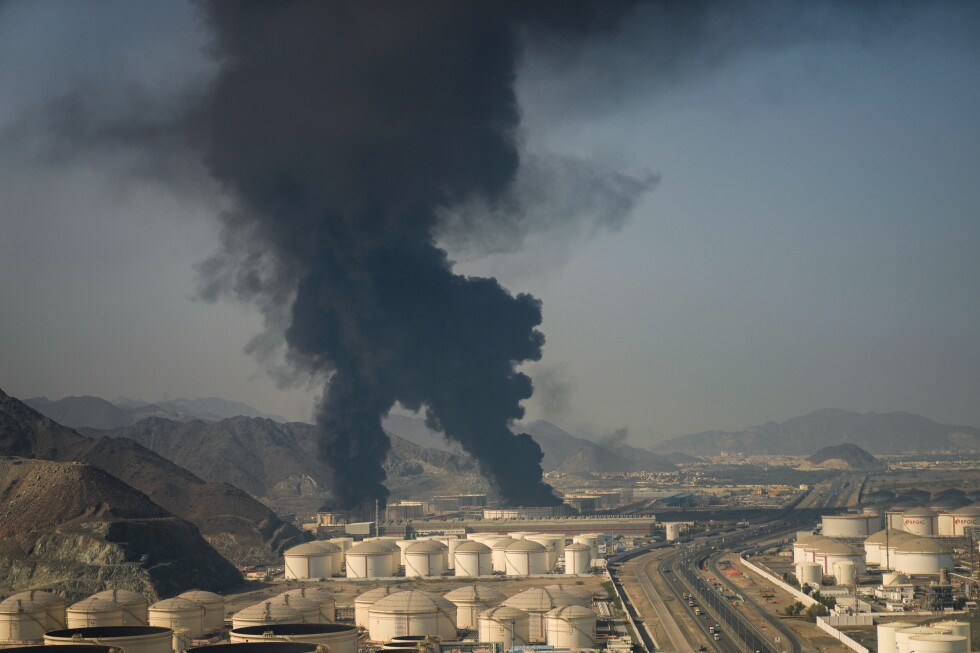
Gulf states reported new missile and drone attacks Sunday as Iran threatened to widen its military campaign and called for the evacuation of three major ports in the United Arab Emirates. These strikes mark the third week of an increasingly dangerous conflict involving the United States, Israel, and Iran.
Authorities in Bahrain, Saudi Arabia, and the UAE warned citizens they were working to intercept incoming projectiles. The alerts came just one day after Iran’s unprecedented threat against non-U.S. assets in the UAE, signaling a potential expansion of its targeting strategy.
Iran has accused the United States of using “ports, docks and hideouts” in the UAE to launch strikes on Kharg Island, Iran’s main oil export terminal, though Tehran has not provided evidence for these claims. UAE officials and other Gulf countries hosting U.S. military bases have firmly denied allowing their territories to be used for operations against Iran.
The human toll of the conflict continues to rise. At least a dozen civilians in Gulf states have been killed by Iranian strikes, most of them migrant workers. The U.S. military has suffered 13 casualties since the conflict began, including seven in combat and six service members who died in a plane crash over Iraq last week.
Iranian Foreign Minister Abbas Araghchi specifically claimed that U.S. forces attacked Kharg Island and Abu Musa Island from two locations in the UAE, including Ras Al Khaimah and another site “very close to Dubai.” He called this development dangerous while asserting that Iran “will try to be careful not to attack any populated area” in the UAE.
U.S. Central Command has not responded to Iran’s allegations. Anwar Gargash, a diplomatic adviser to the UAE’s president, rejected accusations that American forces used Emirati territory to launch attacks on Kharg Island.
Although Iran has launched hundreds of missiles and drones at Arab Gulf neighbors during the conflict, Iranian officials insist they are targeting only U.S. assets. However, civilian infrastructure including airports and oil fields have reportedly been hit or targeted.
The conflict has significantly increased concerns about global energy security. U.S. President Donald Trump called on allies including China, France, Japan, South Korea, and the United Kingdom to send warships to keep the strategically vital Strait of Hormuz “open and safe.” Britain responded by stating it was discussing a “range of options” with allies to secure shipping lanes.
Araghchi dismissed Trump’s request, describing it as “begging” and urging neighboring countries to “expel foreign aggressors” instead. Iran’s joint military command has reiterated its threat to attack U.S.-linked “oil, economic and energy infrastructures” in the region if Iranian oil facilities are targeted.
According to Iran’s semiofficial Fars news agency, recent strikes on Kharg Island targeted an air defense facility, a naval base, an airport control tower, and an offshore oil company’s helicopter hangar, but caused no damage to oil infrastructure.
Meanwhile, the U.S. Department of Defense identified the six service members killed in Thursday’s military refueling aircraft crash in western Iraq. They were Maj. John A. Klinner, 33; Capt. Ariana G. Savino, 31; Tech. Sgt. Ashley B. Pruitt, 34; Capt. Seth R. Koval, 38; Capt. Curtis J. Angst, 30; and Tech. Sgt. Tyler H. Simmons, 28. U.S. officials said the crash followed an unspecified incident involving two aircraft in “friendly airspace,” with the second plane landing safely.
In a separate incident, a missile struck a helipad inside the U.S. Embassy compound in Baghdad on Saturday. No group immediately claimed responsibility, though the heavily fortified embassy complex—one of the largest U.S. diplomatic facilities globally—has frequently been targeted by Iran-aligned militias.
The State Department has renewed its warning for U.S. citizens in Iraq to leave “now,” preferably by land since commercial flights are unavailable. The advisory noted that Iran and its allied militia groups “may continue to target” American citizens, interests, and infrastructure.
The escalating conflict has further destabilized the already volatile Middle East region, with Lebanon’s humanitarian crisis deepening amid Israeli strikes against Iran-backed Hezbollah. Reports indicate more than 800 people have been killed and 850,000 displaced in Lebanon as the conflict expands across multiple fronts.
Fact Checker
Verify the accuracy of this article using The Disinformation Commission analysis and real-time sources.

9 Comments
As a commodities trader, I’m closely monitoring the situation. Disruptions to oil and gas exports through the Strait could roil global energy markets. Prudent risk management is critical during these volatile times.
As an investor in mining and energy equities, I’m closely watching these geopolitical developments. Continued instability in the Strait of Hormuz could disrupt commodity trade flows and impact prices. Prudent risk management is advised.
The safety of civilian populations in the Gulf must be the top priority. All parties should exercise maximum restraint to prevent further loss of life. Diplomatic solutions that address the root causes of tension are urgently needed.
While the threat of conflict is worrying, I’m curious to see how this situation unfolds. Iran’s strategy of escalating attacks on Gulf assets is risky. De-escalation through dialogue would be the best outcome for regional stability and global energy markets.
Increased military mobilization in the Strait of Hormuz raises the specter of an unintended clash. Cooler heads must prevail to avoid miscalculation and a wider regional conflagration. Economic and diplomatic pressure on Iran may be more effective than saber-rattling.
Tensions in the Strait of Hormuz are escalating rapidly. The US must work closely with allies to maintain freedom of navigation and deter further Iranian aggression in the region. Diplomacy should remain the priority to de-escalate the situation.
Escalating regional tensions are deeply concerning, especially for companies operating in the Gulf. Safeguarding critical energy and mining infrastructure must be a top priority for governments and industry. Diplomatic solutions should be exhausted before military options are considered.
Attacks on Gulf states’ ports and infrastructure are deeply concerning. Iran must be held accountable for its provocative actions. Effective multilateral coordination is crucial to protect commercial shipping and energy assets in the Strait.
I agree, the security of global energy supply routes is at stake. Diplomatic efforts to find a peaceful resolution should continue, but robust military deterrence may be necessary if Iran refuses to back down.