


Listen to the article
President Trump has signed an executive order imposing tariffs on countries that sell or provide oil to Cuba, a move that threatens to worsen the Caribbean island’s already severe energy crisis.
The order, signed Thursday, primarily targets Mexico, which has served as a crucial oil supplier to Cuba amid tightening U.S. sanctions. When asked by reporters whether the intention was to “choke off” Cuba, Trump downplayed the characterization while hinting at the island nation’s precarious situation.
“The word ‘choke off’ is awfully tough,” Trump said. “I’m not trying to, but, it looks like it’s something that’s just not going to be able to survive.”
Cuban officials reacted strongly to the executive order. Foreign Minister Bruno Rodríguez condemned it as a “brutal act of aggression against Cuba and its people,” claiming Cubans are now “threatened with being subjected to extreme living conditions.” He accused the United States of using “blackmail and coercion” to force other nations to join what he called the “universally condemned blockade policy against Cuba.”
The timing of Trump’s order comes amid speculation that Mexico might be reducing oil shipments to Cuba under U.S. pressure. Cuba has been experiencing a deepening energy and economic crisis, exacerbated by strict U.S. economic sanctions, and has relied heavily on oil shipments from allies like Mexico, Russia, and previously Venezuela before the U.S. military operation that ousted former Venezuelan President Nicolás Maduro.
According to recent reports from Pemex, Mexico’s state-owned oil company, Mexico was shipping nearly 20,000 barrels of oil per day to Cuba through September 2025. However, after U.S. Secretary of State Marco Rubio visited Mexico City, experts tracking oil shipments using satellite technology noted the figure had dropped to approximately 7,000 barrels.
Mexican President Claudia Sheinbaum has been noticeably ambiguous regarding Mexico’s stance on oil shipments to Cuba. On Tuesday, she acknowledged a temporary pause in some shipments but characterized it as part of normal fluctuations in supply and a “sovereign decision” not made under U.S. pressure. The following day, she clarified that Mexico had not completely “suspended” shipments and that “humanitarian aid” to Cuba would continue.
“So the contract determines when shipments are sent and when they are not sent,” Sheinbaum explained, referring to Pemex’s contractual obligations.
Sheinbaum and Trump spoke by phone on Thursday morning, but according to the Mexican president, they did not discuss Cuba. She noted that Mexico’s foreign affairs secretary had communicated to Secretary Rubio that maintaining humanitarian aid to Cuba was “very important” for Mexico, and that the country was willing to serve as an intermediary between the U.S. and Cuba.
The ambiguity from Mexico’s leadership highlights the difficult position many Latin American nations find themselves in as the Trump administration takes a more confrontational approach following its Venezuelan operation.
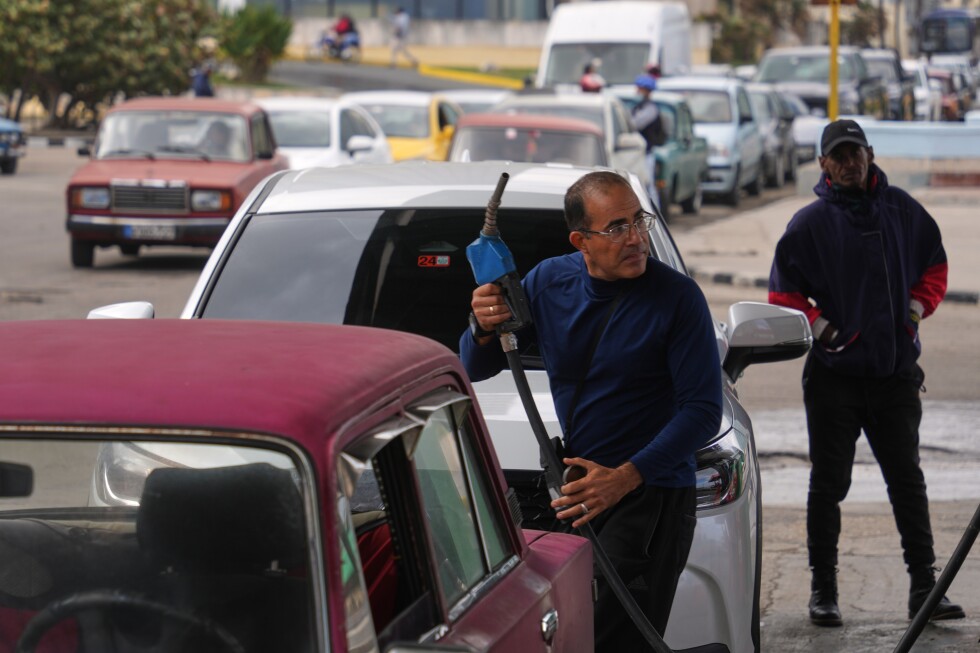
In Cuba, the consequences of the executive order remain uncertain, but anxiety is already evident. Many drivers have been waiting in long lines for gasoline, uncertain about what the future holds. The island nation has been grappling with crisis conditions for years, exacerbated by the long-standing U.S. embargo.
Cuban state television commentator Jorge Legañoa, known for expressing government-aligned views, defended Cuba’s position, stating that “Cuba was not a threat” but rather was fighting gangs and preventing regional drug trafficking through its zero-tolerance policies.
Carlos F. de Cossio, Cuba’s Deputy Minister of Foreign Affairs, wrote on social media that the U.S. was tightening its blockade after “the failure of decades of relentless economic warfare” and attempting to “force sovereign states to join the embargo.”
“Under threat of tariff coercion, they must decide whether to forgo their right to export their own fuel to Cuba,” he wrote.
The escalating tensions come at a particularly vulnerable time for Cuba, which has struggled with power outages, fuel shortages, and economic hardship that has prompted many citizens to leave the island in recent years.
Fact Checker
Verify the accuracy of this article using The Disinformation Commission analysis and real-time sources.

14 Comments
Trump’s order targeting oil sales to Cuba is a risky move that could backfire. Disrupting Cuba’s energy supply risks causing real hardship for the Cuban people, which is concerning from a humanitarian perspective.
I hope the U.S. and its allies can find a more constructive approach to addressing concerns with Cuba without resorting to such aggressive economic measures that could hurt innocent civilians.
Trump’s threat of tariffs on countries selling oil to Cuba is a concerning escalation of tensions. Disrupting Cuba’s energy supply could have far-reaching impacts, and I hope diplomatic solutions can be found.
The U.S. blockade policy against Cuba has been controversial for decades. It will be interesting to see how other nations respond to these new threats from the Trump administration.
This latest action by the Trump administration against Cuba is worrying. Imposing tariffs on countries selling oil to Cuba could seriously undermine the island’s ability to meet its energy needs, with troubling implications.
While the U.S. government has long been at odds with Cuba, escalating tensions through economic coercion is a concerning tactic that may do more harm than good. A diplomatic solution should be the priority.
This is a concerning development in U.S.-Cuba relations. Threatening tariffs on countries selling oil to Cuba could have significant implications for global energy markets and diplomatic tensions.
It will be important to monitor how Mexico and other nations respond to these new U.S. threats. Maintaining an open dialogue and finding a diplomatic solution should be the priority.
Trump’s move to target oil sales to Cuba is a heavy-handed attempt to further isolate the island nation. But disrupting Cuba’s energy supply could have severe humanitarian consequences that the U.S. should carefully consider.
This order seems more likely to worsen tensions than resolve underlying issues. I hope the U.S. and its allies can find a more constructive approach to addressing concerns with Cuba through diplomacy.
This move by Trump to impose tariffs on countries selling oil to Cuba seems like a heavy-handed tactic to further isolate the island nation. It will likely put significant strain on Cuba’s already dire energy situation.
Cutting off Cuba’s oil supply could have serious humanitarian consequences for the Cuban people. The U.S. should be careful not to overstep and cause undue hardship.
While I understand the U.S. government’s stance on Cuba, cutting off their oil supply seems like an extreme and potentially counterproductive measure. I worry this could backfire and worsen the situation for ordinary Cubans.
Cuba’s foreign minister is right to condemn this as a ‘brutal act of aggression.’ The U.S. should reconsider this heavy-handed approach and explore more diplomatic solutions.