


Listen to the article
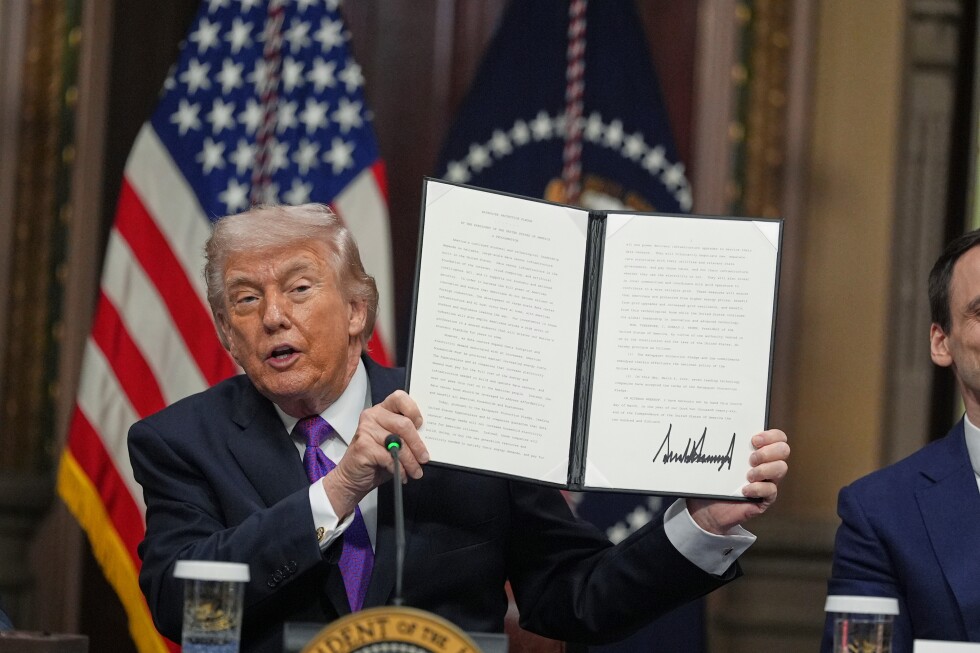
President Trump gathered major technology companies at the White House on Wednesday to secure commitments on managing their own power generation, addressing growing concerns that the rapid expansion of data centers for artificial intelligence could drive up electricity costs for average Americans.
“They need some PR help because people think that if a data center goes in there, electricity prices are going to go up,” Trump said during the meeting. “It’s not going to happen.”
The initiative, which Trump called a “ratepayer protection pledge,” expands on a concept he briefly mentioned in his recent State of the Union address. The meeting included representatives from tech giants Google, Microsoft, Meta, Oracle, xAI, OpenAI, and Amazon, highlighting the administration’s focus on balancing technological advancement with consumer protection.
Under the voluntary agreement, participating companies commit to building or purchasing new power generation for their data centers and covering infrastructure upgrade costs. The arrangement also allows companies to sell excess power to utilities for public use and negotiate separate rate structures with utilities and states to prevent costs from being passed to consumers.
The pledge comes amid mounting community resistance to data center expansion across the United States. Local opposition has centered not only on potential electricity price increases but also on environmental concerns including pollution and water consumption. This backlash contributed to Democratic victories in recent state elections in Georgia, Virginia, and New Jersey, where rising power costs became a significant campaign issue.
Trump emphasized the scale of the energy challenge ahead, noting that demand for electricity is projected to triple by 2035, largely due to AI development. “The U.S. needs to dramatically increase its construction of power plants,” he stated. Government data shows that while construction spending on power generation surged in 2022, it has slightly decreased since peaking in October 2023.
The president’s energy approach has been controversial, with his administration seeking to cancel wind power projects while promoting coal—a fossil fuel that contributes significantly to climate change—as an energy source.
Energy experts have expressed skepticism about whether corporate promises can effectively control rapidly rising electricity costs. The federal government has limited authority in this area, as electricity supplies are primarily regulated at the state level and managed through regional markets with varying structures nationwide.
Lena Moffitt, executive director of environmental group Evergreen Action, criticized the initiative’s lack of enforcement mechanisms. “Now that energy prices have skyrocketed due to his corporate polluter-first policies, Trump is trying to cover up his mistakes with a photo op,” she said, adding that consumers have no way to verify whether tech companies fulfill their commitments.
The Edison Electric Institute, a prominent power industry lobbying group, offered a more positive assessment. “We appreciate President Trump’s focus on ensuring that our nation can drive innovation while also protecting Americans who need affordable, reliable energy,” said Drew Maloney, the organization’s president and CEO, suggesting the pledge would help ensure data centers pay “their fair share” despite their enormous electricity consumption.
Critics note that the approach reflects Trump’s preference for deal-making over formal policy development. Jill Tauber of Earthjustice called for stronger legal frameworks instead of voluntary commitments. “Data centers are increasing costs and pollution for communities across the country,” Tauber stated. “More than a pledge, we urgently need strong policies and protections to ensure that data centers pay their way, disclose and mitigate their impacts, and are powered by clean energy.”
The administration’s initiative comes as Americans have already experienced a 6.3% increase in electricity prices over the past year, according to the Labor Department’s Consumer Price Index, adding practical urgency to theoretical concerns about AI’s energy footprint.
Fact Checker
Verify the accuracy of this article using The Disinformation Commission analysis and real-time sources.

8 Comments
This is an interesting development in the energy-hungry tech industry. It’s good to see companies taking responsibility for their power demands instead of just passing the costs to consumers. Hopefully this helps keep electricity prices stable for regular households.
Interesting that the Trump administration is taking this on. It shows the political importance of addressing rising electricity costs, which can be a hot-button issue. Curious to see if this carries over to other energy-intensive industries.
I wonder if this deal will spur more innovation in renewable energy and storage solutions. The tech industry’s huge energy demands could drive advances that benefit the wider public.
This is a step in the right direction, but I’d like to see more details on how the companies will uphold their commitments. Oversight and transparency will be crucial to ensuring consumers truly benefit.
Kudos to the Trump administration for brokering this agreement. Bringing together major tech players to address rising energy costs is a pragmatic solution. I hope it leads to more sustainable data center operations.
Building their own power generation capacity is a smart move by the tech companies. It gives them more control over their energy costs and helps insulate consumers. Curious to see what technologies they invest in.
I’m curious to see how this plays out in practice. Tech companies have a lot of influence, so it will be important to ensure this deal truly benefits the public and not just the companies’ bottom lines.
While the intentions seem good, I have some skepticism about the tech giants’ motives. They may just be looking to burnish their public image rather than make meaningful changes. The proof will be in the long-term outcomes.