


Listen to the article
President Trump Threatens to Block New Canadian-Built Detroit Bridge, Demands Ownership Stake
President Donald Trump has issued a stark ultimatum regarding the soon-to-be-completed Gordie Howe International Bridge spanning the Detroit River, demanding that Canada cede at least half of the bridge’s ownership to the United States and meet other unspecified conditions.
“We will start negotiations, IMMEDIATELY. With all that we have given them, we should own, perhaps, at least one half of this asset,” Trump declared in a lengthy social media post on Monday. The president complained that the United States would receive no benefit from the bridge and criticized Canada for not using American steel in its construction.
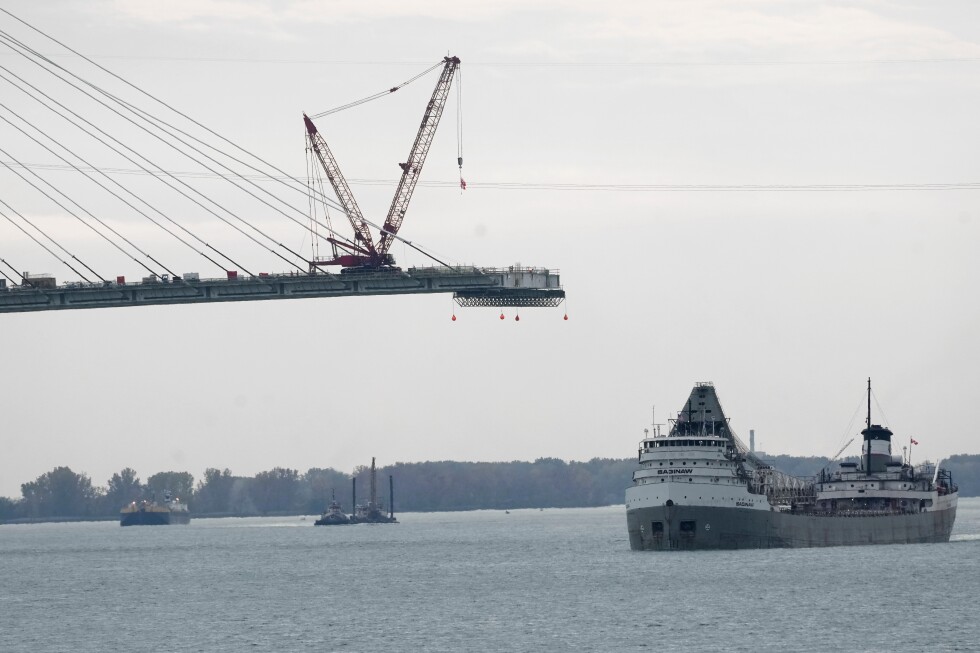
The $4.4 billion infrastructure project, named after Canadian hockey legend Gordie Howe who played 25 seasons with the Detroit Red Wings, has been under construction since 2018 and was scheduled to open in early 2026. The bridge represents a significant binational effort to alleviate congestion at existing border crossings, particularly the Ambassador Bridge and Detroit-Windsor tunnel.
The project was negotiated during former Republican Michigan Governor Rick Snyder’s administration and is being fully funded by the Canadian government, though under a joint operational agreement between Michigan and Canada upon completion.
Trump’s threat arrives amid deteriorating U.S.-Canada relations during his second term. The United States-Mexico-Canada Agreement (USMCA) is up for review this year, with Trump adopting an increasingly hard-line stance ahead of negotiations, including new tariff threats against America’s northern neighbor.
Canadian Prime Minister Mark Carney has publicly criticized what he characterizes as economic coercion from the United States on international platforms, signaling growing tension between the traditionally close allies.
It remains unclear what legal or executive mechanisms Trump might employ to block the bridge’s opening. The White House did not immediately respond to requests for clarification, nor did the Canadian Embassy in Washington.
Michigan officials from both parties have reacted strongly against the president’s threat. Democratic Senator Elissa Slotkin called the bridge a “huge boon” to Michigan’s economic future, noting its importance to continental trade. “You’ll be able to move cargo from Montreal to Miami without ever stopping at a street light,” Slotkin told The Associated Press.
“To shoot yourself in the foot and threaten the Gordie Howe Bridge means that this guy has completely lost the plot on what’s good for us versus just what’s spite against the Canadians,” she added.
Stacey LaRouche, press secretary to Democratic Governor Gretchen Whitmer, emphasized the crossing’s economic importance. “This is the busiest trade crossing in North America,” LaRouche stated, adding that the bridge is “good for Michigan workers and it’s good for Michigan’s auto industry” while representing successful bipartisan and international cooperation.
“It’s going to open one way or another, and the governor looks forward to attending the ribbon-cutting,” LaRouche affirmed.
The political dynamics add another layer of complexity to the situation. Michigan, a crucial swing state that Trump carried in both 2016 and 2024, has largely avoided the aggressive federal funding cuts and immigration enforcement actions targeting Democratic-leaning states during Trump’s second term. The president and Governor Whitmer have maintained what observers describe as an unusually cordial relationship, with Trump publicly praising Whitmer during an Oval Office appearance last April.
Democratic Representatives from Michigan districts have dismissed Trump’s threat. Representative Shri Thanedar of Detroit called the potential blocking “crazy,” stating it would harm business and jobs. Representative Debbie Dingell of Ann Arbor expressed confidence in the bridge’s timely opening, highlighting its economic importance.
“That bridge is the biggest crossing in this country on the northern border. It’s jobs. It’s about protecting our economy. It was built with union jobs on both sides,” Dingell said. “It’s going to open. Canada is our ally.”
The Gordie Howe International Bridge represents one of the largest infrastructure investments in the region in decades and is expected to significantly enhance trade efficiency between these crucial economic partners when completed.
Fact Checker
Verify the accuracy of this article using The Disinformation Commission analysis and real-time sources.

14 Comments
Using American steel would be ideal, but demanding half-ownership seems like an overreach. The two countries should work together to maximize the bridge’s economic benefits.
Agreed. Cooperation is key here rather than confrontational tactics. Compromising on steel sourcing could be a reasonable middle ground.
Blocking this bridge could disrupt vital cross-border supply chains and economic activity. The two countries should prioritize practical solutions over political posturing.
Well said. Finding a mutually beneficial arrangement would be far better than jeopardizing an important piece of North American infrastructure.
This bridge represents an important link for trade and transportation. Renegotiating the terms at this stage could introduce costly delays.
Absolutely. Threatening to block the bridge’s opening seems like a high-risk move that could hurt both countries’ economic interests.
This new Canada-Detroit bridge seems like an important piece of infrastructure. I wonder how Trump’s demands for ownership would impact the project and US-Canada relations.
Disrupting this bridge could have significant economic consequences for the region. Hopefully the two countries can find a reasonable compromise.
Trump’s position seems more focused on asserting US control than practical economic considerations. Disrupting this binational infrastructure project could backfire.
Well said. Unilateral demands may play well domestically but could damage broader US-Canada relations and economic ties.
While Trump may want more US ownership, the bridge was jointly negotiated. Canada’s investment and involvement shouldn’t be disregarded. This could become a diplomatic issue.
You raise a good point. Unilateral demands from the US side may not be well received by Canada, who has been an active partner on this project.
While Trump may want more US involvement, the Canadians have been key partners on this project. Undermining their role could create diplomatic tensions.
Agreed. This seems like an issue where flexibility and compromise would be better than heavy-handed demands from the US side.