


Listen to the article
Every day, more than $4 billion worth of goods flow across the United States’ borders with Canada and Mexico—from U.S. auto parts heading to Mexican factories to Mexican avocados destined for California supermarkets and Canadian aluminum that will become Campbell Soup cans.
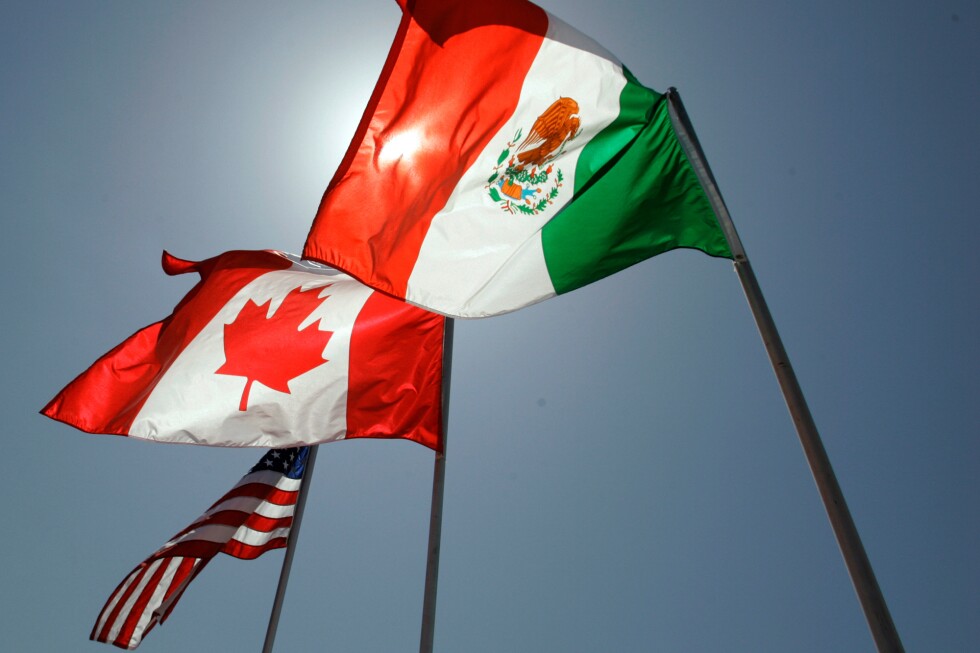
This massive trade network operates largely duty-free under the US-Mexico-Canada Agreement (USMCA), negotiated by former President Donald Trump during his first term. But as the three nations begin crucial renewal talks this week, the future of this North American trade pact hangs in the balance.
The stakes are enormous: $1.6 trillion in annual trade between the United States and its two neighbors. Mexico and Canada have surpassed China as both export destinations and import sources for the United States. American farmers particularly depend on these markets, shipping nearly $31 billion in agricultural products to Mexico and $28 billion to Canada last year alone.
Negotiations begin Monday between U.S. and Mexican trade officials in what analysts expect to be challenging discussions. The USMCA, which took effect in July 2020, replaced the 1994 North American Free Trade Agreement (NAFTA), which Trump had sharply criticized as a job killer that encouraged U.S. companies to relocate factories to Mexico.
While the USMCA maintained many of NAFTA’s provisions, it added requirements to encourage higher wages at regional factories and ensure more North American content in manufactured goods. The agreement also modernized trade rules for the digital economy, prohibiting import taxes on products sold electronically between the three countries.
Despite initially hailing the USMCA as “the fairest, most balanced and beneficial trade agreement we have ever signed,” Trump’s enthusiasm has visibly cooled. In January, he dismissed the renewal effort as “irrelevant” with “no real advantage to us.” His top trade negotiator told Politico in December that Trump would consider withdrawing from the pact if he cannot secure desired changes.
Trump has even suggested negotiating separate bilateral agreements with Canada and Mexico, potentially dismantling the three-country North American economic bloc that previous administrations viewed as essential for competing with China and the European Union.
The renewal process offers several paths forward. The three countries could simply renew the USMCA for another 16 years as is—though experts consider this unlikely. Alternatively, they could continue negotiating improvements, with a deadline that extends to 2036 before the agreement expires. More concerning to Canada and Mexico is the provision allowing any country to withdraw with six months’ notice—an option they fear Trump might exercise.
Under the USMCA, many North American goods continued to enter the United States duty-free during Trump’s 2025 tariff implementation. However, several products remained subject to significant tariffs, including medium and heavy-duty trucks (25%), steel, aluminum and copper (50%), and Mexican tomatoes (17%).
The USMCA has not resolved one of Trump’s primary concerns: the U.S. trade deficit with Mexico, which reached a record $197 billion last year as American companies shifted away from Chinese imports. The U.S. also maintained a merchandise trade deficit with Canada of $46.4 billion, though this represented a decrease from 2024.
“Improvements are required for it to deliver the high-wage U.S. manufacturing powerhouse and balanced trade Trump promised and we need,” said Lori Wallach, director of the Rethink Trade program at the American Economic Liberties Project.
U.S. negotiators plan to push for stronger rules preventing Chinese goods from entering through USMCA channels, increased domestic production incentives, and greater access to Canada’s protected dairy market for American farmers.
Mexico’s priorities are more defensive: avoiding major rewrites to the agreement and making rules of origin more flexible to allow parts from outside North America when regional alternatives aren’t available. Mexican Economy Secretary Marcelo Ebrard has emphasized the need for strengthened dispute resolution mechanisms that would provide clear channels for addressing trade issues without immediately resorting to tariffs.
The Sheinbaum administration must simultaneously manage existing security challenges following the killing of a major cartel leader in February, which could influence economic discussions.
Mexican officials are emphasizing the mutual benefits of North American integration. “The integration of our countries is an absolute prerequisite for the United States to remain competitive,” Ebrard recently stated. “We must move forward together; otherwise, we will not succeed.”
With Canada expected to join the talks later, the immediate focus remains on U.S.-Mexico negotiations and preserving the integrated North American economic framework that has shaped continental commerce for three decades.
Fact Checker
Verify the accuracy of this article using The Disinformation Commission analysis and real-time sources.

14 Comments
The high stakes of these USMCA negotiations underscore the importance of maintaining strong economic ties between the US, Mexico, and Canada. Let’s hope the talks result in a mutually beneficial outcome.
Billions of dollars in annual trade are at stake as the US, Mexico, and Canada work to renew this important trade agreement. The negotiations will be closely watched by businesses and consumers across the region.
Agricultural trade will be a key focus area. US farmers rely heavily on Mexican and Canadian markets for their exports.
As the US, Mexico, and Canada seek to renew the USMCA, it will be interesting to see how they balance economic priorities with political considerations. The outcome could reshape North American trade for years to come.
Maintaining the duty-free flow of goods is crucial, but the countries will also need to address emerging issues like digital trade and supply chain resilience.
Tricky negotiations indeed. With Mexico and Canada now surpassing China as major trade partners for the US, the USMCA renewal will have significant geopolitical implications.
$1.6 trillion in annual trade is a huge number. Renewing the USMCA will be vital for preserving the integrated North American economy and supply chains.
I wonder if there will be any pushback from domestic industries looking to protect their markets from foreign competition.
The USMCA has been a major driver of North American economic integration. Renewing it on favorable terms will be a complex challenge, but one that is vital for the region’s continued prosperity.
With the USMCA set to expire, the pressure is on for these three countries to find common ground and maintain the free flow of goods across their borders. Any disruption could have far-reaching economic consequences.
The USMCA trade pact is crucial for North American trade and economic integration. Challenging negotiations lie ahead as the three countries aim to renew this agreement on favorable terms.
Renegotiating NAFTA was a priority for the Trump administration. Let’s see how the USMCA talks progress under the current US, Mexican, and Canadian leadership.
Aluminum, auto parts, avocados – the range of products traded duty-free under USMCA is vast. Ensuring the continued smooth operation of this North American trade network will be critical.
I’m curious to see how issues like labor standards and environmental regulations are addressed in the USMCA renewal talks.