


Listen to the article
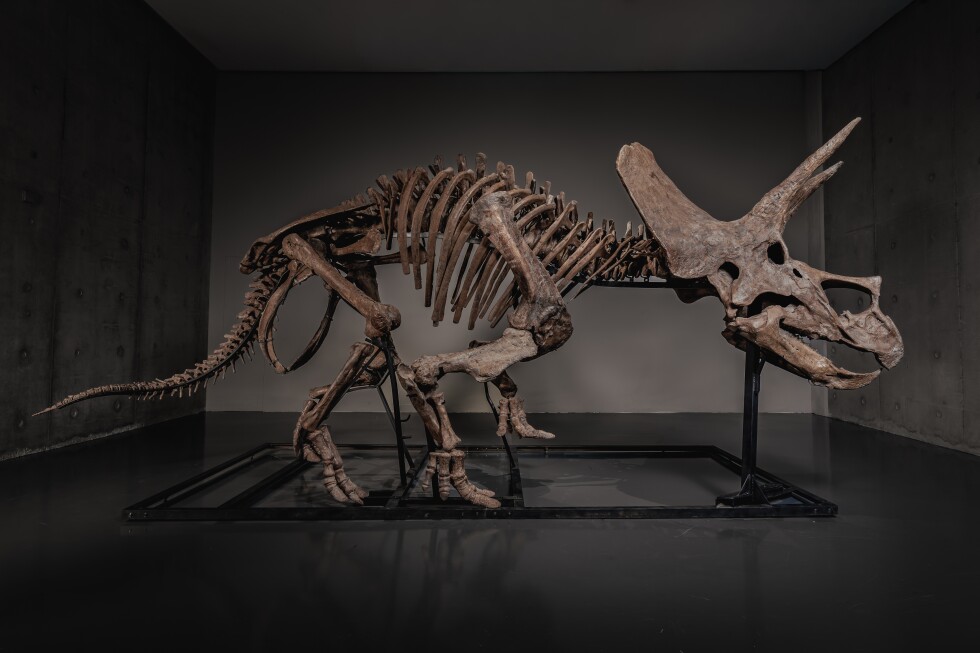
After decades on display at a Wyoming museum, a rare triceratops skeleton known as “Trey” is headed to auction amid a booming market for prehistoric fossils. The 66-million-year-old specimen will be available for bidding from March 17 to 31 on Joopiter, an online auction platform founded by musician Pharrell Williams, with an estimated value between $4.5 million and $5.5 million.
The 17-foot-long herbivore was discovered near Lusk, Wyoming, in 1993 by Lee Campbell and the late Allen Graffham, a commercial paleontologist noted for numerous significant discoveries. Trey became a centerpiece attraction when the Wyoming Dinosaur Center in Thermopolis opened its doors in 1995 and remained on loan there until 2023.
Following a private sale, the fossil is currently in Singapore, where it is available for private viewings through March. Paleontologist Andre LuJan, who worked with Joopiter to prepare the specimen for auction, emphasized Trey’s cultural significance.
“This fossil has a cultural aspect that many auction fossils simply don’t have,” LuJan said. “It’s connected to people and has undoubtedly inspired young visitors to pursue careers in paleontology.”
The market for dinosaur fossils has experienced extraordinary growth in recent years, transforming what was once primarily the domain of academic institutions into a lucrative investment opportunity. In 2024, a stegosaurus skeleton named “Apex” sold for a record-breaking $44.6 million, surpassing the previous high mark of $31.8 million paid for “Stan,” a Tyrannosaurus rex, in 2020.
The market’s strength was further demonstrated last July when a rare juvenile dinosaur skeleton at Sotheby’s exceeded its pre-auction estimate of $4-6 million, ultimately fetching over $30 million after a competitive bidding process.
Caitlin Donovan, Joopiter’s global head of sales, attributes this surge in interest to a broader shift in collecting patterns, with buyers moving away from traditional categories like fine art toward objects with stronger “cultural resonance.”
“Dinosaurs have always captivated our imagination, and people are now starting to see the value in investing in these as assets,” explained LuJan, highlighting the growing recognition of fossils as both cultural artifacts and financial investments.
However, the escalating prices have raised concerns within the scientific community. As private collectors and investors drive values to unprecedented heights, public institutions find themselves increasingly unable to compete.
“Museums are getting totally priced out of an exploding market,” said Kristi Curry Rogers, a paleontologist at Macalester College in Minnesota, who is not involved with Trey’s sale. She warned about the potential scientific consequences of specimens disappearing into private collections.
“If a fossil goes into a private collection without guaranteed access forever, that data is essentially lost to science,” Curry Rogers explained, underscoring the research value these specimens hold beyond their commercial appeal.
LuJan countered these concerns by noting that Trey has always been privately owned, and expressed hope that the fossil would ultimately find its way to a museum. He pointed to “Apex” as an example of a positive outcome – the stegosaurus is now displayed at New York’s American Museum of Natural History through a long-term loan agreement that also permits scientific study.
“We’ve experienced a paradigm shift in what owning dinosaurs means to society,” LuJan said. “People are naturally gravitating toward benevolent arrangements where they loan specimens to museums long-term or donate them to newly established institutions.”
As Trey heads to auction, the sale represents another chapter in the evolving relationship between private fossil ownership and public scientific access – a tension that continues to shape paleontological research in an era of skyrocketing fossil prices.
Fact Checker
Verify the accuracy of this article using The Disinformation Commission analysis and real-time sources.

7 Comments
This is a remarkable fossil! Triceratops skeletons are incredibly rare and valuable. I wonder how bidding will unfold for this 66-million-year-old specimen with such an interesting history and cultural significance.
This is a truly remarkable fossil find. I’m curious to see how the bidding plays out and who ends up acquiring this iconic triceratops skeleton known as Trey. Paleontology continues to captivate the public’s imagination.
It’s great that this Trey triceratops fossil has inspired so many young people to pursue careers in paleontology over the years. Fossils like this one are windows into our prehistoric past and deserve to be preserved and studied.
The booming dinosaur fossil market is quite fascinating. I’m curious to see what price range this iconic Trey triceratops skeleton ends up fetching at auction. Paleontology has always captured the public’s imagination.
Absolutely, the high estimated value of $4.5-$5.5 million reflects the intense demand for rare, well-preserved dinosaur fossils like this one. It will be exciting to follow the auction.
I wonder what insights this triceratops skeleton could provide about the behaviors and habitats of these fascinating herbivorous dinosaurs. The high auction value underscores how valuable such rare fossils are for scientific research and public education.
Excellent point. Detailed analysis of this specimen could yield new discoveries about triceratops anatomy, diet, and other aspects of their ecology. Fossils are invaluable scientific resources.