


Listen to the article
Widespread Lead Contamination Found in New Orleans Water System, Threatening Public Health
Katherine Prevost, a 72-year-old New Orleans resident, was shocked when a recent water test revealed lead contamination in her tap water. For decades, she used this water for cooking her gumbos and crawfish boils, unaware of the potential danger lurking in her pipes.
“We always thought we had good plumbing,” said Prevost, who has lived in the same Upper Ninth Ward home for nearly 60 years. “But because the pipes on the street side is not fixed, that means that regardless of what we do, we’re gonna have lead in our water.”
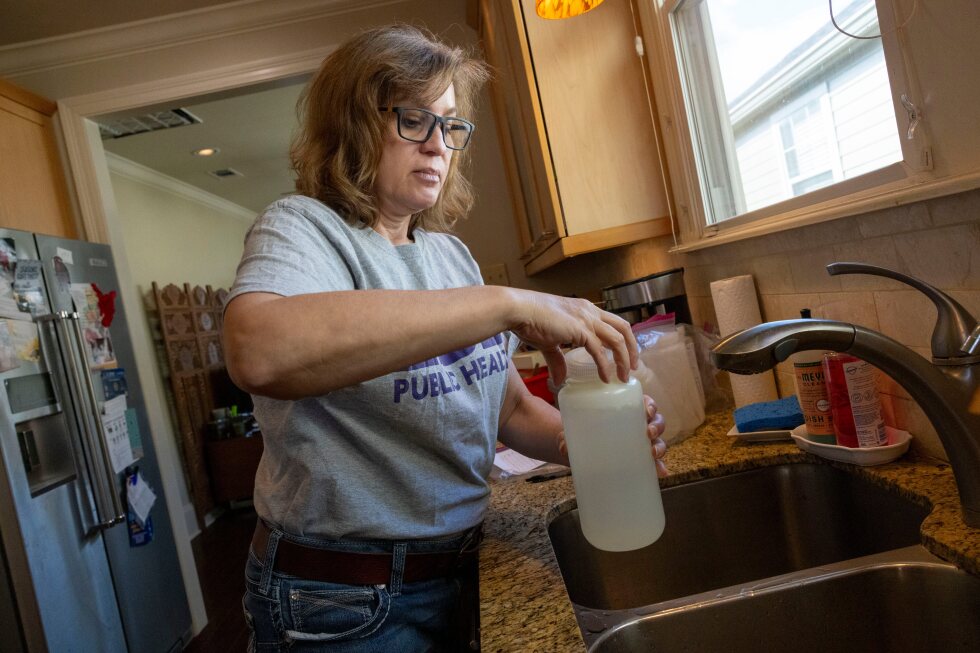
Her experience is far from unique. On Prevost’s Congress Street block alone, lead was detected in seven out of eight households tested. According to previously unpublished data from the Sewerage and Water Board of New Orleans (S&WB) obtained by Verite News, approximately 70% of households participating in the city’s free water testing program between September 2022 and May 2023 had lead in their water. Almost all of these homes exceeded the American Academy of Pediatrics’ recommended limit of 1 part per billion.
The testing program, which examined more than 1,100 households, revealed alarming results. The worst sample showed lead levels 100 times the federal action level. The S&WB’s inventory indicated that homes with lead detected likely had lead service lines on the city’s side of the water meter.
Experts point to the city’s aging infrastructure as the primary culprit. New Orleans boasts one of the oldest water systems on the Gulf Coast, with pipes dating back more than a century.
“Lead is rather ubiquitous in our water, it is all around us,” said Adrienne Katner, an LSU professor specializing in lead and drinking water research. Public health experts warn that the city isn’t doing enough to alert residents to the danger or protect them from exposure.
While the city’s water system technically complies with federal standards, those standards don’t adequately protect residents. Current EPA regulations require 90% of homes in a small survey sample to have less lead than the federal action level, currently set at 15 parts per billion (dropping to 10 ppb in 2027). Since 2012, 90% of S&WB-tested homes had 5 to 8 parts per billion of lead or less.
However, independent testing reveals a more troubling reality. Taya Fontenette, who recently headed the Water Collaborative of Greater New Orleans’ lead awareness program, found lead in 88% of nearly 150 homes she tested in 2023.
Health experts emphasize that no amount of lead is safe for consumption. Even trace amounts can harm brain development in children and contribute to a wide range of health issues in adults, including high blood pressure, kidney problems, and heart disease.
“It cannot be emphasized highly enough that lead affects us all. It affects nearly every organ in the body,” Katner said. “We all need to make every effort to reduce our exposure throughout our entire lifetime.”
The urgency for pipe replacement intensified in 2023 when saltwater intrusion threatened the city’s water supply. Saltwater accelerates pipe corrosion, and climate change increases the likelihood of similar events occurring in the future.
Despite the clear danger, progress on lead pipe replacement has been slow. Contract disputes, costs, and legislative hurdles mean complete replacement could take years. The S&WB recently began accepting new bids for a project management firm for its lead pipe program after an earlier procurement process failed.
“The reality is, to change out service lines, it’s going to be a very long and very expensive project for us,” said Rebecca Johnsey, S&WB’s deputy general superintendent of water programs. “This is not an overnight fix.”
In the meantime, the utility has started replacing lead lines at schools and daycares. As of December, the S&WB had replaced lines serving 14 schools and 144 residences, with three more school replacements scheduled. It had also conducted over 350 service line inspections.
The scale of the problem is immense. Federal estimates suggest 4-9 million lead pipes remain in use nationwide. In New Orleans, the S&WB predicts 50-60% of its 150,000 metered service lines will need partial or complete replacement. Lead was commonly used in early 20th century plumbing due to its malleability, particularly valuable in New Orleans’ shifting soil conditions.
While the water leaves treatment facilities lead-free, the toxic metal leaches from pipes as water travels to homes. The S&WB treats water with corrosion-reducing chemicals, but this doesn’t fully prevent contamination. Disturbances to water lines—including replacement work, road construction, or meter installations—can dislodge lead particles, causing contamination spikes that last for months.
In 2017, the New Orleans Office of the Inspector General investigated the S&WB’s failure to notify residents of heightened lead risk during post-Hurricane Katrina reconstruction. The investigation found thousands of residents may have been unknowingly exposed to elevated lead levels. The agency is now considering a follow-up investigation.
The health implications are serious, particularly for children and pregnant women. Lead can pass from mother to fetus, potentially causing developmental problems and premature births.
“Lead is especially hazardous for children because their brain and their tissues are still developing,” explained Megan Maraynes, an emergency room pediatrician at Manning Family Children’s. Black infants may face higher risk, as studies show they’re more likely to consume formula mixed with tap water.
For the elderly, like Prevost, lead exposure can exacerbate existing health conditions. She wonders if her autoimmune disease, type 2 diabetes, and high blood pressure might be connected to decades of lead exposure.
The S&WB expects to spend approximately $1 billion replacing all of the city’s lead pipes by 2037. So far, the utility has secured $152 million in funding from the Drinking Water State Revolving Loan Fund. However, a provision in the state constitution currently prevents public funds from being used to replace lead lines on private property, creating another obstacle to comprehensive replacement.
As the city works through these challenges, residents like Prevost are left to protect themselves. She plans to stop using tap water for brushing her teeth and will invest in filters or bottled water.
“Fix our pipes so we can be healthy,” Prevost urged. “And so we don’t have to worry about, ‘do we have to buy bottled water’ and ‘do we have to test the water’ before we put it up to our mouth.”
Fact Checker
Verify the accuracy of this article using The Disinformation Commission analysis and real-time sources.
