


Listen to the article
Tokyo’s Nikkei Surges to Record High Following Decisive Japanese Election
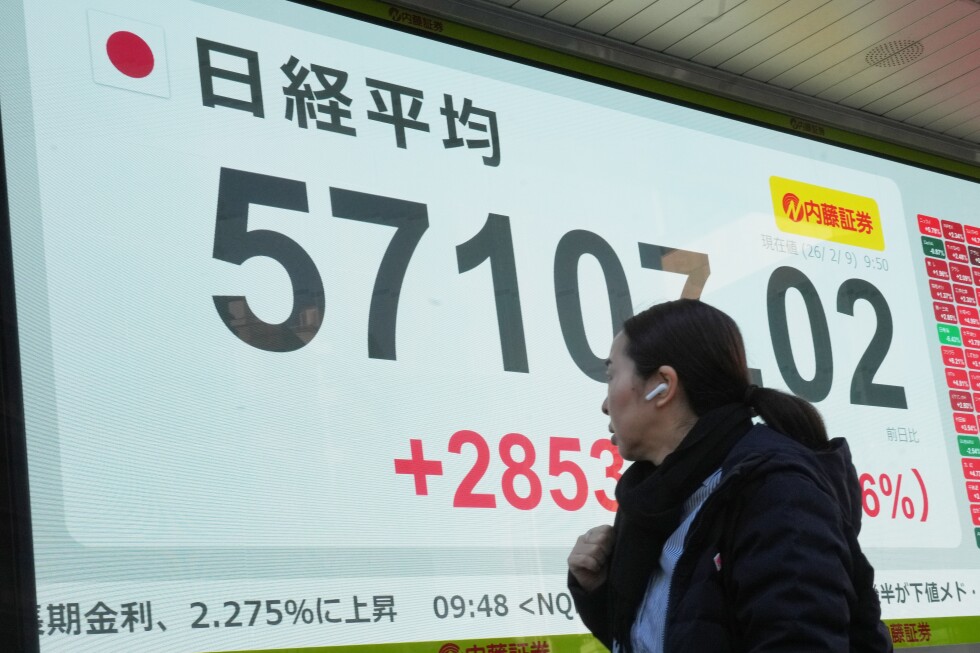
Tokyo’s Nikkei 225 share index soared as much as 5% to an all-time high on Monday after Japanese Prime Minister Sanae Takaichi’s Liberal Democratic Party secured a commanding two-thirds supermajority in parliamentary elections.
By late morning, the Nikkei was trading up 4.7% at 56,788.85, having briefly topped 57,000 earlier in the session to set a new record. The dramatic rise reflects investor confidence in Takaichi’s market-friendly economic agenda, as she has pledged to revitalize Japan’s stagnant economy.
“Japan just delivered the kind of election result markets instinctively embrace because it removes the one thing traders price at a premium: political ambiguity,” noted Stephen Innes of SPI Asset Management. “Politically, the win hands Prime Minister Takaichi freedom of movement and removes the need to bargain every decision down to the lowest common denominator.”
According to public broadcaster NHK, Takaichi’s LDP alone secured 316 seats by early Monday in the 465-member lower house of parliament, comfortably surpassing the 261-seat absolute majority threshold. This represents a historic achievement for the party, marking its strongest electoral performance since its founding in 1955 and exceeding the previous record of 300 seats won under Prime Minister Yasuhiro Nakasone in 1986.
The election victory provides Takaichi with a strong mandate as she tackles her first major task: passing a delayed budget bill to fund economic measures addressing inflation and stagnant wages when the lower house reconvenes in mid-February.
The bullish sentiment extended across Asian markets, with South Korea’s Kospi surging 4.3% to 5,308.84. Hong Kong’s Hang Seng index climbed 1.5% to 26,963.25, while the Shanghai Composite rose 1.2% to 4,112.92. Taiwan’s Taiex gained 2.5%, and Australia’s S&P/ASX 200 jumped 1.9% to 8,873.60.
The regional rally followed Friday’s strong performance on Wall Street, where the S&P 500 rose 2% for its best day since May. The Dow Jones Industrial Average soared 1,206 points, or 2.5%, breaking above the symbolic 50,000 mark for the first time in its history. The tech-heavy Nasdaq composite advanced 2.2%.
Technology stocks, which had suffered significant losses earlier in the week, led Friday’s U.S. market recovery. Semiconductor giant Nvidia jumped 7.8%, trimming its weekly loss that had exceeded 10% at one point. Broadcom climbed 7.1%, erasing its decline for the week.
Despite Friday’s surge, the S&P 500 still recorded its third losing week in the past four. Investor concerns about spending by influential Big Tech companies persisted, while fears that artificial intelligence might disrupt software businesses particularly affected that sector. Software stocks had been hit hard after AI firm Anthropic released free tools to automate services like legal work.
The cryptocurrency market also found some stability, with Bitcoin climbing back above $70,000 after a weeks-long plunge that had briefly sent it near $60,000 late Thursday—more than halfway below its October record.
In currency markets, the dollar weakened slightly against the Japanese yen, trading at 156.85 yen compared to 157.19 yen late Friday. The euro edged up to $1.1820 from $1.1812.
Precious metals markets, which had experienced their own volatility, showed signs of stabilization. Gold rose 0.7% in early Monday trading, while silver surged 4.8%. In Friday’s session, gold had settled 1.8% higher at $4,979.80 per ounce.
Oil prices retreated, with U.S. benchmark crude shedding 55 cents to $63.00 per barrel, while Brent crude, the international standard, gave up 66 cents to $67.39 per barrel.
Fact Checker
Verify the accuracy of this article using The Disinformation Commission analysis and real-time sources.

10 Comments
Impressive election result for PM Takaichi’s LDP party. The Nikkei’s surge reflects investor confidence in her market-friendly economic agenda. It will be interesting to see how she aims to revitalize Japan’s economy.
Removing political ambiguity is a big win for markets. Takaichi’s supermajority gives her the freedom to push through her economic priorities.
While the Nikkei’s surge is promising, I hope Takaichi’s policies will also address social inequalities and environmental challenges facing Japan. Sustainable economic growth is crucial.
It will be interesting to see how Takaichi’s election victory impacts global commodity markets, especially for key Japanese imports like copper, lithium, and uranium. Increased Japanese demand could shift global supply and pricing dynamics.
This election result could have significant implications for Japan’s mining, metals, and energy sectors. I wonder if Takaichi will prioritize boosting domestic production or focus more on trade and investment.
Takaichi’s pro-business agenda may benefit commodity producers and related equities. However, environmental considerations will also be important to monitor.
While the Nikkei’s surge is encouraging, I hope Takaichi’s economic policies will also address the needs of Japan’s workers and families, not just big business interests. A balanced approach is essential for long-term prosperity.
You raise a good point. Takaichi will need to find ways to boost productivity and competitiveness while also ensuring the benefits are shared more broadly in Japanese society.
The Nikkei hitting a new record high is certainly good news for Japan’s markets and economy. I’m curious to learn more about Takaichi’s specific policy proposals and how they aim to spur growth.
A decisive election victory is exactly what Japan’s economy needs right now after years of stagnation. Takaichi will have a strong mandate to enact her economic vision.