


Listen to the article
Americans Feel Economic Strain During Holiday Season, Poll Finds
A new AP-NORC poll reveals that this holiday season lacks its usual cheer for many Americans as they face persistent financial pressures, with large numbers dipping into savings and hunting for bargains amid a perception that the economy remains stagnant under President Donald Trump.
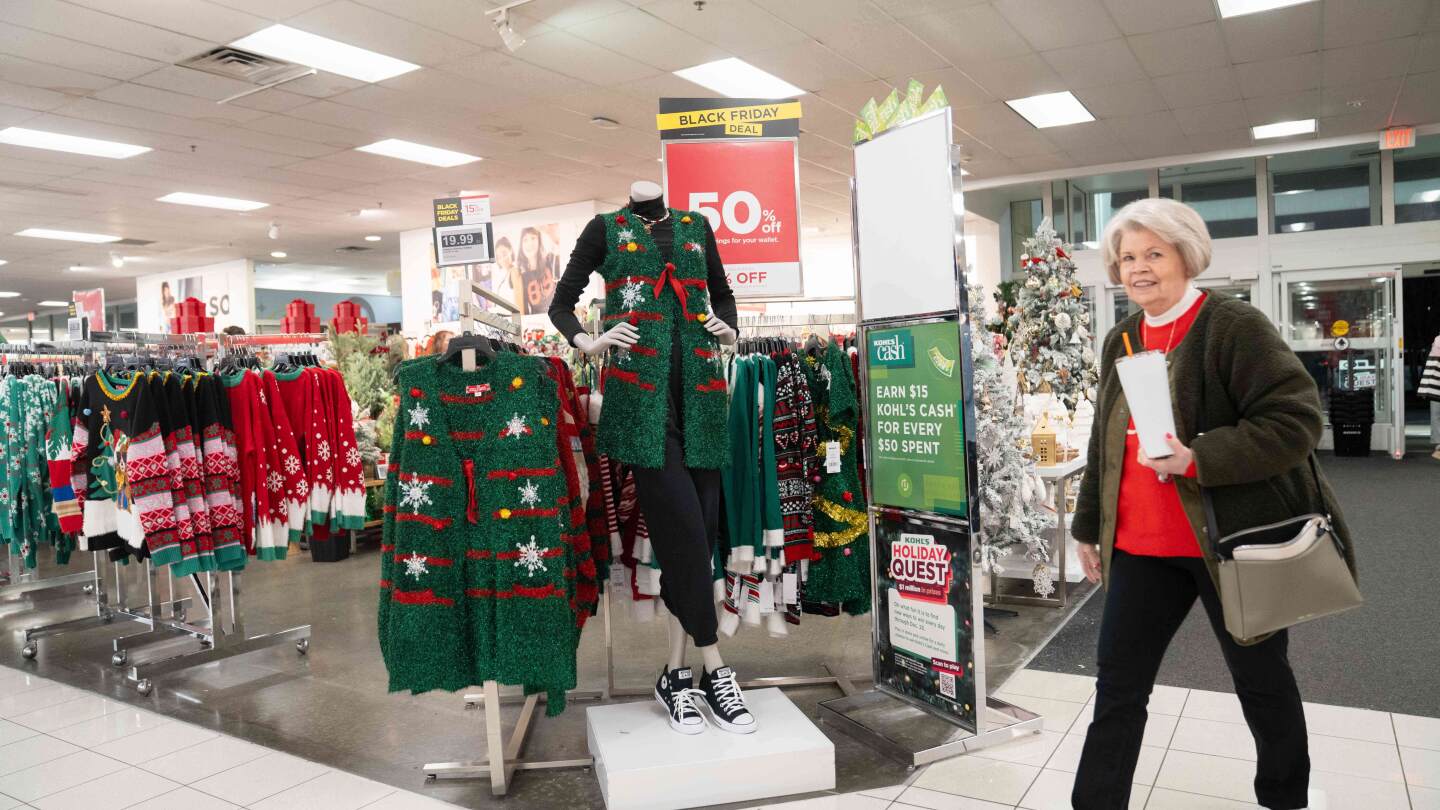
The survey indicates that an overwhelming majority of U.S. adults have noticed higher than usual prices for groceries, electricity, and holiday gifts in recent months. Approximately half of Americans report greater difficulty affording gifts they wish to purchase, with similar numbers postponing major purchases or reducing discretionary spending more than they typically would.
These findings present a challenging reality for the Republican president, who reclaimed the White House largely on promises to lower prices. Despite Trump’s return to office, inflation continues to threaten his popularity just as it did during Democrat Joe Biden’s presidency. The current poll results closely mirror those from December 2022, when Biden was president and the nation was struggling with higher inflation rates.
Trump’s implemented tariffs have contributed to inflationary pressures and created unease about U.S. economic stability, keeping prices at levels many Americans find burdensome. The president has nonetheless insisted there is “no” inflation and that the economy is thriving, expressing frustration at the disconnect between his assessment and public sentiment.
“When will people understand what is happening?” Trump posted on Truth Social last Thursday. “When will Polls reflect the Greatness of America at this point in time, and how bad it was just one year ago?”
Despite the president’s optimism, about 68% of U.S. adults continue to describe the country’s economy as “poor,” unchanged from December 2024, before Trump’s return to office.
White House officials plan to send Trump across the country to boost public confidence in the economy ahead of next year’s midterm elections. However, the president’s recent comments in Pennsylvania, where he defended price increases tied to his tariffs by suggesting Americans should buy fewer toys and school supplies for children, stand in stark contrast to concerns expressed by poll respondents—even among his supporters.
Sergio Ruiz, a 44-year-old Trump voter from Tucson, Arizona, reported increasing use of “buy now, pay later” programs to manage gift expenses for his children. “Prices are up. What can you do? You need to make more money,” Ruiz said, adding that he hopes for lower interest rates to help his real estate business.
The poll found that about half of Americans are more actively seeking the lowest prices than usual, while approximately 40% are dipping into their savings more than normal. Democrats are more likely than Republicans to report cutting expenses or hunting for bargains, though many Republicans are also budgeting more carefully than usual.
Public sentiment about holiday shopping and the economy appears remarkably similar to late 2022 under Biden’s presidency, when inflation had reached a four-decade high. Although inflation has since eased substantially, it still runs at 3%—a full percentage point above the Federal Reserve’s target—as the job market shows signs of slowing.
The survey suggests that the absolute level of prices, not just the rate of inflation, causes financial strain for many families. Roughly 87% of U.S. adults report noticing higher than usual grocery prices in recent months, while about two-thirds cite higher prices for electricity and holiday gifts. Approximately half note higher than normal gasoline prices.
Consumer spending has remained resilient despite negative economic sentiment, though Trump’s tariffs have altered shopping behaviors. Andrew Russell, a 33-year-old adjunct professor in Arlington Heights, Illinois, said he previously shopped online for unique global gifts but now buys locally. “This year, I only bought things that I can pick up in person,” noted Russell, who voted Democratic in 2024.
Looking ahead, few Americans expect significant economic improvement next year—indicating that Trump’s combination of tariffs, income tax cuts, and international investment initiatives has done little to build confidence. About 40% of U.S. adults expect economic conditions to worsen next year, while roughly 30% anticipate little change. Only about 20% believe things will improve, with Republicans showing greater optimism.
This represents a decline in economic optimism from last year, when approximately 40% believed 2025 would be better than 2024. Trump has maintained that benefits from his policies will become more apparent in 2026.
Millicent Simpson, a 56-year-old Cleveland resident who relies on government assistance programs, expects the economy to worsen for people in her situation. “He’s making it rough for us,” she said of Trump. “He’s messing with the government assistance for everybody, young and old.”
The AP-NORC poll surveyed 1,146 adults between December 4-8 using a sample drawn from NORC’s probability-based AmeriSpeak Panel, designed to be representative of the U.S. population. The margin of sampling error is plus or minus 4 percentage points.
Fact Checker
Verify the accuracy of this article using The Disinformation Commission analysis and real-time sources.

19 Comments
Production mix shifting toward Business might help margins if metals stay firm.
Nice to see insider buying—usually a good signal in this space.
Good point. Watching costs and grades closely.
Good point. Watching costs and grades closely.
I like the balance sheet here—less leverage than peers.
Good point. Watching costs and grades closely.
Good point. Watching costs and grades closely.
I like the balance sheet here—less leverage than peers.
If AISC keeps dropping, this becomes investable for me.
Good point. Watching costs and grades closely.
Good point. Watching costs and grades closely.
I like the balance sheet here—less leverage than peers.
Good point. Watching costs and grades closely.
Silver leverage is strong here; beta cuts both ways though.
I like the balance sheet here—less leverage than peers.
Good point. Watching costs and grades closely.
Good point. Watching costs and grades closely.
If AISC keeps dropping, this becomes investable for me.
I like the balance sheet here—less leverage than peers.