


Listen to the article
U.S. Opens First Domestic Sterile Screwworm Fly Facility in Decades to Protect Cattle Industry
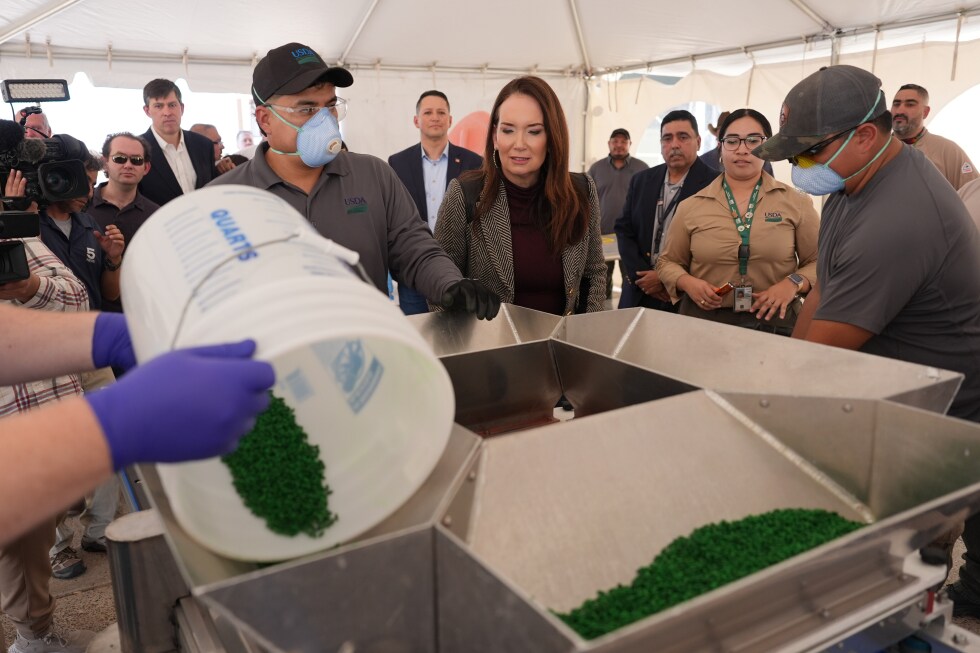
A new center for dispersing sterile screwworm flies opened Monday in Edinburg, Texas, marking the first such facility on U.S. soil in decades. The center represents a critical defense against the flesh-eating parasite that threatens to cross the Mexican border and potentially devastate the American cattle industry.
U.S. Agriculture Secretary Brooke Rollins and Texas Governor Greg Abbott unveiled the facility, located at a former Air Force base. The center will enable the dispersal of millions of sterile male New World screwworm flies—bred in either Mexico or Panama—along both sides of the U.S.-Mexico border.
“It’s a real testament to the all hands on deck—federal, state and local—the fact that we do not have the pest in our country yet,” Rollins said during the opening ceremony.
The new facility serves as an interim solution while the USDA constructs a larger, more permanent breeding operation. The department is investing $750 million in a fly factory in the same region, though construction isn’t expected to be completed until late 2027. Additionally, the USDA is allocating $21 million to convert an existing fruit fly breeding facility in southern Mexico into one that can produce screwworm flies beginning this summer.
The sterile fly strategy employs a simple but effective biological control mechanism. When sterile male flies mate with wild females—who only mate once during their brief adult lives—the eggs laid in open wounds or on mucous membranes fail to hatch into the destructive maggots that devour the living flesh of infected animals.
These flesh-eating larvae pose a serious threat to livestock, wild mammals, pets, and potentially humans, making the control program essential for agricultural biosecurity.
The Mexican cattle industry has already suffered significant losses from screwworm infestations. In response, the United States closed its border to imports of cattle, bison, and horses from Mexico last July, disrupting an important trade relationship between the two countries.
Governor Abbott emphasized the urgency behind the new facility: “We knew we needed a short-term, gap-filling solution, which is exactly what we are cutting a ribbon on today.”
This isn’t the first time the U.S. has battled screwworm flies. A similar program breeding sterile males had largely eradicated the pest from American territory by the early 1970s. Since then, outbreaks have been rare and contained, including a limited incident in the Florida Keys in 2017 and a recent case involving a horse being imported from Argentina into Florida, which was promptly treated.
After eliminating the pest domestically, the U.S. had shuttered its fly factories. For years, a single facility in Panama has been the Western Hemisphere’s only producer of sterile males, with a capacity of about 117 million flies weekly. The planned new Texas facility will significantly expand this capacity, designed to produce up to 300 million sterile flies per week.
In November, the USDA opened a dispersal facility in Tampico, central Mexico, to distribute Panama-bred flies. However, that location sits approximately 330 miles south of the U.S.-Mexico border, limiting its effectiveness for protecting U.S. territory.
Beyond the new facilities, the USDA announced last month it would offer up to $100 million in grants for innovative projects aimed at improving fly breeding techniques, developing more effective traps and lures, and creating new treatments for infestations.
The comprehensive approach highlights the serious threat screwworm poses to American agriculture and the significant resources being deployed to prevent its reestablishment in the United States, protecting both the economic interests of the cattle industry and animal welfare across the region.
Fact Checker
Verify the accuracy of this article using The Disinformation Commission analysis and real-time sources.

11 Comments
Curious to see how effective this sterile fly program will be at controlling the screwworm parasite. It’s good the US is taking proactive steps, but $750 million is a substantial investment – hope it pays off in the long run.
You raise a fair point. The upfront costs are high, but the potential economic damage from a screwworm outbreak could be catastrophic for the cattle industry. Protecting livestock health is clearly a top priority.
Interesting to see the US taking proactive steps to combat the screwworm parasite threat through this new sterile fly dispersal facility. Disrupting the breeding cycle is a clever approach, though the multi-year timeline for the permanent operation is concerning.
Glad to see the US government taking this threat seriously and establishing a dedicated facility to combat the screwworm. Dispersing sterile flies is an innovative approach, though the multi-year timeline for the full facility is concerning.
This seems like an important initiative to safeguard the US cattle industry from the devastating screwworm parasite. Deploying sterile male flies to disrupt breeding is a smart tactic, though the substantial investment and lengthy timeline for the full facility is noteworthy.
You make a fair point. The upfront costs are high, but preventing a potential screwworm outbreak that could cripple the cattle sector is likely worth the investment in the long run. Protecting livestock health is critical.
The US opening a dedicated screwworm fly facility is an interesting and necessary move to protect the cattle industry. Dispersing sterile males is an innovative approach, though the multi-year timeline for the full facility is a bit concerning.
This is an important initiative to safeguard the US cattle industry. Screwworms can be highly destructive, so deploying sterile male flies to disrupt their breeding cycle makes a lot of sense. Curious to see the results of this program over time.
Agreed, preventing the screwworm from gaining a foothold in the US is critical. The interim facility is a prudent step while the larger permanent operation is built. Proactive measures like this can help avoid major economic damage down the line.
This is an interesting initiative to protect the US cattle industry from the devastating screwworm parasite. Dispersing sterile male flies to disrupt breeding seems like a smart approach, though the timeline for the larger facility is quite long.
Yes, the interim facility is a critical stopgap measure while the permanent operation is built. Preventing the screwworm from crossing into the US is vital for ranchers and the broader livestock sector.