


Listen to the article
European Union Expands Global Trade Partnerships Amid U.S. Policy Shifts
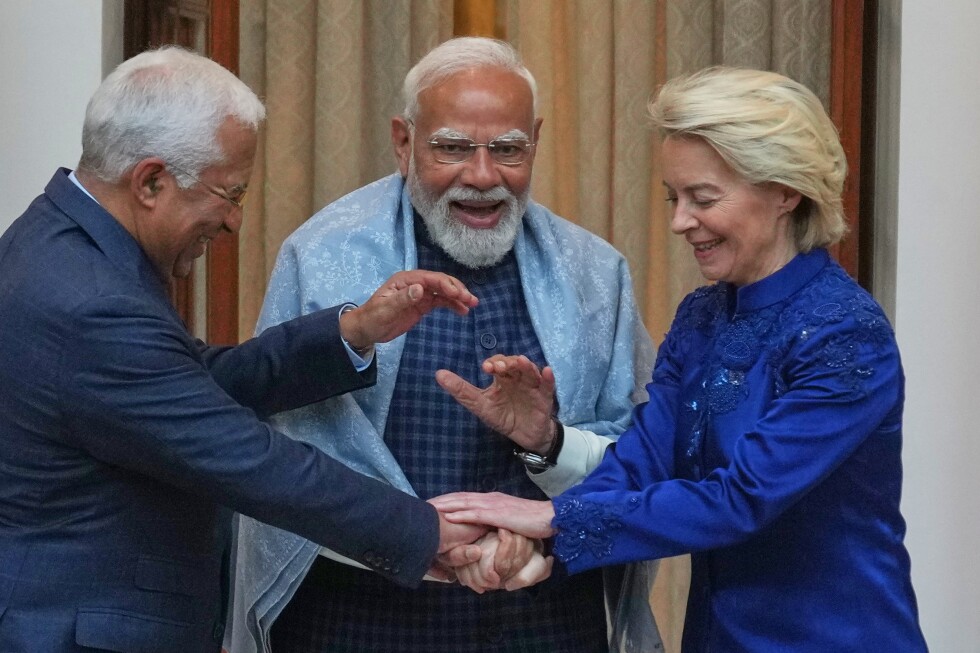
The European Union and India announced an ambitious free trade agreement on Tuesday, marking the latest step in the EU’s aggressive push to forge new global economic partnerships at a time of increasing uncertainty in transatlantic relations.
The landmark deal, which European Commission President Ursula von der Leyen called the “mother of all deals” after signing it in New Delhi, could affect up to 2 billion people. It will eliminate tariffs on nearly 97% of EU exports to India—including cars and wine—and 99% of India’s shipments to the EU, such as textiles and medicines.
“Europe and India need each other today like never before,” said Garima Mohan, a senior fellow at the German Marshall Fund. She noted that while Brussels and New Delhi have long sought closer ties as a counterweight to China’s economic rise, recent U.S. policy shifts under the Trump administration accelerated the process.
“This movement towards diversification, looking for new partners as well as building self-reliance was precipitated by the tensions with China and really driven home by the fracture of the trans-Atlantic partnership,” Mohan explained. The timing of the deal “says something of the world we live in.”
The agreement reflects a broader strategic pivot by the EU, which has rapidly expanded its global trade relationships over the past year. In July, the bloc struck its first trade deal with Indonesia. Two weeks ago, von der Leyen signed an agreement with South America’s Mercosur nations after decades of negotiations, creating a market of over 700 million people. The EU has also strengthened economic ties with Japan, South Korea, and Australia—Pacific nations wary of both Beijing’s ambitions and Washington’s unpredictable politics.
“There is a hope that things will change given the importance of the U.S. for us… but there is a realization now that we are a bit more alone in this world,” said Ivano di Carlo, a senior policy analyst at the European Policy Centre.
This accelerated push for new partnerships comes after President Trump threatened to impose tariffs on European goods over disputes including American control of Greenland, only to reverse course days later. Such policy volatility has pushed the EU to pursue what Cypriot President Nikos Christodoulides called “decisive, credible and united action” during his speech outlining priorities for Cyprus’ six-month EU presidency.
“The international order we relied upon for decades is no longer a given,” Christodoulides told the European Parliament. “This moment calls for a union that is more autonomous and open to the world.”
Beyond trade, the EU has significantly ramped up investment in its defense sector. While Russia’s invasion of Ukraine initially drove the creation of financial tools to boost the bloc’s defense industry, Trump administration criticisms of Europe’s low defense spending have accelerated these initiatives.
France has led calls for European “strategic autonomy,” an approach gaining support as Washington signals that its security priorities may lie elsewhere. EU leaders recently agreed to increase defense budgets, with €150 billion ($162 billion) in loans earmarked for air and missile defense, artillery systems, ammunition, drones, and emerging technologies.
European defense stocks, including Leonardo (Italy), Rheinmetall (Germany), Thales (France), and Saab (Sweden), have risen as investors anticipate increased military spending across the continent. However, experts caution that achieving true self-sufficiency would require overcoming decades of U.S. dependence and the fragmentation of Europe’s defense industry.
Energy independence represents another strategic priority for the EU. While reducing Russian energy imports, the bloc has increased purchases from the U.S., which now supplies 14.5% of EU oil and 60% of its liquefied natural gas, according to Eurostat data.
Yet European Commissioner for Energy Dan Jørgensen cautioned against creating new vulnerabilities. “We do not want to replace one dependency for another—we need to diversify,” he said at a recent summit in Hamburg. Brussels is exploring additional energy sources in the eastern Mediterranean and the Gulf, where negotiations for a free trade agreement with the United Arab Emirates are underway.
“Decoupling is easier said than done,” Mohan noted, but the EU’s diversification strategy through new global partnerships provides leverage in dealing with major powers like China, Russia, and the United States.
Fact Checker
Verify the accuracy of this article using The Disinformation Commission analysis and real-time sources.

12 Comments
The EU’s push for new global trade partnerships is understandable given the uncertainties with the US and China. India’s huge market potential makes it an attractive partner. Though I’m curious how this will impact the EU’s relations with other key players like Russia and the Middle East.
That’s a good question. The EU will likely have to balance its relationships carefully to avoid alienating any major powers. But diversifying trade seems like a prudent move in the current geopolitical climate.
Interesting to see the EU expanding its trade partnerships globally. India’s a strategic market with huge growth potential, so this deal could be a big win for both sides. Curious to see how it impacts the EU’s relations with the US and China in the long run.
Agree, the EU seems to be hedging its bets and reducing reliance on any single major power. Diversifying trade relationships is probably a smart move given the current geopolitical tensions.
This EU-India deal is a smart move. India’s massive consumer market is very attractive, and the EU needs to diversify its trade relationships. Seems like a win-win, though I wonder how the US will view it given the geopolitical tensions.
Good point. The US may see this as the EU drifting away from the transatlantic alliance. But the EU probably feels it needs to protect its own interests, especially as US policy becomes more unpredictable.
The EU’s efforts to forge new trade partnerships, like this deal with India, are noteworthy. It suggests the EU is looking to diversify its economic ties and reduce its dependence on the US and China. A smart move given the current geopolitical uncertainties.
Absolutely. The EU seems to be taking a more pragmatic, self-interested approach to trade and foreign policy. Strengthening ties with India could give the EU more clout on the global stage.
The EU-India trade deal is a significant development. With rising uncertainty in US-EU ties, it makes sense for the EU to seek new economic partnerships, especially with fast-growing markets like India. Curious to see how this shapes global trade dynamics going forward.
You’re right, the EU is clearly trying to reduce its dependence on the US and China. Strengthening ties with India could give the EU more leverage in future negotiations.
This EU-India trade deal is a significant development. It shows the EU is serious about reducing its reliance on the US and China for trade. Curious to see if this leads to further shifts in global trade and power dynamics in the coming years.
Agreed. The EU is clearly trying to position itself as more of an independent global player, not just an appendage of US foreign policy. Will be interesting to see how this affects its relations with other major economies.