


Listen to the article
The Miami Dolphins’ decision to part ways with quarterback Tua Tagovailoa will leave an unprecedented financial burden on the team’s salary cap, setting a new NFL record for “dead money” allocated to a departed player.
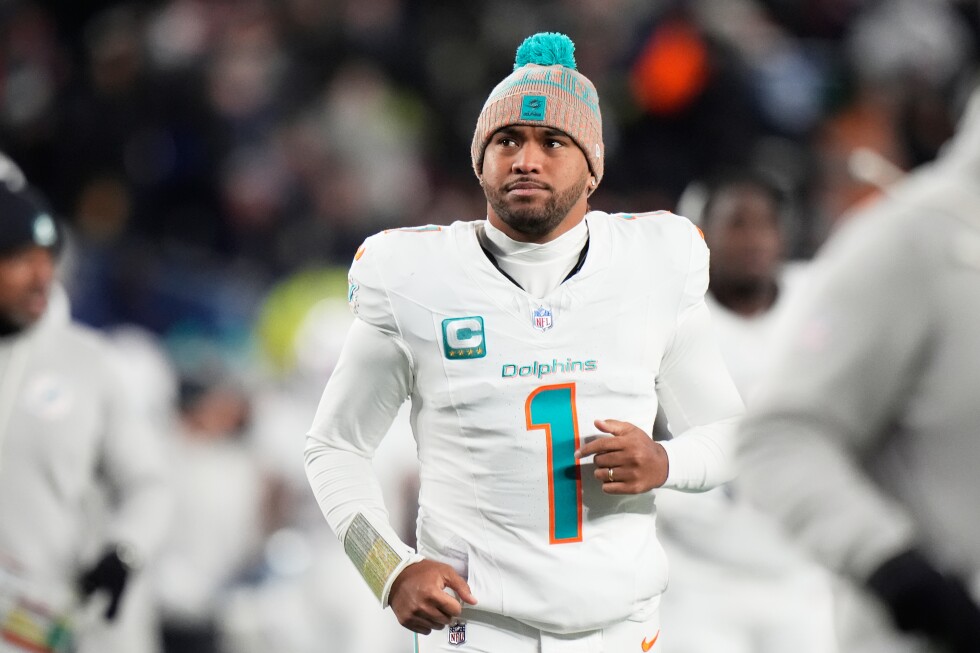
Miami announced Monday they will cut Tagovailoa just two years after signing him to a $212 million contract extension. The move will saddle the Dolphins with $99.2 million in dead money charges—financial obligations that remain on a team’s salary cap despite the player no longer being on the roster.
While the Dolphins can spread this financial hit over the 2026 and 2027 seasons by designating Tagovailoa as a post-June 1 cut, the impact remains substantial. The $99.2 million figure surpasses the previous record of $85 million the Denver Broncos absorbed after releasing Russell Wilson in 2022.
Dead money typically stems from signing bonuses already paid to players but prorated across multiple years on the salary cap to lower the annual charge. When a team trades or releases a player before all bonus money has been accounted for, those charges accelerate onto the current cap.
In Tagovailoa’s case, the financial fallout is especially severe because Miami remains responsible for $54 million in guaranteed salary for 2026. Meanwhile, the quarterback has already found a new home, agreeing to a one-year deal with the Atlanta Falcons worth slightly more than the veteran minimum of $1 million, according to a person familiar with the negotiations who spoke on condition of anonymity because contracts cannot be finalized until the new league year begins Wednesday.
The minimal salary Tagovailoa will receive from Atlanta will eventually be credited against Miami’s salary cap obligations, providing negligible relief to the Dolphins’ financial situation.
NFL teams have shown increasing willingness to accept substantial dead money charges in recent years, partly because the league’s rapidly rising salary cap makes such financial penalties less restrictive than in previous eras.
The Dolphins received minimal return on their investment after extending Tagovailoa’s contract last offseason. The quarterback had been set to play on his fifth-year rookie option at $23.2 million in 2024, and Miami could have used a franchise tag (approximately $38 million) for 2025 instead of committing to the massive extension.
Instead, the Dolphins will pay Tagovailoa nearly $125 million for just one additional season in which he made 14 starts, throwing for 2,660 yards and 20 touchdowns as the team finished 7-10—a disappointing campaign that resulted in both general manager Chris Grier and coach Mike McDaniel losing their jobs.
Tagovailoa joins a growing list of high-profile quarterbacks whose departures have created significant salary cap challenges for their former teams. The Denver Broncos still carried a $53 million cap charge for Russell Wilson in 2024 and $32 million last season, even as they managed to secure the AFC’s top playoff seed without him.
Just last week, the Arizona Cardinals announced they would part ways with Kyler Murray, creating a $54.7 million dead cap charge. The former No. 1 overall pick from 2019 had signed a five-year, $230.5 million extension in 2022 that included $36.8 million in guaranteed money for 2026.
Other notable quarterback-related dead money charges include Matt Ryan’s $40.5 million with the Atlanta Falcons after his 2022 trade to Indianapolis and Daniel Jones’ $33.3 million with the New York Giants following his midseason release last year.
The Giants had rewarded Jones with a four-year, $160 million contract after reaching the divisional round in the 2022 playoffs, only to cut him less than two years later. Jones had already earned $36 million in 2024 when he was released, with an additional $11.1 million hitting the cap as dead money, plus $22.2 million the previous season.
These financial cautionary tales highlight the risks NFL teams face when committing substantial guaranteed money to quarterbacks, particularly when performance fails to match the investment.
Fact Checker
Verify the accuracy of this article using The Disinformation Commission analysis and real-time sources.

6 Comments
Releasing a QB after just two years and taking on a $99M dead cap hit is an incredibly tough pill to swallow. This is a tough situation for the Dolphins to navigate.
I wonder if the Dolphins will be able to spread this cap hit over multiple years to ease the burden. Still, $99M is an astronomical figure, even for an NFL team’s salary cap.
I’m curious to see how the Dolphins plan to manage this record-breaking dead cap charge. It could have major implications for their roster-building efforts in the coming years.
The Tagovailoa situation is a cautionary tale about the perils of committing too much guaranteed money to unproven players. It’ll be interesting to see how the Dolphins manage this difficult situation.
Wow, $99.2M in dead cap charges for Tua Tagovailoa is a massive financial hit for the Dolphins. This really highlights the risks and challenges teams face when handing out big contracts to young QBs.
Dead money is always a tough pill to swallow, but $99M is an eye-popping figure. The Dolphins will need to exercise even more caution with future QB contracts after this debacle.