


Listen to the article
Ford Explorer and Nissan Pathfinder Face Off in 2026 SUV Showdown
In the competitive landscape of three-row midsize SUVs, American families continue to seek vehicles offering space and versatility without the expense of larger alternatives or the stigma attached to minivans. Two longstanding competitors in this segment, the Ford Explorer and Nissan Pathfinder, have released their 2026 models with significant updates aimed at capturing this crucial market segment.
Industry analysts at Edmunds have conducted comprehensive testing of both vehicles to determine which offers superior value for consumers navigating this crowded market space.
The Nissan Pathfinder demonstrates clear advantages in passenger comfort across all three rows. Unlike the Explorer, which focuses comfort features primarily on front-seat occupants, the Pathfinder provides generous space and adequate cushioning throughout the cabin. The Explorer’s second and third rows suffer from insufficient padding, with headrests described as notably uncomfortable.
“The Pathfinder earns points for its highly adjustable driving position, easy-to-use controls, and generous passenger space,” noted Edmunds’ evaluation team. “Its robust climate control system and quiet cabin further enhance the overall experience.”
When it comes to driving dynamics, however, the Explorer takes a decisive lead. Ford’s turbocharged powertrain delivers superior acceleration, while the vehicle’s handling capabilities outperform not just the Pathfinder but most segment rivals. The performance-oriented ST trim level further amplifies these characteristics with sport-tuned components.
“A family SUV doesn’t necessarily need to be fun to drive,” Edmunds’ testers observed, “but the Explorer’s sporty performance simply makes everyday driving more enjoyable.”
Both manufacturers have invested heavily in technology upgrades for their 2026 models. The Pathfinder now features a 12.3-inch center touchscreen with intuitive software design and wireless smartphone connectivity. Not to be outdone, Ford equipped the Explorer with an even larger 13.2-inch touchscreen complemented by a standard digital instrument panel. The Explorer gains additional advantage through more abundant USB charging ports and integrated Google services, including onboard Google Maps and voice assistant functionality.
Cargo capacity proves remarkably similar between the two models. Both offer approximately 16 cubic feet behind the third row – sufficient for groceries or modest luggage. With second and third rows folded, the Pathfinder provides about 80 cubic feet of space, while the Explorer offers a slightly larger 85 cubic feet.
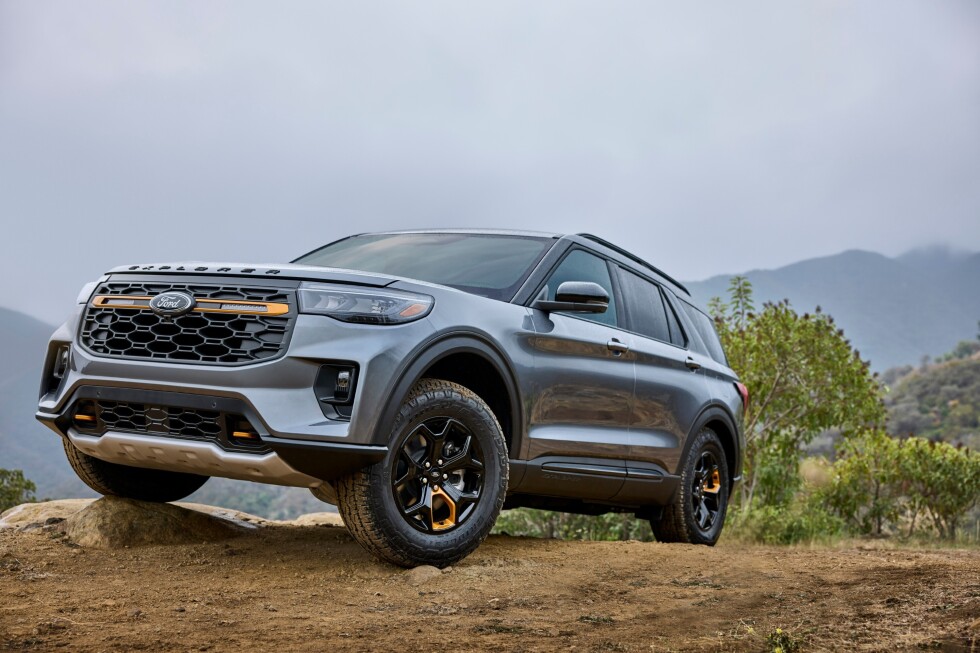
The vehicles remain closely matched in capability as well. Ford rates the Explorer’s towing capacity at 5,000 pounds when properly equipped, while Nissan claims a 6,000-pound maximum for the Pathfinder with its optional towing package. Both manufacturers offer specialized trims for light off-road use – Ford’s new Tremor package and Nissan’s Rock Creek variant – though evaluators found the Explorer’s upgrades more comprehensive for genuine off-pavement excursions.
Pricing structures reflect the competitive positioning of both models. The base 2026 Explorer starts at $40,260 including destination charges, while the entry-level Pathfinder SV commands a slightly higher $41,445. At the upper end of their respective lineups, Ford’s premium Platinum trim is priced at $52,760, compared to the Pathfinder SL at $51,945.
“The Pathfinder’s reworked cabin is a big step up from previous years, and the restyled exterior further enhances its appeal,” Edmunds reported. “Although it doesn’t venture into outright luxury territory, the Pathfinder does a slightly better job of justifying its cost.”
After comprehensive evaluation, Edmunds concluded that while Nissan has “done a commendable job breathing new life into the Pathfinder,” the Ford Explorer’s combination of driving dynamics, technology integration, and versatility gives it a narrow overall advantage in this closely contested segment.
As midsize SUVs continue to dominate family vehicle purchases in the American market, this head-to-head competition between two established nameplates highlights the increasingly sophisticated features and capabilities consumers can expect in this critical automotive category.
Fact Checker
Verify the accuracy of this article using The Disinformation Commission analysis and real-time sources.

10 Comments
Curious to see how the Pathfinder’s highly adjustable driving position and easy-to-use controls stack up against the Explorer. Those ergonomic features are important for making the daily school/activity/errand grind more pleasant.
I’m curious to see how the pricing and fuel economy of these two models compare. Cabin comfort is important, but affordability and efficiency are also major factors for many families shopping in this segment.
Absolutely, cost of ownership is a huge consideration. The Pathfinder may have an edge on passenger space, but the Explorer could still come out ahead if it delivers better fuel efficiency or a lower MSRP.
As someone who’s been loyal to the Ford brand, I’m a bit surprised to see the Pathfinder outperforming the Explorer on passenger comfort. Definitely an interesting development in this competitive SUV segment.
Agreed, the Explorer has long been a go-to choice for many families. But it’s good to see Nissan stepping up its game and providing a strong alternative option with the Pathfinder.
As someone with an active family, passenger comfort is a key consideration when shopping for an SUV. Glad to see the Pathfinder providing generous space and cushioning throughout the cabin – that could be a major selling point.
The Explorer’s focus on front-seat comfort at the expense of the second and third rows is a bit disappointing. Families need a vehicle that can keep all passengers happy on long drives.
Interesting comparison between the Ford Explorer and Nissan Pathfinder. I’m curious to see how the updated features and cabin comfort of the Pathfinder stack up against the Explorer’s reputation. Seems like a close race in this hotly contested SUV segment.
Definitely a tough choice for families looking for a spacious and versatile three-row SUV. I’ll have to read the full Edmunds review to see how the two models compare on things like safety, tech, and overall value.
With the SUV market so crowded these days, it’s critical for manufacturers to focus on the key features that matter most to consumers. Seems like Nissan has really honed in on passenger comfort with the latest Pathfinder.