


Listen to the article
Vote Counting Begins in Thailand’s Three-Way Electoral Battle
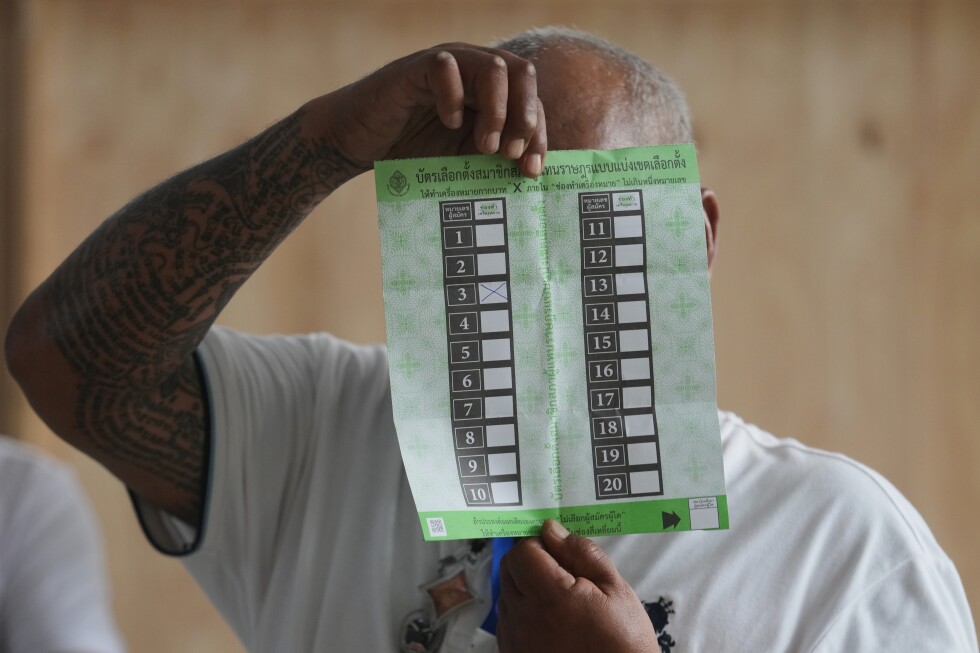
Vote counting is underway in Thailand’s general election as the Southeast Asian nation faces a pivotal choice between competing political visions that could determine its economic and social trajectory for years to come.
The election, which saw 53 million registered voters heading to polls on Sunday, has emerged as a three-way contest among parties representing progressive, populist, and establishment political forces. The election comes against a backdrop of sluggish economic growth and rising nationalist sentiment following border tensions with Cambodia.
While more than 50 parties contested the election, only three major contenders have the nationwide organization and voter base to potentially secure a governing mandate: the progressive People’s Party, incumbent Prime Minister Anutin Charnvirakul’s Bhumjaithai Party, and the Pheu Thai Party, which represents the political movement of billionaire former premier Thaksin Shinawatra.
Pollsters widely predict that no party will win an outright majority in the 500-seat House of Representatives, meaning coalition negotiations will likely determine the next government. Under Thai electoral rules, a simple majority of elected lawmakers selects the prime minister.
The People’s Party, led by Natthaphong Ruengpanyawut, is considered the frontrunner to win the most seats. The party is the successor to the Move Forward Party, which won the 2023 election but was subsequently blocked from forming a government by conservative forces and later dissolved by court order.
“I think we will get the mandate from the people, and we promised the people that we will form the people’s government to bring policies that benefit all, not a few in the country,” Natthaphong told reporters after casting his ballot in Bangkok.
The People’s Party has maintained its predecessor’s platform of sweeping reforms targeting Thailand’s military, police and judiciary – policies that have resonated strongly with younger, urban voters seeking democratic change. However, legal constraints have forced the party to moderate its stance on the kingdom’s controversial lèse-majesté law, which criminalizes criticism of the monarchy with harsh penalties.
Political analysts note that the People’s Party faces a challenging electoral landscape. “By softening its reform agenda, the party risks weakening its core support base,” said Napon Jatusripitak, director of the Center for Politics and Geopolitics at Thailand Future, a Bangkok-based think tank. “Additionally, its positions critical of the military have become a potential liability amid the surge of patriotism following last year’s border clashes with Cambodia.”
The Bhumjaithai Party, headed by incumbent Prime Minister Anutin Charnvirakul, represents Thailand’s conservative establishment and has emerged as a formidable contender. Anutin, who became prime minister only last September, dissolved parliament in December after facing the threat of a no-confidence vote.
His political fortunes received an unexpected boost when border tensions with Cambodia allowed him to reposition himself as a wartime leader, helping overcome earlier popularity challenges stemming from devastating floods and financial scandals. Bhumjaithai’s campaign has emphasized national security and economic stimulus measures.
“We have done everything that we had to, but we cannot force the mind of the people. We can only present ourselves, and hope that the people will have faith in us,” Anutin said after voting in northeastern Buriram province, a party stronghold.
The party’s electoral strategy relies heavily on traditional patronage networks and strong grassroots organization in Thailand’s vote-rich northeastern region. Many analysts consider Bhumjaithai the most likely party to form the next government through coalition building.
The third major contender, Pheu Thai, represents the latest incarnation of the political movement founded by former Prime Minister Thaksin Shinawatra. Despite repeated electoral victories, Thaksin-backed parties have frequently been removed from power through court decisions and actions by state watchdog agencies.
Following the 2023 election, Pheu Thai softened its political stance enough to return to power with tacit acceptance from Thailand’s royalist-military establishment, which viewed it as preferable to the more progressive Move Forward party. Nevertheless, Thailand’s conservative court system ultimately removed two Pheu Thai prime ministers over a two-year period and ordered Thaksin imprisoned on longstanding charges.
Pheu Thai is now campaigning on economic revitalization and populist policies, including cash handouts to stimulate consumption. The party has nominated Thaksin’s nephew, Yodchanan Wongsawat, as its prime ministerial candidate.
“I’m excited, because I think today will be another busy day for the country’s democracy,” Yodchanan told reporters after casting his vote.
Sunday’s election also includes a referendum asking voters whether Thailand should replace its current constitution, which was drafted under military rule in 2017. The referendum doesn’t propose a specific new charter but would authorize parliament to begin a formal drafting process.
Pro-democracy activists view constitutional reform as essential for reducing the influence of unelected institutions like the military and judiciary in Thailand’s political system, while conservatives warn such changes could lead to instability in the kingdom of 70 million people.
Final election results are expected to emerge in the coming days, with coalition negotiations likely to follow as Thailand determines its political direction amid economic challenges and regional uncertainties.
Fact Checker
Verify the accuracy of this article using The Disinformation Commission analysis and real-time sources.

9 Comments
This election seems to highlight the political divides in Thailand – between progressive, populist, and establishment forces. I’m curious to see how the electorate responds and whether a clear mandate emerges.
Given the fragmented nature of the results, effective coalition-building will be crucial for the next government to implement its agenda. It will be a delicate balancing act.
Thailand’s election is a complex affair with high stakes for the country’s future. The outcome could have ripple effects throughout the region.
Interesting to see this three-way race in Thailand’s election. It will be fascinating to see how the coalition negotiations play out and which vision for the country’s future emerges victorious.
This election seems to represent a fork in the road for Thailand. The competing visions on offer could shape the country’s trajectory for years to come.
The backdrop of sluggish economic growth and nationalist sentiment adds an extra layer of complexity to this election. Thailand’s choice could have significant regional implications.
With no party expected to win an outright majority, the post-election negotiations will be fascinating to watch. Thailand’s next government will need to navigate tricky political waters.
Compromise and consensus-building will be essential for the future administration to address Thailand’s economic and social challenges effectively.
It will be interesting to see how the Thai electorate responds to the different policy platforms presented by the main parties. A lot is at stake in this pivotal vote.