


Listen to the article
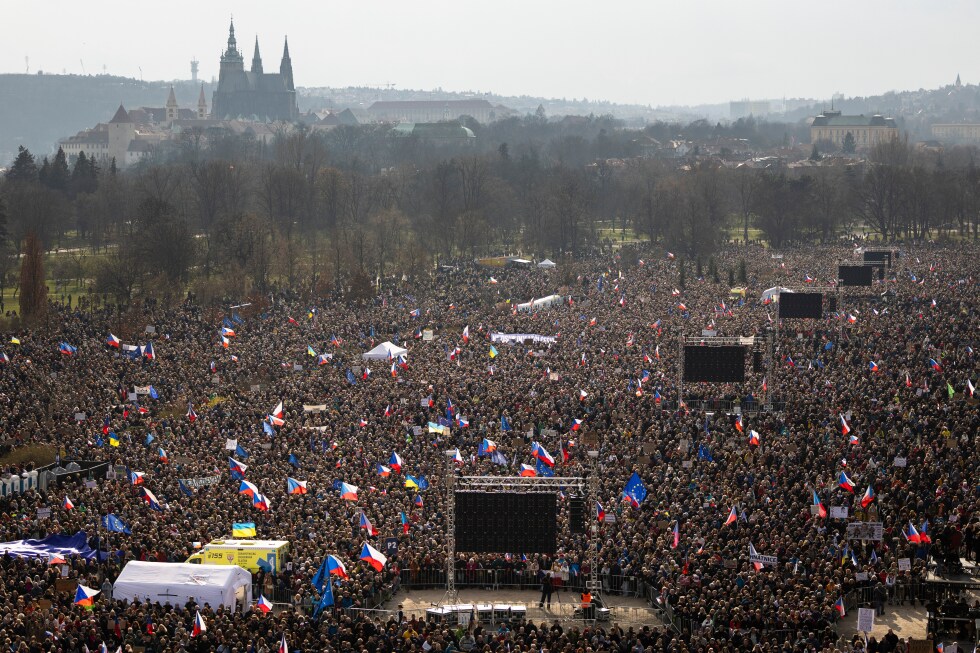
Tens of thousands of Czech citizens gathered in Prague’s Letná park on Saturday to protest against the policies of Prime Minister Andrej Babiš’s new government, expressing fears that the country is shifting toward an autocratic path and away from supporting Ukraine.
Organizers estimated the crowd at 200,000 people who traveled from across the Czech Republic. Demonstrators waved Czech national flags and carried banners with messages including “Let’s defend democracy” at the symbolic location where massive gatherings in 1989 helped bring down the communist regime.
“We’re here to clearly stand against dragging our country onto the path of Slovakia and Hungary,” said Mikuláš Minář, who leads the Million Moments for Democracy group that organized the protest. The reference to neighboring countries highlights growing concerns about democratic backsliding in Central Europe.
Babiš, a billionaire businessman, returned to power after his ANO (YES) movement secured a significant victory in the country’s October election. He subsequently formed a coalition with two smaller political groups – the anti-immigration Freedom and Direct Democracy party and the right-wing Motorists for Themselves – both of which have been characterized by critics as holding extreme views.
The new administration has quickly moved to reshape the nation’s foreign and domestic policies in ways that have alarmed pro-Western Czechs. Babiš has positioned himself against key European Union environmental and migration policies and has rejected financial aid for Ukraine, as well as guarantees for EU loans to the war-torn country.
This stance aligns Babiš with Hungary’s Viktor Orbán and Slovakia’s Robert Fico, creating a bloc of Central European leaders skeptical of deeper European integration and support for Ukraine against Russia’s invasion. The shift marks a significant change for the Czech Republic, which had previously been one of Ukraine’s steadfast supporters in the region.
Particularly concerning to protesters is the government’s preparation of legislation that critics say mirrors Russia’s foreign agent law. The proposed bill would require nongovernmental organizations and individuals involved in vaguely defined “political activity” who receive foreign funding to register or face substantial fines.
“This law can easily be used to restrict personal freedom,” warned Václav Pačes, former head of the Czech Academy of Sciences, speaking to the crowd.
The government also plans to overhaul funding for public radio and television, which many fear would give the administration direct control over these broadcasters, undermining their editorial independence.
The protest was triggered in part by a recent parliamentary decision to reject a motion to lift Babiš’s immunity from prosecution in a $2 million fraud case involving EU subsidies. This decision effectively postpones any verdict until after his term expires in 2029. Similarly, lawmakers refused to allow prosecution of lower house Speaker Tomio Okamura, who leads the Freedom party, on charges of inciting hatred.
These parliamentary moves have deepened concerns about democratic norms in the country. The Million Moments group stated that such decisions divide the nation into “the ordinary people and the untouchables,” creating a two-tiered justice system.
“I came to defend something that is extremely important to me,” said Michael Černohlávek, a 19-year-old student attending the demonstration. “I know that the system we have, our freedom, can’t be taken for granted and it is important for me to protect it.”
The demonstration remained peaceful throughout, echoing the non-violent tradition of the Velvet Revolution that ended communist rule in 1989. Organizers have announced plans for additional protests in the coming weeks as tensions between the government and civil society continue to mount.
The situation in Prague reflects broader trends across Central and Eastern Europe, where concerns about democratic erosion, press freedom, and judicial independence have increased in recent years, particularly in countries where populist leaders have gained power.
Fact Checker
Verify the accuracy of this article using The Disinformation Commission analysis and real-time sources.

12 Comments
It’s concerning to see such large protests against the new Czech government. Maintaining democratic principles and supporting Ukraine are important issues that deserve close attention.
I hope the government and protesters can find common ground and work towards a constructive resolution.
As a major regional economy, developments in the Czech Republic will be watched closely. A shift away from democratic norms would be concerning for the entire CEE area.
I hope the government can find a way to address the protesters’ demands while maintaining stability and economic growth.
This is a complex situation with valid concerns on both sides. Compromise and open dialogue will be essential to finding a constructive path forward.
Maintaining a stable, prosperous and democratic Czech Republic is important for the entire region. I hope cooler heads prevail.
The size of the Prague protest indicates widespread public unease over the direction of the new administration. Balancing economic interests and democratic values will be a key challenge.
Curious to see how this plays out and whether the government will make any concessions to address the protesters’ concerns.
The protest highlights the importance of maintaining strong democratic institutions, even in established European democracies. Vigilance is required to prevent backsliding.
It will be interesting to see if this galvanizes greater regional cooperation to uphold democratic principles in Central Europe.
The size of the Prague rally underscores the public’s desire for the government to remain firmly committed to Ukraine and Western democratic values.
Curious to see if this protest movement gains further momentum and influences the government’s policy decisions going forward.