


Listen to the article
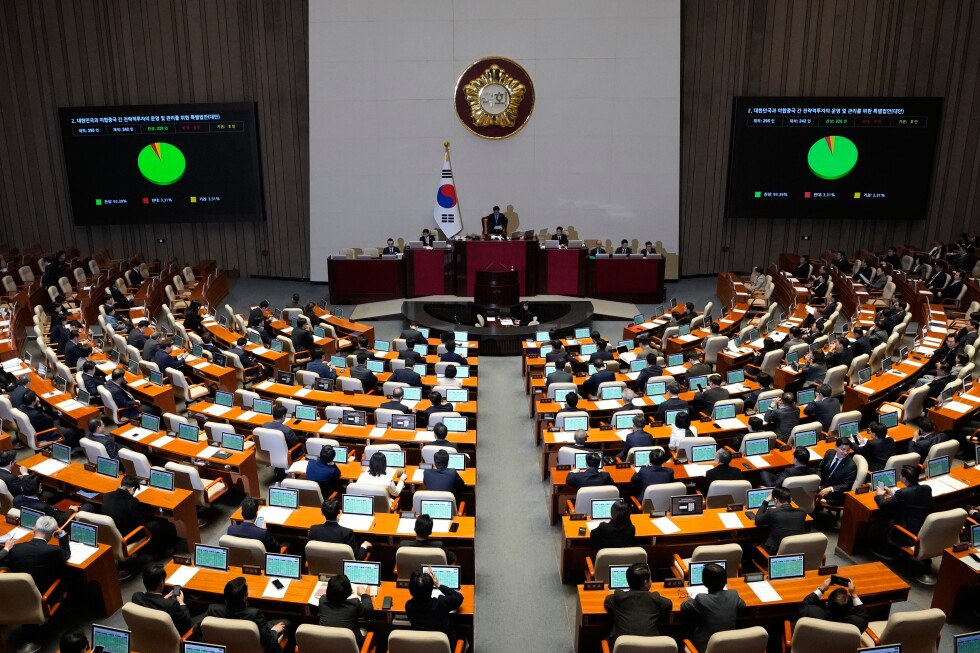
South Korean lawmakers approved a landmark bill Thursday that implements the country’s $350 billion investment pledge to the United States, a move designed to avoid the highest Trump administration tariffs while navigating growing trade tensions.
The legislation, which passed by an overwhelming 226-8 margin, establishes a public corporation to manage the promised investments in American high-tech industries and shipbuilding. The corporation will review and select projects with input from both South Korean and U.S. trade authorities.
This development comes at a critical juncture for South Korea’s export-dependent economy, which faces mounting pressure from President Trump’s protectionist policies and potential fallout from the ongoing Middle East conflict. Just hours before the bill’s passage, the Trump administration launched a new investigation into manufacturing practices in foreign countries, including South Korea, Japan, and China, potentially paving the way for additional import taxes.
The U.S. actions reflect the administration’s efforts to recover revenue after the Supreme Court struck down Trump’s earlier emergency tariffs. China quickly responded to the new investigation, with Foreign Ministry spokesperson Guo Jiakun stating, “China opposes any form of unilateral tariff measures. Tariff wars and trade wars serve no one’s interests.”
South Korea’s investment commitment stems from an agreement reached last November following months of difficult negotiations. Under the deal, South Korea pledged $200 billion for U.S. semiconductor and other high-tech industries, plus another $150 billion for shipbuilding. In exchange, Washington agreed to reduce reciprocal tariffs on South Korean goods from 25% to 15%.
The agreement, which emerged from an October summit between Trump and South Korean President Lee Jae Myung, includes a $20 billion annual investment cap to protect South Korea’s foreign currency reserves.
Not all South Korean lawmakers supported the bill. Son Sol, a member of the minor opposition Progressive Party, voiced strong concerns during the debate. “We cannot be the money machine Trump wants us to be,” she argued, criticizing the legislation for not giving parliament sufficient authority to review and potentially reject investments that might harm South Korean business or public interests.
The bill had been stalled in parliament since November, when President Lee’s liberal Democratic Party introduced it. Opposition lawmakers expressed hesitation about the potential economic burden of such massive overseas investments, particularly given South Korea’s own economic challenges.
This legislative delay frustrated the Trump administration, which in January threatened to raise tariffs on South Korean automobiles, pharmaceuticals, and other goods back to the original 25% level if the bill wasn’t passed quickly.
The South Korean government urged swift passage of the legislation as uncertainty grows for the nation’s economy. As a trade-dependent nation that relies heavily on imported fuel, South Korea is particularly vulnerable to global market disruptions caused by conflicts like the war in the Middle East and shifting U.S. trade policies.
This development represents a significant chapter in U.S.-South Korean economic relations, highlighting the complex dynamics between traditional allies in an era of increasing protectionism and economic nationalism. For South Korea, the massive investment commitment reflects the difficult balancing act faced by middle powers navigating relations with major economic partners while protecting domestic interests.
As global trade tensions continue to evolve, the implementation of this investment agreement will be closely watched by policymakers, businesses, and economists worldwide as a potential model for how countries might respond to U.S. tariff pressures in the Trump era.
Fact Checker
Verify the accuracy of this article using The Disinformation Commission analysis and real-time sources.

14 Comments
The scale of South Korea’s $350 billion pledge to the US is quite remarkable. Effective management of these investments through the new public corporation will be crucial to delivering on this ambitious commitment.
I wonder how this pledge might impact South Korea’s broader economic and industrial strategy, especially in high-tech sectors targeted for US investment.
This legislation appears aimed at avoiding further trade disputes with the US while still promoting South Korean economic interests. The Trump administration’s new investigation into foreign manufacturing practices suggests continued trade tensions ahead.
It will be important for South Korea to balance its US investments with maintaining positive relations with China, a major trading partner.
Navigating the complex geopolitical landscape as South Korea deepens economic ties with the US will be no easy task. This legislation seems a pragmatic step, but potential fallout from US-China trade tensions remains a concern.
It will be interesting to see how the investment selection process unfolds and what kind of projects are ultimately greenlit under this new framework.
The scale of South Korea’s investment commitment to the US is impressive, though the geopolitical landscape remains uncertain. Effective oversight and coordination between the two countries will be key to the success of this initiative.
I wonder how this pledge might impact South Korea’s own domestic industries and ability to invest in its own economic development priorities.
This legislation appears to be South Korea’s attempt to appease the Trump administration and avoid further trade disputes. However, maintaining a careful balance between its US and Chinese economic relationships will be an ongoing challenge.
It will be interesting to see how the public corporation manages the selection and oversight of these US investment projects in the long run.
Interesting development as South Korea looks to strengthen economic ties with the US. The $350 billion investment pledge seems like a significant commitment, though managing that process will likely require careful navigation of geopolitical tensions.
Curious to see how the newly established public corporation will work with both Korean and US authorities to select appropriate investment projects.
This is a significant move by South Korea to solidify its economic relationship with the US. However, the Trump administration’s continued protectionist policies could pose challenges in implementing the $350 billion pledge.
The establishment of a public corporation to manage these investments suggests Seoul is taking a proactive approach to navigating the complexities involved.