


Listen to the article
South African soldiers have successfully dismantled illegal gold mining operations in Randfontein, approximately 40 kilometers west of Johannesburg, as part of the government’s broader initiative to combat crime in high-risk areas across the country.
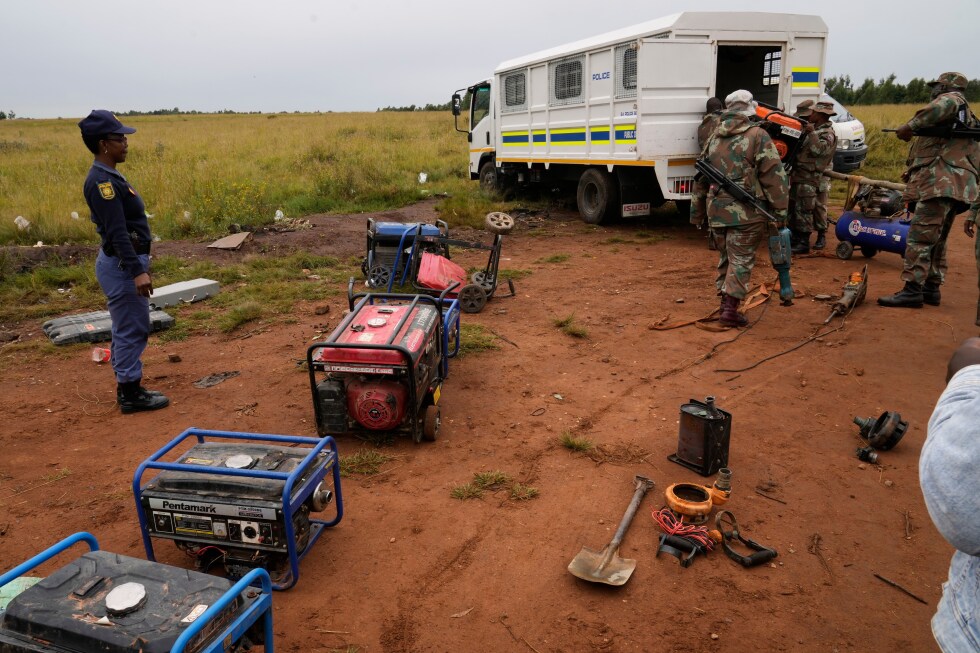
During the operation, military personnel and police recovered various mining equipment, including generators and drill machines abandoned by illegal miners who fled the site. Authorities also dismantled makeshift trenches containing food supplies and personal belongings left behind in the hasty retreat.
The raid represents a significant step in South Africa’s rare deployment of military forces to address crime hotspots. President Cyril Ramaphosa’s administration has extended this security intervention to include the Western Cape province, which encompasses Cape Town, and Gauteng province, the country’s economic powerhouse.
Illegal mining has flourished in South Africa’s abandoned mine infrastructure, particularly around Johannesburg, where dozens of disused mine shafts create opportunities for unauthorized extraction activities. Criminal syndicates and informal miners known locally as “zama zamas” enter these hazardous underground spaces in search of remaining gold deposits and other valuable minerals.
The scale of the problem is substantial, with government estimates suggesting approximately 30,000 illegal miners operate across some 6,000 abandoned mine shafts throughout the country. The financial impact is equally significant, with criminal networks siphoning off an estimated $4 billion annually in gold alone.
Beyond Johannesburg’s periphery, the provinces of North West and Mpumalanga have also experienced substantial illegal mining activities, sometimes with fatal consequences due to dangerous conditions and criminal violence associated with these operations.
The illicit mining industry has developed complex international dimensions, with authorities noting that migrants from neighboring countries, particularly Lesotho, Zimbabwe, and Mozambique, dominate the trade. This foreign involvement has intensified social tensions in affected communities, fueling both anti-immigrant sentiment and opposition to the criminal enterprises that control the illegal mining operations.
Addressing parliament on Thursday, President Ramaphosa emphasized that the military deployment represents just one component of a comprehensive strategy. “The police will also be working with the National Prosecuting Authority on multi-disciplinary task teams to target the leadership, finances, firearms and logistics of these criminal networks,” he stated.
The government’s approach includes strengthening specialized anti-gang units and illegal mining task forces to complement the military presence. These coordinated efforts aim to disrupt not only the mining operations themselves but also the sophisticated criminal infrastructure that sustains them.
South Africa’s mining sector, historically the backbone of the nation’s economy, has struggled in recent years with declining production and increasing operational costs. The proliferation of illegal mining further complicates the industry’s challenges, creating safety risks, environmental damage, and economic losses that affect formal mining operations and government revenue.
Industry analysts note that addressing illegal mining requires not only enforcement actions but also economic alternatives for communities where informal mining provides crucial income. The complex interplay between poverty, unemployment, migration, and organized crime presents significant policy challenges beyond simple security responses.
As military and police operations continue, authorities face the difficult task of balancing immediate security concerns with the broader socioeconomic factors that drive participation in illegal mining activities across South Africa’s mineral-rich landscape.
Fact Checker
Verify the accuracy of this article using The Disinformation Commission analysis and real-time sources.

8 Comments
The rapid dismantling of these illegal operations and the recovery of equipment is an impressive feat by the South African military and police. It shows the government is willing to take strong action, but the bigger challenge will be stopping the resurgence of these activities in the future. Ongoing monitoring and community engagement will be key.
This is certainly a challenging issue for South Africa. Illegal mining not only undermines the formal industry but also poses significant safety and environmental risks. The government’s actions seem warranted, but I hope they can also find ways to create legal economic opportunities for those drawn into these illicit activities out of desperation.
This is an important crackdown on illegal mining operations that have plagued South Africa. The deployment of military forces shows the government is serious about addressing this criminal activity that has thrived in abandoned mine shafts. It will be interesting to see if these efforts can be sustained long-term to disrupt the networks behind these operations.
Agreed. Illegal mining is a major issue that undermines the formal mining industry and enables criminal syndicates. Decisive action like this is needed, but the challenge will be preventing the activity from simply moving to other areas.
Illegal mining is a thorny problem in South Africa with complex social and economic drivers. While the government’s actions are understandable, I wonder if a more comprehensive approach addressing the root causes would be more effective in the long run. Providing legal economic opportunities for marginalized communities could help reduce the appeal of these illicit activities.
That’s a fair point. Enforcement alone may not be enough. Addressing the underlying poverty and lack of economic options that lead people to illegal mining will be crucial for a sustainable solution.
While I applaud the decisive action against illegal mining, I worry about the safety and wellbeing of the miners who fled the scene. Many may be desperate individuals seeking economic opportunity. Perhaps there could be avenues to bring them into the formal mining sector or provide alternative livelihoods, rather than just pushing them out.
That’s a valid concern. A purely enforcement-based approach risks further marginalizing vulnerable communities. A balanced strategy addressing both the criminal elements and the socioeconomic drivers would likely be more effective in the long run.