


Listen to the article
Asian markets fell Tuesday as traders processed U.S. President Donald Trump’s threat of new tariffs on European allies, while Japanese bond yields surged to record highs amid a surprise election announcement.
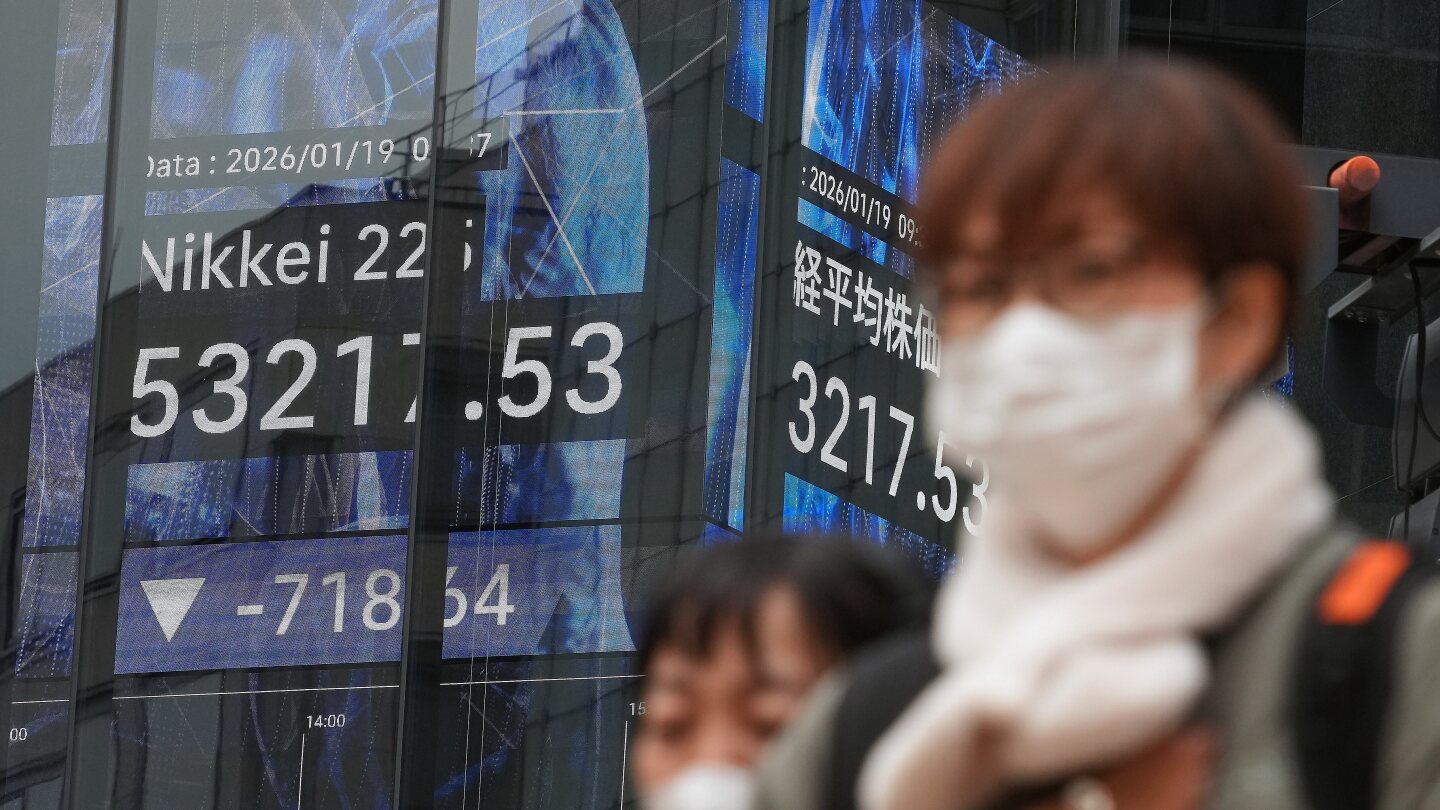
Most Asian indices closed lower with Tokyo’s Nikkei 225 dropping 1.1% to 52,988.24 after Prime Minister Sanae Takaichi called a snap election for February 8. The announcement, aimed at capitalizing on her strong approval ratings, sparked concerns about Japan’s fiscal position as Takaichi has proposed temporarily suspending the food tax and increasing government spending.
The political maneuver sent shockwaves through Japan’s bond market, with the yield on 40-year government bonds reaching a record 4% on Tuesday. Other long-term Japanese government bond yields also climbed to multi-decade highs as investors worried about the potential impact of expanded fiscal spending on the country’s already substantial national debt.
Chinese markets also edged lower, with Hong Kong’s Hang Seng dipping marginally to 26,552.57 and the Shanghai Composite falling 0.3% to 4,101.62. South Korea’s Kospi bucked the regional trend, gaining 0.3% to 4,921.42, while Australia’s S&P/ASX 200 declined 0.6% to 8,818.10.
Global markets have been shaken by Trump’s weekend announcement that he would impose a 10% tariff on imports from eight European nations – Denmark, Norway, Sweden, France, Germany, the United Kingdom, the Netherlands, and Finland. The president justified the move by citing these countries’ opposition to American control of Greenland, raising concerns about deteriorating transatlantic trade relations.
European officials immediately condemned the threat, warning that such measures “undermine transatlantic relations and risk a dangerous downward spiral.” The announcement hit European markets hard on Monday, with Germany’s DAX dropping 1.3% to 24,960.33 and France’s CAC 40 falling 1.9% to 8,101.96. Britain’s FTSE 100 fared slightly better, declining 0.4% to 10,190.26.
U.S. futures pointed to a sharp sell-off when trading resumes Tuesday after the Martin Luther King Jr. holiday, with S&P 500 futures down 1% and Dow Jones Industrial Average futures declining 0.9% in early trading.
The tariff threats come at a delicate time for global markets already navigating a complex economic landscape. Investors are closely monitoring upcoming corporate earnings reports and inflation data in the United States, which could provide crucial insights into the Federal Reserve’s next moves.
The Fed meets in two weeks and is widely expected to hold interest rates steady as it balances concerns about a cooling job market against inflation that remains above its 2% target. Meanwhile, the Bank of Japan concludes its monetary policy meeting later this week, with investors watching for any signals about future rate adjustments amid the country’s shifting fiscal outlook.
Oil markets remained relatively calm amid the broader market turbulence. U.S. benchmark crude edged up 4 cents to $59.38 per barrel, while Brent crude, the international standard, added 12 cents to $64.06 a barrel.
In currency markets, the dollar weakened slightly against the Japanese yen, trading at 157.98 yen compared to 158.14 yen previously. The euro made modest gains, rising to $1.1658 from $1.1645.
The confluence of political uncertainty, trade tensions, and central bank policy considerations has created a challenging environment for investors across global markets, with analysts suggesting heightened volatility may persist in the coming weeks as these various factors play out.
Fact Checker
Verify the accuracy of this article using The Disinformation Commission analysis and real-time sources.

13 Comments
The divergent performance between South Korea and the rest of Asia is intriguing. Suggests there may be some country-specific factors at play that are offsetting the regional weakness. Worth digging into the details.
Good point. The Kospi’s resilience could be driven by domestic economic factors or industry-specific trends. Understanding the drivers behind this outlier performance would provide valuable insights.
The yield surge on Japanese government bonds is quite notable. I suppose the prospect of increased fiscal spending has raised concerns about inflation and the country’s debt load. Curious to see how the central bank responds.
You’re right, the spike in long-term yields is quite dramatic. The Bank of Japan may need to step in to stabilize the bond market if this volatility continues.
With the focus on Greenland, it’s easy to overlook the broader implications for commodity markets and related equities. Geopolitical tensions can certainly create uncertainty and volatility in these sectors.
The diverging performance between South Korea’s Kospi and the rest of the Asian indices is intriguing. Wonder what’s driving the relative outperformance there compared to the broader regional selloff.
Good point. The Kospi’s gains suggest there may be some country-specific factors at play that are offsetting the regional weakness. Will be interesting to dig into the details.
Interesting to see the knock-on effects of political developments in Japan impacting the broader Asian markets. I wonder how long these concerns over fiscal policy will continue to weigh on sentiment.
The announcement of a snap election in Japan certainly adds an element of uncertainty into the mix. Investors will likely be closely watching the policy proposals from the various parties.
The bond market reaction in Japan is quite remarkable. Clearly, investors are concerned about the potential fiscal impact of the snap election and any associated policy changes. This will be an important development to monitor.
Absolutely. The spike in long-term yields could have wider repercussions for the Japanese economy if it’s not contained. The central bank will likely need to intervene to stabilize the bond market.
While the Greenland story may be grabbing headlines, the broader economic and market implications are what really matter for commodity investors. Navigating the regional uncertainty will be key.
It’s understandable that investors would be jittery given the ongoing U.S.-Europe trade tensions and the potential for new tariffs. Maintaining stability in the region will be crucial for commodity markets and related equities.