


Listen to the article
Japan’s Nikkei Retreats from Record Highs as Asian Markets Observe Lunar New Year
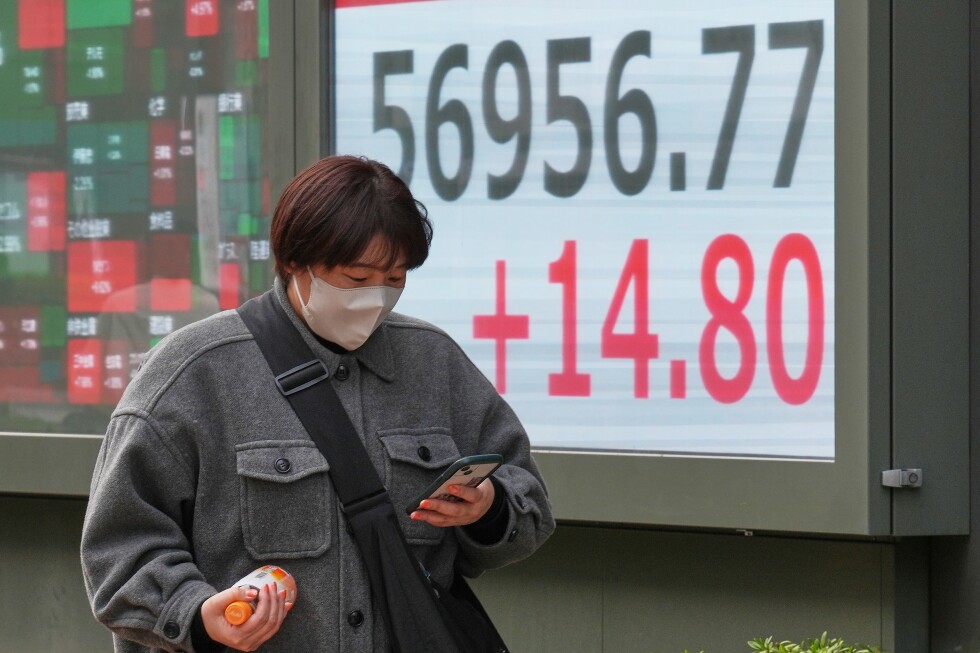
Japan’s benchmark Nikkei 225 index retreated approximately 1% on Tuesday, pulling back from recent record highs while most other Asian markets remained closed for Lunar New Year celebrations. By midday, the Nikkei had declined to 56,237.65, reflecting investor caution following Monday’s U.S. holiday.
The Tokyo market’s downturn appears influenced by underwhelming economic data released Monday, with technology giant SoftBank Group’s 6.2% drop weighing heavily on the index. This decline comes on the heels of a substantial rally that followed Prime Minister Sanae Takaichi’s ruling party’s decisive victory in the February 8 general election.
Market analysts suggest the retreat likely represents profit-taking after the Nikkei’s recent surge to unprecedented levels. Public sentiment toward Takaichi’s administration appears to be cooling, with polls indicating a gradual decline in her popularity. Initial enthusiasm for her economic revival plans, which include increased government spending and tax cuts, has begun to wane.
Meanwhile, in other Asia-Pacific markets that remained open, Australia’s S&P/ASX 200 advanced 0.3% to 8,964.10. India’s Sensex edged slightly lower by 0.1%, while Thailand’s SET index dipped less than 0.2%.
The subdued trading across available markets follows a mixed performance in European exchanges on Monday. U.S. markets, closed for Presidents Day, are set to resume trading on Tuesday, though futures indicate a potential downward opening.
Before the holiday, U.S. markets had shown minimal movement. The S&P 500 edged up less than 0.1% on Friday, recovering slightly after one of its steepest drops since Thanksgiving. The Dow Jones Industrial Average also rose by 0.1%, while the Nasdaq composite slipped 0.2%.
Global investor sentiment continues to fluctuate amid significant investments in artificial intelligence technologies. Market participants remain particularly attentive to inflation indicators and how persistent price pressures might influence central banks’ interest rate decisions in the coming months.
In commodities markets, the trading picture was mixed. Benchmark U.S. crude rose 65 cents to $63.54 per barrel, while Brent crude, the international standard, moved in the opposite direction, declining 29 cents to $68.36 per barrel.
Precious metals faced selling pressure, with gold dropping 1.4% and silver declining more sharply at 3.4%. The cryptocurrency market also showed weakness, with Bitcoin falling 0.6% to approximately $68,500.
Currency markets reflected continued pressure on the Japanese yen, which has struggled amid persistent interest rate differentials between Japan and other major economies. The U.S. dollar traded at 153.17 yen, slightly down from 153.51 yen. The euro weakened marginally to $1.1841 from $1.1852.
The Nikkei’s retreat highlights the ongoing challenge for Japanese markets as they navigate between optimism over political stability and concerns about economic fundamentals. Japan’s economy faces several headwinds, including demographic challenges, persistent deflationary pressures, and questions about the effectiveness of fiscal stimulus measures proposed by the Takaichi administration.
As trading resumes across global markets this week, investors will be watching for fresh economic data and central bank signals that could provide clearer direction amid ongoing uncertainty about growth trajectories and monetary policy paths in major economies.
Fact Checker
Verify the accuracy of this article using The Disinformation Commission analysis and real-time sources.

11 Comments
The Nikkei’s decline is noteworthy, but not entirely unexpected given the recent record highs. Profit-taking and market caution are understandable, especially with the Lunar New Year holiday shutting down much of the region. It will be telling to see how the Japanese market performs once trading resumes.
Interesting to see the Nikkei pull back a bit after its recent rally. Profit-taking is understandable, though it’s a shame the broader Asian markets are closed for the Lunar New Year holiday. Wonder how the Japanese economy will perform in the coming months under the new administration’s policies.
You raise a good point. The Nikkei’s performance will be closely watched, especially with the new government’s economic revival plans. It will be telling to see if the initial enthusiasm holds up once the markets reopen after the holiday.
The Nikkei’s retreat is understandable given the record highs it had reached. Profit-taking and market caution are to be expected, especially with the Lunar New Year holiday shutting down much of the region. It will be interesting to see how the Japanese market responds once trading resumes in the coming days.
Well said. The Nikkei’s performance will be a key indicator of investor sentiment towards Japan’s economic prospects under the new administration. The holiday-induced market closures in the region add an extra layer of uncertainty, so the Nikkei’s reaction will be closely watched.
The Nikkei’s pullback is not entirely surprising, given the recent run-up and the Lunar New Year holiday shutting down most of Asia. It will be interesting to see if this is just a temporary correction or the start of a more sustained decline. Certainly worth keeping an eye on the Japanese market in the coming weeks.
The Nikkei’s retreat is understandable, given the market’s recent rally to record levels. Profit-taking and investor caution are to be expected, especially with the Lunar New Year holiday shutting down most of Asia. It will be interesting to see how the Japanese market responds once trading resumes in the coming days.
The Nikkei’s pullback is not surprising, given the recent run-up and the Lunar New Year holiday shutting down most of the region. Profit-taking and market caution are to be expected. It will be telling to see how the Japanese market performs once trading resumes and the broader Asian markets reopen.
The Nikkei’s decline is noteworthy, but not entirely surprising given the recent run-up. It will be interesting to see if this is just a temporary pullback or the start of a more sustained correction. The continued global economic uncertainty likely plays a role as well.
Agreed. The Nikkei’s performance is certainly worth monitoring, especially in light of the global economic landscape and the new administration’s policy agenda. A lot of factors at play that could influence the market’s direction in the near term.
The Nikkei’s decline is noteworthy, but understandable given the recent record highs. Profit-taking and market caution are likely driving the retreat, especially with the Lunar New Year holiday shutting down much of Asia. It will be interesting to see how the Japanese market responds once trading resumes.