


Listen to the article
Saudi Arabia has formally called on Emirati-backed separatists in Yemen to withdraw from two governorates, threatening to intensify divisions within the coalition fighting Houthi rebels. The statement from Saudi Arabia’s Foreign Ministry on Thursday appears aimed at publicly pressuring the Southern Transitional Council (STC), a force long supported by the United Arab Emirates.
“The kingdom stresses the importance of cooperation among all Yemeni factions and components to exercise restraint and avoid any measures that could destabilize security and stability, which may result in undesirable consequences,” the Saudi Foreign Ministry said in its statement.
The STC has expanded its control into Yemen’s Hadramout and Mahra governorates, areas that Saudi Arabia now wants returned to the National Shield Forces, another faction in the complex civil war. Saudi mediation efforts aim to have the council’s forces “return to their previous positions outside of the two governorates and hand over the camps in those areas,” according to the ministry.
The Hadramout governorate’s local authority expressed support for the Saudi announcement and welcomed a joint Saudi-UAE delegation to the region. It endorsed calls for the Emirati-backed separatists to withdraw from their current positions.
This internal coalition fracture threatens to further complicate Yemen’s already dire situation. In recent months, STC supporters have increasingly displayed the flag of South Yemen, which existed as a separate nation from 1967 to 1990. Demonstrations took place Thursday in Aden, where protesters supported secession from the rest of Yemen. Aden has functioned as the seat of power for anti-Houthi forces since the conflict began.
The confrontation has placed additional strain on the relationship between Saudi Arabia and the UAE. While the neighboring countries maintain close ties as OPEC members, they have increasingly competed for regional influence in recent years. This latest development in Yemen follows escalating violence in Sudan, another Red Sea nation where the kingdom and Emirates support opposing forces.
Yemen’s civil war began when Houthi rebels seized the capital, Sanaa, in September 2014, forcing the internationally recognized government into exile. In March 2015, Saudi Arabia led a coalition armed with U.S. weapons and intelligence to support the exiled government. Despite Saudi claims, Iran has denied arming the rebels, though Iranian-manufactured weapons have been discovered on battlefields and in shipments intercepted en route to Yemen, violating a UN arms embargo.
The prolonged conflict has had devastating humanitarian consequences. Over 150,000 people have been killed in the fighting, while tens of thousands more have died due to the resulting humanitarian crisis. The United Nations has described Yemen as experiencing one of the world’s worst humanitarian disasters, pushing the Arab world’s poorest nation to the brink of famine.
In recent months, the Houthi rebels launched attacks on hundreds of ships in the Red Sea in response to the Israel-Hamas war, significantly disrupting global shipping routes. While maritime traffic has slowly increased during a recent lull in attacks, many shipping companies continue to reroute vessels around Africa’s Cape of Good Hope to avoid the Red Sea and Gulf of Aden.
Additional instability in Yemen could prompt renewed U.S. military intervention. Earlier this year, Washington conducted an intense bombing campaign against the rebels, which former President Trump halted just before his Middle East trip. The Biden administration has also carried out strikes against the Houthis, including using B-2 bombers to target underground bunkers allegedly used by the group.
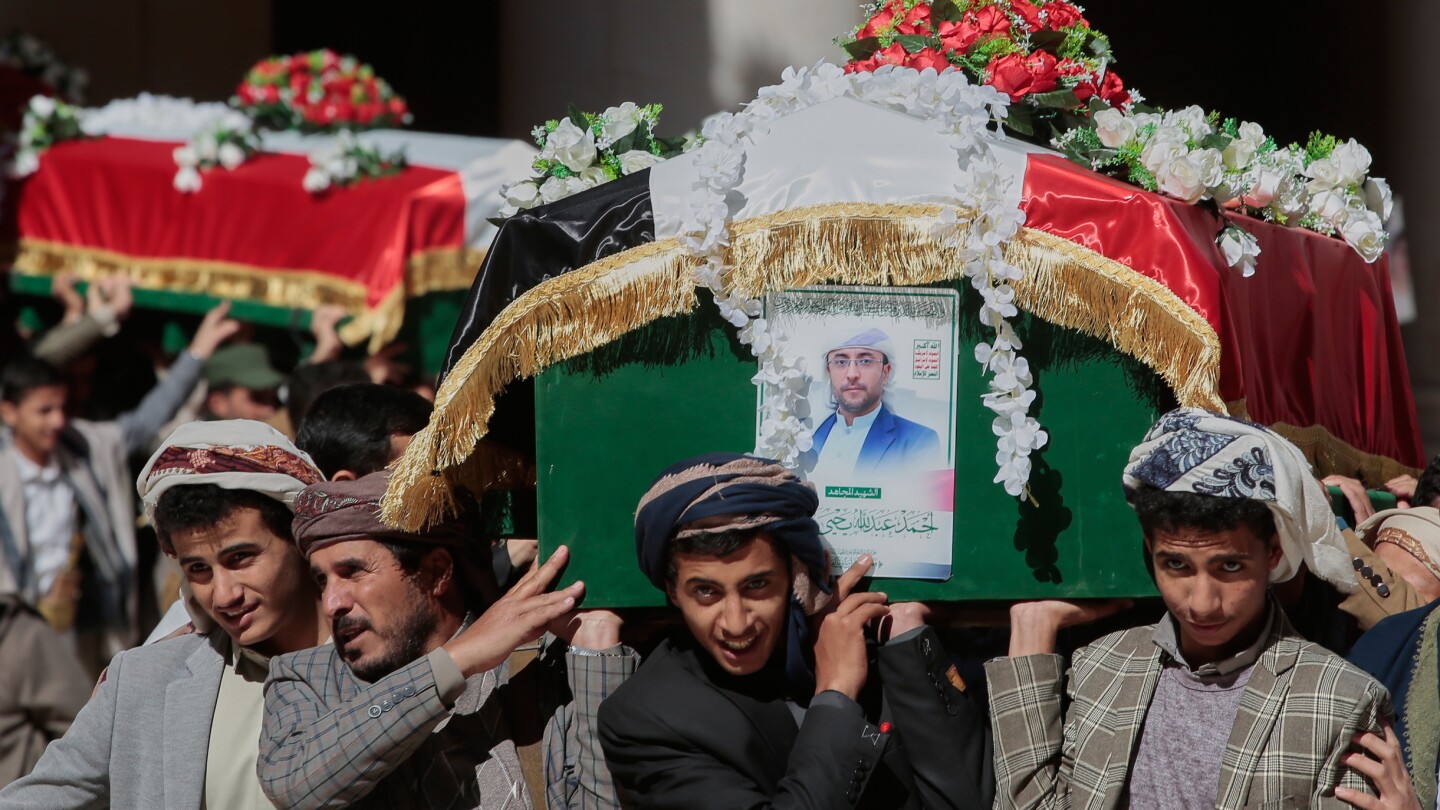
Meanwhile, the Houthis conducted funeral services Thursday in Sanaa for several fighters, including Major General Zakaria Abdullah Yahya Hajar, identified by analysts as the group’s drone and missile chief. U.S. forces reportedly targeted Hajar in a March strike in Sanaa. He allegedly received training from Iran’s Revolutionary Guard’s Quds Force.
The Houthis have recently intensified threats against Saudi Arabia and detained dozens of workers from UN agencies and other aid organizations, claiming without evidence that they were spies—allegations strongly denied by the United Nations and other organizations.
Fact Checker
Verify the accuracy of this article using The Disinformation Commission analysis and real-time sources.

8 Comments
Interesting to see the tensions within the Saudi-led coalition against the Houthis in Yemen. The call for the STC separatists to withdraw from key governorates highlights the complex dynamics at play. This could further strain the anti-Houthi alliance if not handled carefully.
You’re right, the coalition against the Houthis seems increasingly fractured. Maintaining unity will be crucial for their efforts, though reconciling the interests of various Yemeni factions won’t be easy.
The situation in Yemen remains highly volatile, with shifting alliances and power dynamics. Saudi Arabia’s call for the STC to withdraw is an attempt to assert control, but risks escalating tensions within the anti-Houthi coalition. Careful diplomacy will be needed to find a sustainable resolution.
Agreed, Yemen’s civil war has become a quagmire with no easy solutions. The competing interests of regional powers like Saudi Arabia and the UAE further complicate matters. Restoring stability and security in the country remains an elusive goal.
This move by Saudi Arabia underscores the fragility of the anti-Houthi coalition. The tensions between the STC and the Saudi-backed forces are a concerning development that could hamper efforts to combat the Houthis. Resolving these internal conflicts will be crucial for the coalition’s long-term success.
This is yet another worrying development in the ongoing conflict in Yemen. The rift between Saudi Arabia and the UAE-backed STC separatists could have significant implications for the fight against the Houthis. It’s crucial that the coalition finds a way to resolve these internal divisions.
The call for the STC to withdraw from the two governorates reflects the complex power dynamics at play in Yemen. Saudi Arabia is trying to reassert its influence, but risks further destabilizing the region if the separatists refuse to comply. Resolving these internal tensions will be crucial for the anti-Houthi efforts.
Absolutely. The Saudi-led coalition is already facing significant challenges in their fight against the Houthis. Internal divisions and power struggles could undermine their overall strategy and provide an opening for the Houthis to gain ground. Careful diplomacy will be required to prevent the situation from deteriorating further.