


Listen to the article
South Dakota’s Critical Mineral Debate Heats Up Amid Global Demand
As worldwide demand surges for rare earth elements and critical minerals, South Dakota finds itself at the center of its own mining debate. The state hosts reserves of 15 minerals designated as “critical” by the U.S. government, drawing both interest from mining companies and opposition from environmental and Native American groups.
Critical minerals are naturally occurring metallic materials valued for their unique properties essential to modern technologies. While South Dakota doesn’t have any of the 17 elements classified as rare earths, it does possess 15 of the 50 minerals labeled “critical” by the federal government, including antimony, arsenic, barite, beryllium, lithium, graphite, and tungsten.
These resources are located primarily in western counties including Custer, Fall River, Harding, Lawrence, Pennington, and Perkins, as well as the central counties of Buffalo and Lyman, according to a 2024 analysis by the state Legislative Research Council.
“Given its long history of mining, and based on new studies, the Black Hills region is well-known as a place where usable critical minerals are present, which is attracting exploratory mining,” said Christopher Pellowski, geology professor at South Dakota Mines in Rapid City.
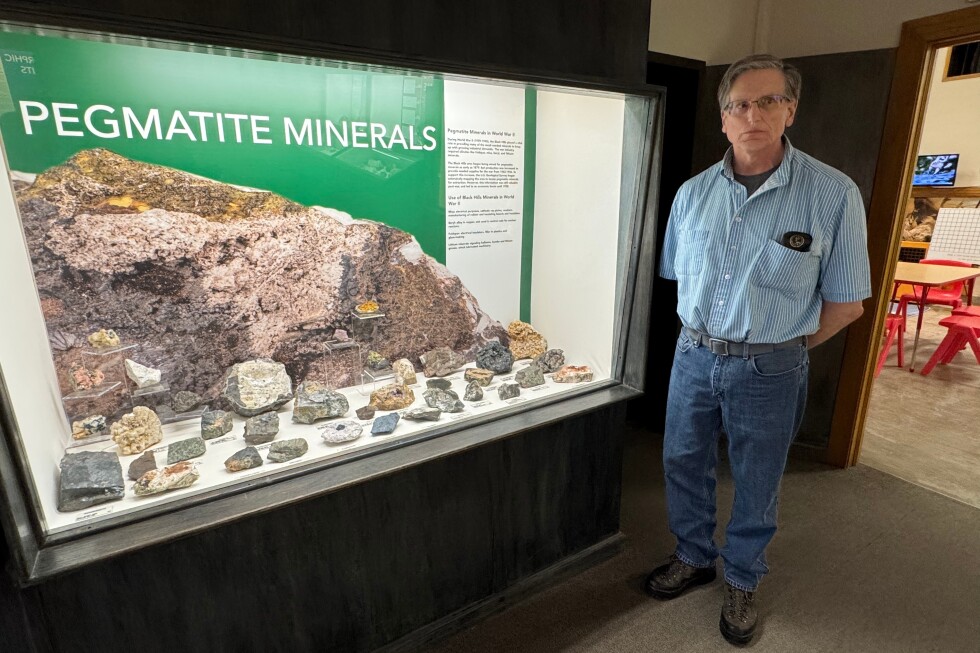
While these minerals can be abundant, they’re typically difficult to extract because they’re embedded within other minerals that require complex separation processes. Pellowski noted that the common Black Hills igneous rock pegmatite can contain lithium deposits, but he doesn’t expect large-scale mining operations until substantial, monetizable reserves are confirmed.
“Mining is important and it’s a real economic driver… But I don’t see us at a point where we’re ready for a large commitment,” Pellowski explained. “They’re just going to have to do this in steps. And what they’re doing now is the homework to get their heads wrapped around what’s there.”
Several exploration efforts are already underway across the state. Lithium has seen the most activity, with four exploration projects in the central Black Hills targeting pegmatite ore near Hill City and Keystone. Once mined in South Dakota during the mid-20th century for use in glass and ceramics, lithium is now highly sought for lithium-ion batteries used in smartphones, laptops, electric vehicles, and energy storage systems.
Other projects include a licensed pegmatite mine in Lawrence County seeking ore containing niobium, tantalum, tellurium, tin, and tungsten. Rapid City-based Pete Lien and Sons is pursuing graphite exploration by drilling 18 holes approximately 1,000 feet deep on federal lands near Rochford. Graphite has applications in electric vehicle batteries, lubricants, brake linings, and other products.
Recent legislative efforts to increase regulation on lithium mining have failed. Under current law, lithium mines can be classified similar to sand and gravel operations, which require minimal public notification and are exempt from the environmental and cultural impact studies mandatory for hard rock mines.
This regulatory gap has sparked controversy, similar to the ongoing dispute in Piedmont where a proposed limestone mine fell under sand and gravel permit laws, bypassing city notification requirements.
Opposition to mining expansion has grown among Native American tribes and environmental groups. The NDN Collective political organization has publicly opposed uranium and lithium mining, as well as Pete Lien and Sons’ graphite exploration. The latter site is located near Pe’ Sla, a sacred Lakota ceremonial area in the central Black Hills.
Water quality and quantity represent major concerns for opponents like the Black Hills Clean Water Alliance. Executive Director Lilias Jarding noted that over 250,000 acres of the Black Hills are already under active federal mining claims.
“It’s an issue of both quantity and quality of water,” Jarding told South Dakota News Watch. “We’re in a semi-arid area and mining uses huge quantities of water and makes the quality of the water worse.”
She emphasized mining’s broader environmental impacts: “Wildlife is displaced and people can be displaced. An open-pit mine destroys the landscape and contributes to global warming because mining creates 10% of the total carbon emissions worldwide.”
While South Dakota’s critical mineral development remains mostly exploratory, neighboring Wyoming demonstrates the potential economic impact of such resources. Rare Element Resources has invested $170 million in extracting and separating rare earth minerals from the Bear Lodge region in northeast Wyoming, just west of the South Dakota border.
The company has built a $70 million demonstration plant in Upton, Wyoming, employing over 20 full-time workers to process NdPr oxide (Neodymium-Praseodymium oxide), a key component in high-strength permanent magnets used in electric vehicles, robotics, electricity turbines, and medical devices.
“It’s no secret that China controls roughly 90% of rare earth processing, separation and production,” said Paul Bonifas, RER director of business development. “Because all of these things are essential to national defense, it is absolutely a national security imperative that we domesticate the rare earth supply chain.”
The potential economic value is substantial—RER’s market value reached nearly $440 million in January 2026, highlighting the high stakes in critical mineral development beyond regional concerns.
Fact Checker
Verify the accuracy of this article using The Disinformation Commission analysis and real-time sources.

12 Comments
The Black Hills region’s mining heritage and mineral resources could make it an attractive location for critical mineral extraction. However, the local opposition highlights the need for a measured, responsible approach that addresses community concerns.
Agreed. Transparent communication and collaborative decision-making will be critical to navigate the complex tradeoffs and find a balanced solution.
As global demand for critical minerals surges, South Dakota’s reserves present both an economic opportunity and an environmental/social challenge. Thoughtful, inclusive policymaking will be essential to navigate this issue successfully.
Well said. Responsible, sustainable mining practices that incorporate community input will be key to unlocking South Dakota’s mineral wealth in a way that benefits all stakeholders.
With growing global demand for rare earth elements and critical minerals, it’s understandable why mining companies are eyeing South Dakota’s reserves. But the environmental and indigenous groups raise valid concerns that deserve serious consideration.
Absolutely. Responsible mining that minimizes impacts and respects local communities will be essential. A careful, inclusive process is needed to determine the way forward.
Interesting to see South Dakota becoming a focus for critical mineral mining. As global demand surges, secure domestic supply of these strategic resources will be crucial. But the environmental and indigenous concerns will need to be carefully weighed.
Absolutely. Sustainable development that balances economic and environmental priorities is key. Engaging all stakeholders will be important to find the right path forward.
The debate over critical mineral mining in South Dakota is a complex one, with valid concerns from both sides. Careful, evidence-based decision-making that prioritizes environmental protection and respects indigenous rights will be crucial.
Agreed. Given the strategic importance of these resources, finding the right balance between economic development and environmental/community stewardship will be critical.
South Dakota’s critical mineral resources could be an economic boon, but the state’s mining history also highlights the need for robust environmental safeguards and indigenous consultation. Balancing these interests will be a challenge.
Well said. Transparency, stakeholder engagement, and a commitment to sustainable practices will be key to ensuring any mining projects are developed responsibly and with the support of the local community.