


Listen to the article
Serbian Students Launch Nationwide Campaign for Early Elections Amid Anti-Government Movement
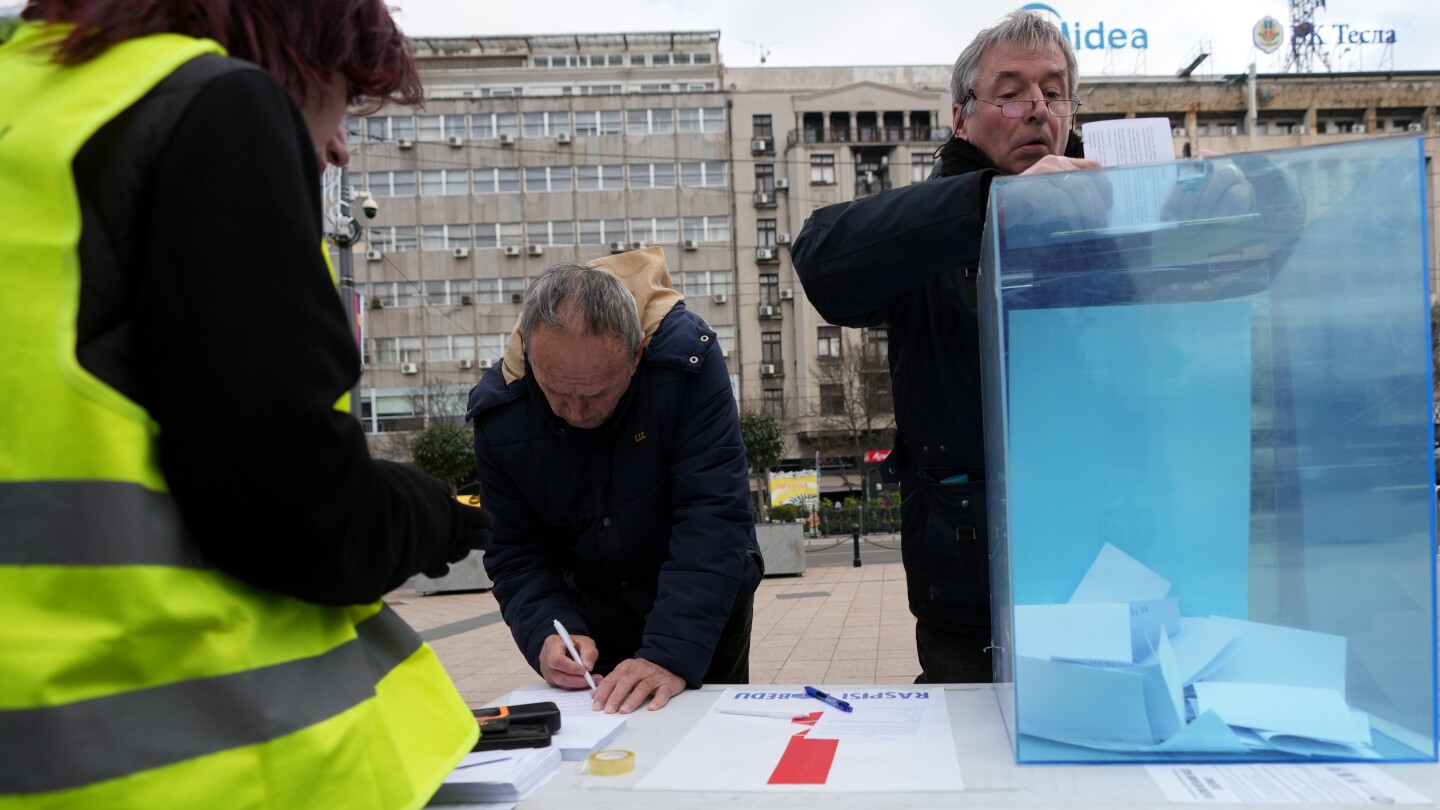
Students across Serbia braved freezing temperatures Sunday to collect signatures demanding early parliamentary elections in a coordinated nationwide effort aimed at challenging President Aleksandar Vucic’s government.
The campaign saw nearly 500 signature collection points established in dozens of cities, towns, and villages throughout the Balkan nation. While not a formal petition, organizers described the initiative as a pressure tactic and a gauge of public sentiment against Vucic’s administration.
“We have stands that serve to connect with the citizens,” explained Igor Dojnov, a student volunteer at one of the collection points in central Belgrade. The effort represents the latest phase in what has become a sustained youth-led protest movement that first emerged in November 2023.
The demonstrations initially erupted following a tragic train station accident in the northern city of Novi Sad, where a concrete canopy collapse killed 16 people. The disaster sparked widespread outrage, with protesters blaming the incident on alleged corruption and disregard for construction and safety regulations during renovation work. More than a year later, no one has been held accountable for the deaths.
Belgrade resident Milca Cankovic Kadijevic expressed her support for the student movement, saying, “I have a desire to live decently — me, my children and my grandchildren.”
The student-led protests have proven particularly challenging for Vucic, who has held power in various capacities for 13 years. Earlier this year, the movement scored a significant victory when Serbia’s prime minister resigned in January amid mounting public pressure.
Vucic has thus far rejected calls for immediate elections, though he has hinted at the possibility of an early vote sometime in 2025. Both parliamentary and presidential elections are officially scheduled for 2027.
The president’s response to the demonstrations has drawn international criticism. Following the prime minister’s resignation, Vucic launched a crackdown on protesters that raised concerns about democratic backsliding in the country. While the frequency of street protests has diminished in recent months, political analysts believe dissatisfaction with Vucic’s government remains widespread.
Serbia’s political situation reflects broader tensions in the country’s foreign policy orientation. Though Vucic has officially committed to pursuing European Union membership for Serbia, his administration has simultaneously cultivated close relationships with Russia and China. This balancing act has complicated Serbia’s Western integration path and raised questions about the government’s true priorities.
Critics accuse Vucic of eroding democratic institutions, restricting media freedoms, and allowing corruption and organized crime to flourish under his leadership – allegations the president vehemently denies.
Instead, Vucic has characterized the protesters as agents of foreign interference, claiming they are attempting to orchestrate a “color revolution” at the behest of Western powers. The term refers to a series of pro-democracy movements that toppled governments across the former Soviet Union, Yugoslavia, the Middle East, and Asia in the early 2000s.
The students’ signature campaign represents a strategic shift in protest tactics, moving from street demonstrations to more structured political organizing. By establishing a visible presence across both urban and rural areas, the movement aims to demonstrate that opposition to Vucic extends beyond Belgrade’s city center.
Political analysts note that the persistence of the student movement more than a year after the initial tragedy indicates deeper societal frustrations with governance issues in Serbia. Whether this campaign will ultimately force early elections remains uncertain, but it signals continuing pressure on a government that has rarely faced such sustained domestic opposition.
Fact Checker
Verify the accuracy of this article using The Disinformation Commission analysis and real-time sources.

10 Comments
This is an interesting development in Serbia. The students’ call for early elections reflects growing dissatisfaction with the government. It will be worth watching if this youth-led movement gains momentum and leads to meaningful political change.
The train station accident appears to have been a catalyst for this protest movement. Addressing issues of corruption and infrastructure safety will be crucial for the government to regain public trust.
The student-led campaign for early elections in Serbia reflects a desire for a political reset. However, the path forward may not be straightforward, as entrenched interests and power dynamics could complicate the process.
The tragic train station incident appears to have been a catalyst for the broader protest movement. Addressing issues of infrastructure safety and government accountability will be crucial for restoring public trust.
The student protests in Serbia are a reminder of the power of grassroots movements to challenge established political structures. Whether this leads to meaningful change will depend on a complex interplay of factors, both domestic and international.
It will be interesting to see how the Serbian government responds to the protesters’ demands. A willingness to engage in constructive dialogue and implement reforms could help defuse the tensions.
The student protests highlight the complexities of the political situation in Serbia. While early elections may be one path forward, it remains to be seen if that would truly address the underlying concerns driving the demonstrations.
It’s encouraging to see young people actively engaged in the political process and pushing for accountability. Their efforts could spur broader civic participation and democratic reforms.
Serbia’s political landscape seems to be at a crossroads. The student-led movement’s call for early elections reflects a desire for change, but the ultimate outcome remains uncertain. Careful observation of the situation will be important in the coming months.
The train station tragedy appears to have been a flashpoint, but the protesters’ demands go beyond that specific incident. Addressing issues of corruption and government accountability will be key to resolving the current tensions.