


Listen to the article
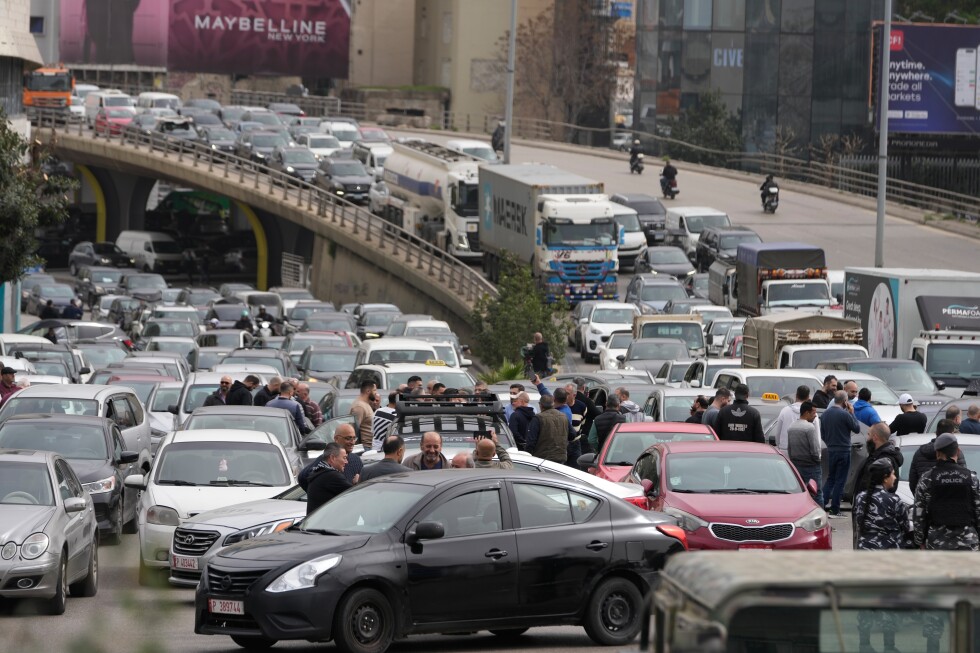
Lebanese protesters took to the streets on Tuesday, blocking major roads in and around Beirut following a controversial government decision to impose new taxes on fuel and other goods to fund public sector pay increases.
The Lebanese Cabinet on Monday approved a tax of 300,000 Lebanese pounds (approximately $3.30) on every 20 liters of gasoline. The government deliberately exempted diesel fuel from the tax hike, acknowledging its essential role for Lebanese citizens who rely on private generators amid chronic state electricity shortages that often leave households with only a few hours of power daily.
In addition to the fuel tax, the Cabinet agreed to raise the value-added tax on all applicable products from 11 to 12 percent, a measure that still requires parliamentary approval before implementation.
Information Minister Paul Morcos explained that the new taxes aim to support salary increases and pension boosts for public employees, whose wages were devastated during Lebanon’s 2019 currency collapse. The pay increases, estimated to cost approximately $800 million, would effectively provide public workers with the equivalent of an additional six months’ salary.
“Everything is getting more expensive, food and drinks, and Ramadan is coming,” said Ghayath Saadeh, a taxi driver among those who blocked a main road leading to downtown Beirut. “We will block all the roads, God willing, if they don’t respond to us.”
The tax hikes have touched a particularly sensitive nerve in Lebanon, where economic hardship continues to plague the population. Despite sitting on one of the Middle East’s largest gold reserves, Lebanon suffers from rampant inflation and widespread corruption that has undermined economic stability for years. The cash-strapped country is also reeling from an estimated $11 billion in damages sustained during the 2024 conflict between Israel and Hezbollah.
These new tax measures evoke troubling memories of 2019, when the government’s proposal to introduce a $6 monthly fee on internet calls through services like WhatsApp sparked nationwide protests. Those demonstrations paralyzed the country for months as citizens demanded the resignation of political leaders over endemic corruption, government dysfunction, failing infrastructure, and the country’s sectarian power-sharing system.
International financial institutions, including the International Monetary Fund, have long pressured Lebanon to implement substantial financial reforms, but progress has been minimal. The current tax increases come amid this backdrop of stalled reforms and continued economic deterioration.
In a separate development, the Cabinet also received a report from the Lebanese army on its progress implementing a plan to disarm non-state militant groups, including Hezbollah. The military announced last month that it had completed the first phase of this disarmament plan, focusing on areas south of the Litani River near the Israeli border.
The second phase will cover portions of southern Lebanon between the Litani and Awali rivers, including the port city of Sidon. Information Minister Morcos stated that this next stage is expected to take four months but could be extended “depending on the available resources, the continuation of Israeli attacks and the obstacles on the ground.”
This disarmament initiative follows a U.S.-brokered ceasefire that formally ended hostilities between Hezbollah and Israel in November 2024. Since then, Israel has accused Hezbollah of rebuilding its capabilities and has continued launching near-daily strikes in Lebanon while maintaining occupation of several strategic hilltop positions on Lebanese territory.
Hezbollah has maintained that the ceasefire agreement only requires its disarmament south of the Litani River and has refused to discuss disarming elsewhere until Israel ceases its military operations and withdraws completely from Lebanese soil.
As Lebanon grapples with these dual challenges of economic reform and security concerns, the patience of its citizens appears to be wearing thin, with today’s protests potentially signaling a new wave of civil unrest.
Fact Checker
Verify the accuracy of this article using The Disinformation Commission analysis and real-time sources.

9 Comments
This is a complex issue without easy solutions. The government needs to generate revenue and support public workers, but higher fuel prices will hit citizens already dealing with an economic crisis. Hopefully they can find a balanced approach that doesn’t overly burden the public.
The protesters have a valid concern – fuel price hikes can really strain household budgets, especially in an economic crisis. However, the government is also in a tough spot trying to find ways to fund public sector pay increases. I’m curious to see if they can find a middle ground that addresses both sets of concerns.
The protesters seem to have a valid grievance – fuel price hikes can really strain household budgets, especially in an economic crisis. However, the government is in a tough spot trying to find ways to fund public sector pay increases. I’m curious to see if they can find a middle ground that addresses both sets of concerns.
This is a complex issue without easy solutions. On one side, the government needs to generate revenue and support public workers. On the other, higher fuel prices will hit citizens already dealing with an economic crisis. Hopefully they can find a balanced approach that doesn’t overly burden the public.
This is a tricky situation in Lebanon. On one hand, the government needs to find ways to generate revenue and support public sector workers. On the other, higher fuel taxes will put a real strain on citizens already struggling with an economic crisis. Hopefully they can find a balanced approach that doesn’t overly burden the public.
Interesting that the government is exempting diesel from the tax hike, likely to ensure it remains affordable for households relying on private generators. That’s a pragmatic move, though it may undermine the broader revenue goals. Overall, this highlights the difficult tradeoffs policymakers face in a crisis like this.
You make a good point. Exempting diesel could help mitigate hardship for many citizens, but it also reduces the potential revenue gains. The government will have to carefully balance competing priorities as they implement these new measures.
Interesting that the government is exempting diesel from the tax hike. That’s likely a pragmatic move to keep it affordable for households relying on private generators, but it may undermine the broader revenue goals. Overall, this highlights the difficult tradeoffs policymakers face in a crisis like this.
You make a good point. Exempting diesel could help mitigate hardship for many citizens, but it also reduces the potential revenue gains. The government will have to carefully balance competing priorities as they implement these new measures.