


Listen to the article
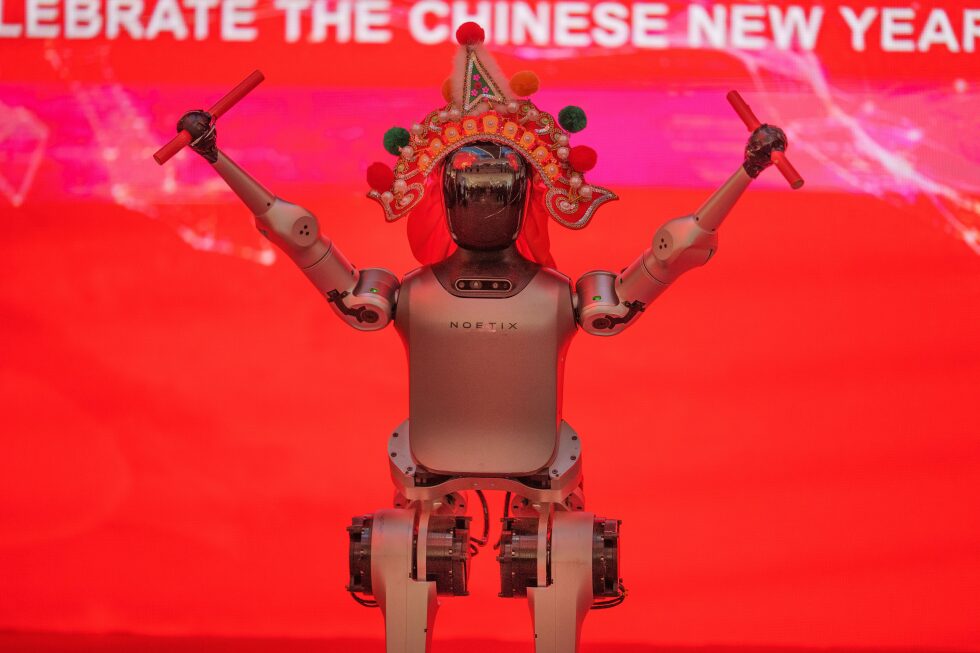
In China, robots are joining the celebration of the Lunar New Year, bringing a high-tech dimension to one of the country’s most important traditional festivals. At a mall in western Beijing, four humanoid robots, each standing about 95 centimeters tall, recently participated in a dress rehearsal for upcoming holiday performances.
The robots, dressed in colorful lion costumes, performed a series of coordinated movements—bending knees, moving left and right, and shaking their masks—captivating curious onlookers who stopped to watch the spectacle.
As Beijing prepares for Lunar New Year celebrations next week, venues across the city are setting up stages and props for various fairs and activities. For the second consecutive year, one fair will be dedicated to technology, with robots taking center stage.
“This year, the number of our robots has increased a lot,” explained Qiu Feng, a member of the organizing committee. “They will perform dance, martial arts, Peking Opera, poetry and soccer.”
Visitors to the fair will witness robots engaging in diverse activities, from dancing and stacking blocks to skewering hawthorn berries for traditional sweet snacks and playing soccer matches. While some of these performances were featured last year, Qiu noted that this year’s exhibitions will showcase “finer actions and a stronger high-tech vibe.”
These robot demonstrations reflect China’s accelerating efforts to develop advanced robotics capable of performing increasingly complex tasks with artificial intelligence and minimal human intervention. Chinese technology companies and startups are investing heavily in robotics research and development, positioning the country as a growing force in the global robotics industry.
Booster Robotics, one of the Chinese startups behind the mall performance, will display approximately 20 humanoid robots at the fair. Ren Zixin, the company’s marketing director, highlighted the autonomous capabilities of their soccer-playing robots: “It is an AI environment, which means, once the whistle sounds, the remote control will all be put aside and all its decision-making and motion control are made by the robots themselves.”
Despite significant technological advances, these robots still require human assistance for certain tasks, such as dressing them in costumes or repositioning them when they stop moving. This balance between robotic autonomy and human oversight illustrates both the remarkable progress and current limitations of robotics technology.
The integration of cutting-edge technology with traditional cultural celebrations represents China’s broader approach to modernization—embracing innovation while maintaining connections to cultural heritage. Robots performing lion dances—a centuries-old tradition believed to bring good luck—symbolizes this marriage of old and new.
China’s push for robotics advancement comes amid a global race for technological supremacy, with implications for manufacturing, healthcare, entertainment, and other sectors. The country has made robotics development a key component of its national strategy, with Chinese companies filing increasing numbers of robotics patents in recent years.
“Technology is developing faster and becoming more advanced every day,” Qiu observed. “As long as we keep up with this trend, our fair will continue to evolve and rise with the times.”
As the Lunar New Year approaches, these robot performances offer a glimpse into how traditional celebrations may evolve in an increasingly digital era. For visitors to Beijing’s tech fair, watching robots dance, play, and perform cultural arts provides not only entertainment but also a window into China’s technological aspirations and the future relationship between humans and machines.
Fact Checker
Verify the accuracy of this article using The Disinformation Commission analysis and real-time sources.

9 Comments
Fascinating to see how China is embracing robotics and technology to celebrate its traditional Lunar New Year festivities. The robot lion dancers and performers sound quite captivating and a unique twist on the celebrations.
I wonder if these robots will be able to fully capture the spirit and energy of traditional Lunar New Year celebrations, or if there will still be a desire for more human-centric performances.
The growing role of robots in Chinese Lunar New Year celebrations is an interesting example of how technology is being integrated into cultural traditions. It will be exciting to see how the public responds to these robotic performers.
I’m curious to learn more about the technical capabilities of these robots and how they were programmed to perform traditional dances, martial arts, and other activities.
Robots joining the Lunar New Year celebrations in China is a clever way to put a contemporary spin on a time-honored tradition. I’m curious to see how the robot performers are received by the public.
The idea of robots participating in Lunar New Year celebrations is quite innovative. I’m interested to see how the public reacts to these high-tech additions to traditional cultural festivities.
It will be fascinating to learn more about the technical development and programming behind these robot performers. Blending centuries-old traditions with modern robotics is an intriguing concept.
Integrating robots into Lunar New Year festivities is a clever way to bring a modern, high-tech element to a centuries-old celebration. It will be intriguing to see how these robotic performers are received by the public.
I wonder if the organizers have considered potential safety or logistical challenges of incorporating robots into crowded public events. Coordinating the robots’ movements with human performers could be complex.