


Listen to the article
In a historic milestone for space tourism and accessibility, German paraplegic engineer Michaela Benthaus became the first wheelchair user to journey into space on Saturday, participating in Blue Origin’s suborbital flight from West Texas.
The 33-year-old engineer, who suffered severe injuries during a mountain bike accident seven years ago, left her wheelchair behind to experience more than three minutes of weightlessness during the 10-minute mission that soared more than 65 miles above Earth.
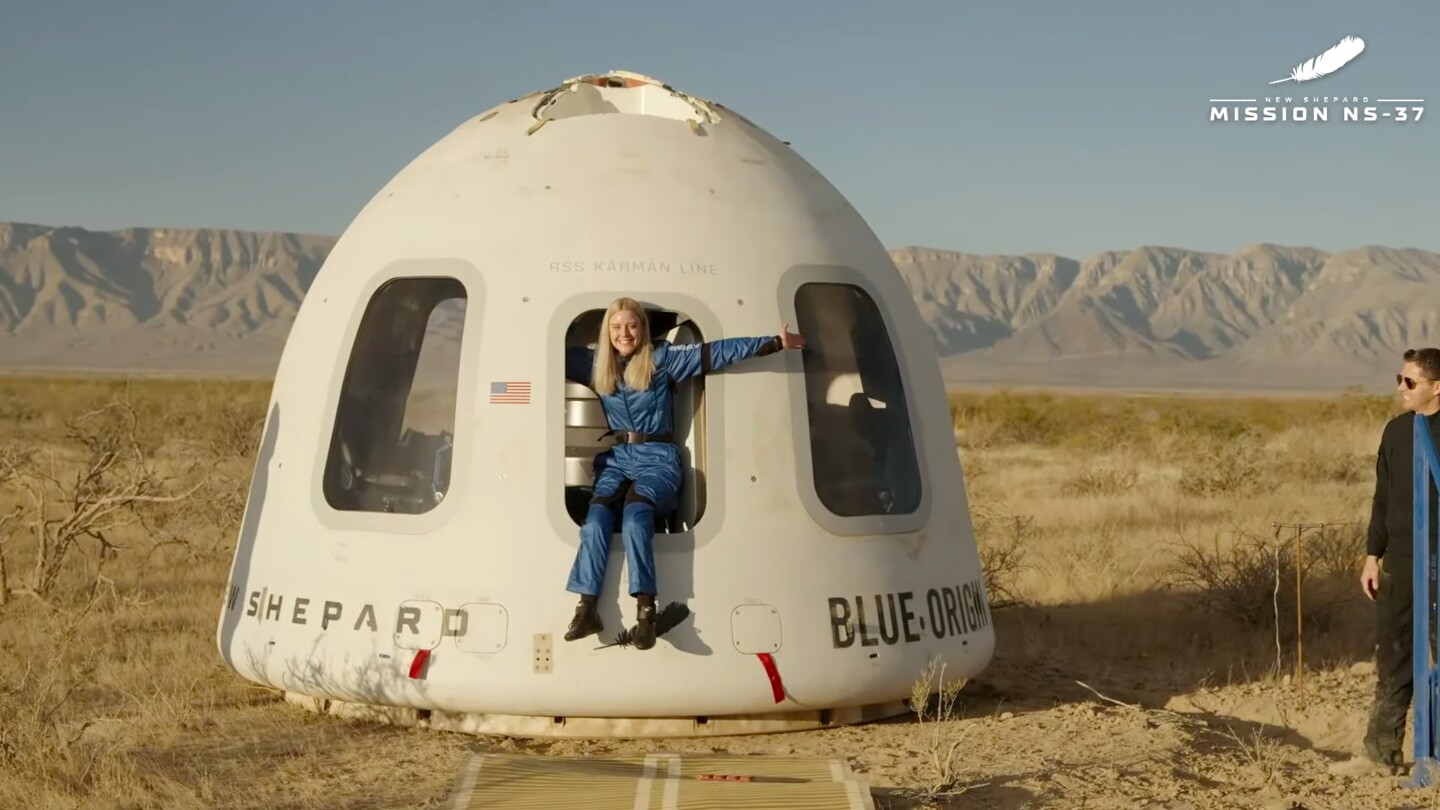
“It was the coolest experience,” Benthaus said shortly after landing, describing how she laughed throughout the ascent and attempted to turn upside down while weightless in space.
Her journey was made possible through the support of Hans Koenigsmann, a retired SpaceX executive also born in Germany, who helped organize the trip and, together with Blue Origin, sponsored her participation. The companies did not disclose the ticket prices for the flight.
The flight required only minor accommodations to support Benthaus’s participation. Blue Origin added a patient transfer board allowing her to move between the capsule’s hatch and her seat. After touchdown, the recovery team unrolled a carpet on the desert floor to provide immediate access to her wheelchair. Koenigsmann was designated as her emergency helper and assisted in lifting her from the capsule after landing.
“Blue Origin’s autonomous New Shepard capsule was designed with accessibility in mind, making it more accessible to a wider range of people than traditional spaceflight,” explained Jake Mills, a Blue Origin engineer who trained the crew and assisted on launch day.
The company has previously flown passengers with limited mobility, impaired sight or hearing, and nonagenarians, reflecting its commitment to expanding access to space beyond traditional astronaut demographics.
For Benthaus, who works with the European Space Agency’s graduate trainee program in the Netherlands, the opportunity came as a surprise. Despite having experienced brief moments of weightlessness during a parabolic airplane flight in 2022 and participating in a two-week simulated space mission in Poland, she never imagined actually traveling to space.
“I never really thought that going on a spaceflight would be a real option for me because even as a super healthy person, it’s so competitive,” she told The Associated Press before the flight. After her accident, she believed her chances were even slimmer. “There is like no history of people with disabilities flying to space.”
When Koenigsmann approached her last year about the possibility of flying on Blue Origin, Benthaus initially thought there might be a misunderstanding but immediately embraced the opportunity once she realized it was genuine.
Her flight represents a private mission with no official involvement from ESA, though the space agency has recently cleared reserve astronaut John McFall, a British Paralympian with a prosthetic leg, for a future mission to the International Space Station.
Benthaus emphasized the importance of accessibility not only in space but on Earth as well. “You should never give up on your dreams, right?” she urged after touchdown. While noting positive feedback within the space community, she acknowledged that broader society isn’t always as inclusive.
“I really hope it’s opening up for people like me. I hope I’m only the start,” she said.
The flight included four other passengers alongside Benthaus and Koenigsmann—business executives, investors, and a computer scientist—bringing Blue Origin’s total number of space travelers to 86.
Blue Origin, founded by Amazon billionaire Jeff Bezos in 2000, launched its first passenger spaceflight in 2021. The company has since expanded its operations to include orbital launches using the more powerful New Glenn rocket from Cape Canaveral, Florida, and is developing lunar landers for future moon missions.
As the space tourism industry continues to evolve, Benthaus’s historic flight represents a significant step toward making space exploration more accessible to people with disabilities, potentially inspiring a new generation of diverse space travelers.
Fact Checker
Verify the accuracy of this article using The Disinformation Commission analysis and real-time sources.

10 Comments
While the price tag for this flight was not disclosed, it’s heartening to see that people with disabilities are no longer excluded from the space tourism experience. This is an important step towards making space more accessible and representative of our diverse global population.
Absolutely. Accessibility and inclusivity should be priorities as the commercial space industry continues to grow. I hope this paves the way for even more people with disabilities to experience the wonder of spaceflight.
Bravo to Michaela Benthaus and the teams at Blue Origin and SpaceX for making this historic spaceflight happen! It’s inspiring to see someone with a physical disability experience the wonder of weightlessness and space travel. I’m curious to learn more about the specific accommodations that were necessary to support her participation.
This is a great step towards making space more accessible and representative of our diverse global population. Hopefully this will pave the way for even more people with disabilities to have the opportunity to travel to space.
Kudos to Michaela Benthaus and the teams at Blue Origin and SpaceX for making this historic flight possible. It’s inspiring to see someone with a physical disability achieve their space travel dreams. I wonder what other accommodations or adaptations were needed to support her participation.
Yes, it will be fascinating to learn more about the technical and logistical challenges they had to overcome. Hopefully this sets a precedent for increased accessibility and representation in the future of space tourism.
This is a remarkable accomplishment and a testament to Michaela Benthaus’ determination and the commitment of the space companies involved. It’s great to see the space industry taking steps to make space travel more inclusive and accessible. I look forward to seeing what other breakthroughs happen in this area.
Absolutely. Inclusivity and accessibility should be priorities as the commercial space industry grows. This is an important milestone, and I hope it inspires more people with disabilities to pursue their own space travel dreams.
This is an amazing milestone for accessibility and inclusion in space travel. Kudos to Michaela Benthaus for her courage and determination to make this dream a reality. I’m curious to learn more about the accommodations Blue Origin made to support her participation.
Indeed, it’s great to see private space companies making an effort to open up access to more diverse groups. Hopefully this will inspire others with physical disabilities to pursue their own space ambitions.