


Listen to the article
Canada’s Premier Ford Says “Walls Closing In” on Trump After Supreme Court Decision
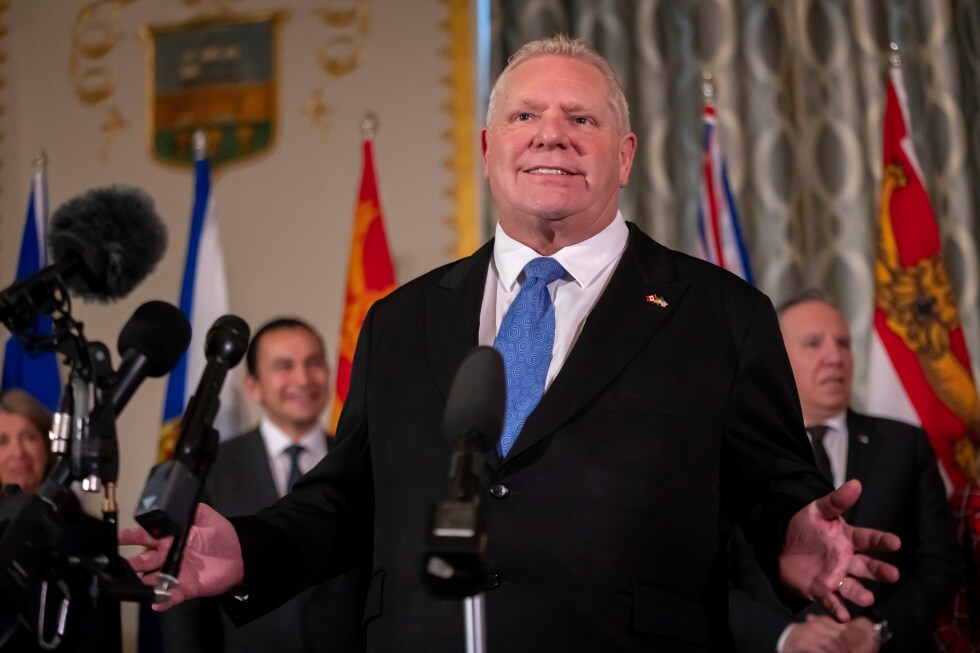
The leader of Canada’s most populous province delivered sharp criticism of U.S. President Donald Trump on Monday, declaring that “the walls are closing in” following a significant U.S. Supreme Court ruling against Trump’s tariff policies.
Ontario Premier Doug Ford characterized the current situation as an “economic war” and expressed his view that no trade deal with the United States would be preferable to accepting unfavorable terms.
“It’s very challenging right now. I just sit back some days, and I am not the only one. Everyone in the world sits back. How can one person, one man, create so much turmoil around the world? Not just here in Canada but around the world. It is pretty staggering. So I can’t wait for the midterms,” Ford said.
The Supreme Court’s decision last Friday invalidated tariffs Trump had imposed on numerous countries using emergency powers legislation. In response, Trump has indicated he will pursue alternative, though more limited, legal avenues to maintain his tariff agenda.
Ford viewed the court’s decision positively, even as he acknowledged the significant challenges Canada faces in its trade relationship with its largest partner. While most Canadian exports to the U.S. fall under the protection of the United States-Mexico-Canada Agreement (USMCA), certain sectors of the Canadian economy—particularly aluminum, steel, automotive industries, and lumber—continue to feel the impact of existing tariffs.
The Ontario premier warned that the USMCA itself could be at risk during its upcoming review this year. He urged caution in negotiations with the U.S., citing Trump’s treatment of other nations that rushed into trade agreements. “Other countries like Japan and the U.K. rushed in to get a deal and all of a sudden, he turned on them like a rattlesnake. We’re going to be cautious,” Ford stated.
Looking ahead to November’s U.S. midterm elections, Ford noted that many Republican seats in both the House and Senate will be contested, including several in neighboring Michigan. He also highlighted a recent House vote that opposed Trump’s tariffs on Canada—a rare bipartisan action where Republicans joined Democrats in rebuking the White House’s trade policy.
“The walls are closing in on President Trump,” Ford remarked. “You saw him lose the vote and six Republicans crossed the floor with Congress and then you saw the Supreme Court.”
Ford pointed to economic consequences of the tariff policies, saying they are contributing to inflation in the United States. “Down in the U.S. people are feeling the crunch. They don’t see the prices going down with food and other goods. That all has come down to the uncertainty that he’s put around the world and his number one customer in the world.”
The comments come amid escalating tensions between the neighboring countries. Trump recently threatened to impose a 100% tariff on Canadian imports, citing concerns over Canada’s proposed trade relationship with China. This has further strained relations between the U.S. and its longtime ally under Prime Minister Mark Carney’s leadership.
Daniel Béland, a political science professor at McGill University in Montreal, noted the diplomatic risk inherent in such direct criticism of Trump. “There is always a diplomatic risk for foreign politicians to criticize President Trump so bluntly and publicly, as his thin skin is now legendary,” Béland said. “For instance, last fall, the president reacted very negatively to an Ontario’s anti-tariff ad featuring Ronald Reagan by suspending trade talks between Canada and the United States.”
Despite these risks, Béland observed that Ford’s comments align with widespread Canadian sentiment, noting that Trump remains highly unpopular across Canada.
As both countries prepare for upcoming elections—the U.S. midterms in November and Canada’s own electoral cycle—the trade relationship between these historically close allies continues to face unprecedented strain under the weight of tariff disputes and increasingly sharp rhetoric from leaders on both sides of the border.
Fact Checker
Verify the accuracy of this article using The Disinformation Commission analysis and real-time sources.

23 Comments
If AISC keeps dropping, this becomes investable for me.
Good point. Watching costs and grades closely.
Nice to see insider buying—usually a good signal in this space.
Good point. Watching costs and grades closely.
Good point. Watching costs and grades closely.
The cost guidance is better than expected. If they deliver, the stock could rerate.
Good point. Watching costs and grades closely.
Interesting update on Ontario’s premier says ‘the walls are closing in’ on Trump after Supreme Court tariff decision. Curious how the grades will trend next quarter.
Production mix shifting toward Business might help margins if metals stay firm.
Good point. Watching costs and grades closely.
Good point. Watching costs and grades closely.
Interesting update on Ontario’s premier says ‘the walls are closing in’ on Trump after Supreme Court tariff decision. Curious how the grades will trend next quarter.
Interesting update on Ontario’s premier says ‘the walls are closing in’ on Trump after Supreme Court tariff decision. Curious how the grades will trend next quarter.
Good point. Watching costs and grades closely.
Good point. Watching costs and grades closely.
Silver leverage is strong here; beta cuts both ways though.
I like the balance sheet here—less leverage than peers.
Production mix shifting toward Business might help margins if metals stay firm.
Good point. Watching costs and grades closely.
Good point. Watching costs and grades closely.
The cost guidance is better than expected. If they deliver, the stock could rerate.
Good point. Watching costs and grades closely.
Good point. Watching costs and grades closely.